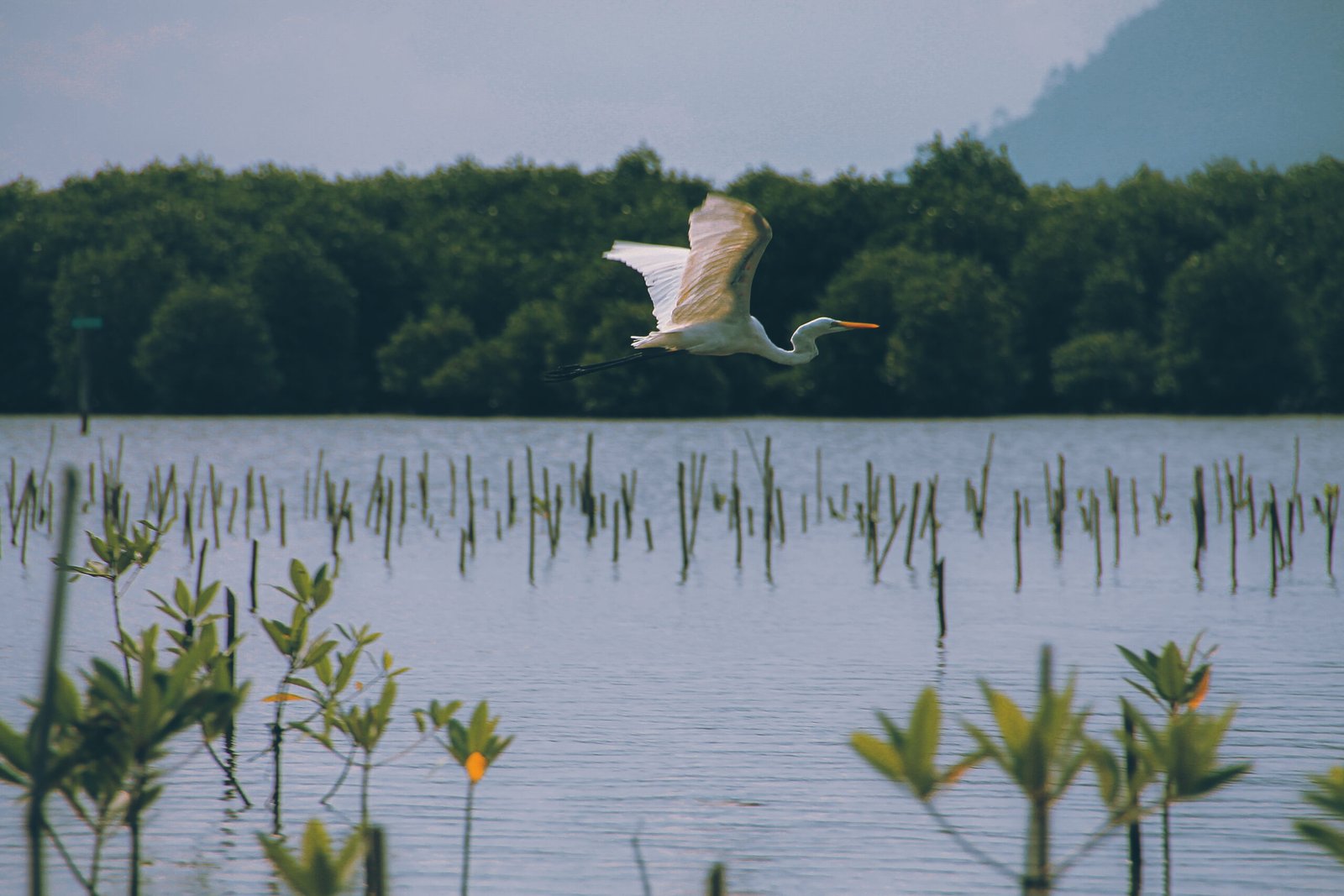

When we talk about climate change, the conversation always goes to deforestation, fossil fuel, agriculture and industrilization, we rarely talk about water’s edge. In Indonesia’s vast coastline there are quietly powerful source to fight climate change, it is blue carbon especially seagrass meadows and mangroves forest. The importance of climate change mitigation has made blue carbon ecosystem, especially mangroves, as one of the most vital global environmental policy These ecosystems it is very efficient to become carbon sink, because it can store around 800-1,200 tons of carbon per hectare. According to the United States National Oceanic and Atmospheric Administration, mangroves and coastal wetlands, it can absorbs carbon at a rate roughly ten times greater than that of tropical forests and can store up to five times more carbon per unit area. This extraordinary capacity coming from the combination of living biomass, tidal sediments, and the waterlogged soil condition that slow down the decomposition of organic matter. While a tropical rainforest cycles carbon relatively quickly, a mangrove forest locks carbon into deep, stable soil deposits that can remain undisturbed for centuries. This means that protecting an existing mangrove forest is not just about preserving a habitat. It is about keeping a big amounts of stored carbon safely underground, away from the atmosphere where it would contribute to global warming.
Theres no country on this planet that can use this opportunity better than Indonesia because Indonesia, has about 22.6% (Ayostina et al. 2022) of the world’s mangrove ecosystem across the coastal zone around 3.3 million hectares, it plays a important role in global climate mitigation efforts, not to mention the seagrass meadows, the second largest in the globe. Daniel Murdiyarso, he is the president of the Indonesian Academy of Sciences, he said that If we conserve those carbon reserves, it would be the same as avoiding fossil fuel emissions.
Figure 1. Carbon stock pools in Indonesian mangroves across eight regions
Source: Murdiyarso et al. (2015), Nature Climate Change
But the sad part is only about 16 percent of the country’s mangroves and 45 percent of its seagrass areas sat within formally protected zones. In Kalimantan, deforastation already wiped out about 58,000 hectares of mangrove between 2009 and 2019 for aquaculture pond and palm oil plantation. Every hectare of mangrove that destroyed it does not just release its carbon back into the atmosphere, but it also eliminating the ecosystem it provides to local communities, including coastal protection from storm surges, nursery habitat for fisheries, and clean water filtration. For the fishing communities who depending on these coastal system for their livelihood, destruction of mangroves is not just an environmental problem, it is an economic and social crisis that slowly unfold devastating effect. The connection between mangroves and also coastal communities runs deeper than most people outside these areas understand. Mangrove roots create a physical buffer that dissipates wave energy, significantly reducing the damages that caused by typhoon and tsunami. Studies after the 2004 Indian Ocean tsunami showed that coastal areas with intact mangrove forests suffered considerably less damage than those where mangroves had been cleared. Beyond physical protection, mangroves provide food security. Fish, shrimp, and crabs use mangrove roots as nursery areas during the early stages of their lives before moving to open water. When mangroves disappear, fish populations in nearby waters decline, and the communities that depend on them follow.
If the government do nothing the cost will be unimaginable, fortunately Indonesian government start to respond, so in 2012 theres predential regulation to manage mangroves ecosystem. Indonesia’s National Medium-Term Development Plan in 2020-2024 integrating blue carbon into its low carbon development priorities, and in the financial part, Indonesia opened IDX Carbon to international buyers in early 2025. Indonesian Government also aim to do rehabilitation to 1.8 million hectares of mangroves area by 2045. All these plan are good on paper, yet in reality there are institutional problems and market reality, One of the most critical challenges is the lack of coordination among body of ministries, especially between Ministry of Environment and Forestry (KLHK) and Ministry of Marine Affairs and Fisheries (KKP). KLHK is responsible on the land-based ecosystems, including mangroves, while KKP holds authority for coastal and marine spatial planning, which also include mangrove areas. This overlapping make the situation where these two ministries claim jurisdiction over the same areas, resulting in regulation ambiguity.
But, there are still optimism apart from the policy of the government, accros the islands, local communities are protecting the blue carbon ecosystem with their customary law. The local people in the Eastern part of Indonesia called Rote Ndao, for example, maintains a traditional marine management system that has protecting local ecosystems for centuries despite the area not being formally designated as marine protected area, recognising and support these kind of system can significantly expand the country’s protected coastal area at lower cost. Aside from that, alliance of Mangrove Ecosystem Restoration has been restored 262 hectares across DKI Jakarta and South Sumatra since 2018, with target to cover about 400,000 hectares in development shows that community-driven approach can work at scale. What Indonesia needs now is the combination of these things, robust scientific mapping, especially for seagrass where inventories of national still incomplete, stronger enforcement of existing laws of coastal protection, and maintaining investment in both government and community-based restoration.
Keywords: Blue Carbon, Indonesia, Mangrove, Government, Mitigation






 Reston Dennis Juah
 Noor Ul Ain

 Hassan Barrie
 Hoby Nasandratra Andriamiandrisoa
Không giống với các trang web không rõ nguồn gốc, 888SLOT đầu tư nghiêm túc vào hệ thống quản lý rủi ro và bảo vệ người dùng. Tất cả các giao dịch tài chính đều được mã hóa, đồng thời nền tảng cung cấp công cụ tự kiểm soát cho người chơi như giới hạn đặt cược và tính năng tự loại trừ. TONY07-03