
Adaptation finance is usually seen as a technical problem that revolves around the amount of funding, modalities, or mechanisms of funding and project implementation. However, for climate-vulnerable countries, particularly Least Developed Countries (LDCs) and Small Island Developing States (SIDS), adaptation finance represents much more than financial assistance. It’s widely portrayed as a matter of survival, justice, and recognition in a global system that has historically benefitted some countries while leaving others far more vulnerable to the effects of climate change. The Global South is not only asking for monetary aid but for the recognition of past responsibilities, unequal vulnerability and the costs that have been inflicted on them by a crisis that they were least responsible for (Hadžić, 2024) (Jaiswal, 2015).
The magnitude of adaptation challenge is enormous. By 2035, the need for adaptation in developing countries is estimated to be around US$310-365 billion per year, while public international adaptation funding is approximately US$26 billion in 2023 (UNEP, 2025). This financing gap illustrates the huge disparity in terms of adaptation needs and the increasing impacts of climate change. Vulnerable countries are increasingly required to build resiliency to climate change impacts while being financially constrained (UNEP, 2025) . In many nations around the globe, especially in Africa, Asia, and the Pacific, adaptation is no longer a future need; rather, it is an urgent need, due to recurring floods, droughts, coastal erosion, food insecurity, and displacement constantly affecting the lives and livelihoods of people.
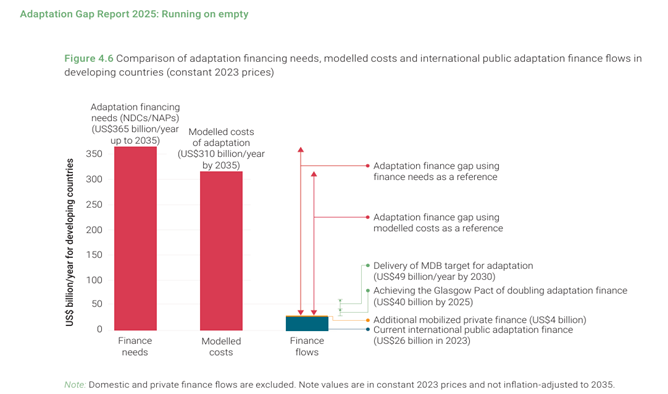
Figure 1. Comparison of adaptation finance needs, modelled adaptation costs, and international public adaptation finance flows in developing countries. Adaptation finance flows remain significantly short of adaptation needs, underscoring the adaptation finance gap at the heart of climate diplomacy and climate justice discussions (UNEP, 2025).
Climate diplomacy is thus integral to the understanding of adaptation finance. (Tänzler & Carius, 2026) contend that climate diplomacy has now extended its scope from environmental negotiations into the realm of foreign policy, development cooperation, security, humanitarian, adaptation, and mitigation. Adaptation finance is also central to this larger diplomatic agenda, as it connects climate negotiations to development agendas, budgetary limitations, debt levels, and national security issues. Recently, adaptation finance is increasingly a language of survival in climate diplomacy for the countries that are most vulnerable to climate change.
However, the concept of adaptation finance continues to be highly debated. Many developed countries perceive climate finance as assistance, partnership or investment, while many developing countries perceive climate finance as climate justice, historical obligation, and partial compensation for the effects of historical emissions (Ciplet et al., 2013). These competing narratives are not only semantic – they influence the politics of climate diplomacy. If adaptation finance is treated as aid, donor countries have a high degree of discretion in how and on what terms they give such aid. For countries that are vulnerable to climate change, they perceive climate finance through the lens of justice, arguing that they are entitled to compensation and that developed countries should take responsibility for the actions they have committed in the past.
These tensions were evident in negotiations surrounding the New Collective Quantified Goal (NCQG) on climate finance adopted at COP29. The agreement set the goal of climate finance of at least $300 billion per year by 2035, and called for increased mobilization of $1.3 trillion per year for climate action (UNFCCC, 2024). Although this represents a significant political achievement, important concerns remain. Firstly, the target focuses on climate finance instead of adaptation finance. Second, the amount committed is still short of the estimated adaptation costs or needs. Third, the bulk of climate finance remains in the form of concessional loans, which may cause debt sustainability challenges in climate-sensitive countries (UNEP, 2025).
Putnam’s theory of two-level negotiations can be utilized to explain the politics of adaptation finance. Internationally, governments negotiate under the auspices of the United Nations Framework Convention on Climate Change (UNFCCC), focusing on questions around equity, burden-sharing, and historical responsibility, which have a huge role in shaping bargaining positions and subsequently influence climate finance outcomes (Putnam, 2017). At the domestic level, countries’ proactivity towards climate adaptation interventions is heavily influenced by competing priorities and budget constraints, while developed countries, on the other hand, have to defend their commitments to deliver climate finance to their domestic constituencies. Despite such commitments from developed countries, it should be noted that developing countries may have limited institutional capacity, face a long accreditation process, and governance fragmentation that hinders access to and implementation of adaptation finance effectively.
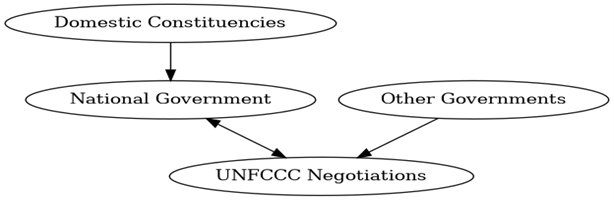
The understanding of this dual dynamic was further reinforced through my work at the UNFCCC as a climate finance officer on adaptation and loss and damage. It is important to understand that international commitments alone are not enough, and commitments do not necessarily guarantee implementation. Therefore, for commitments to translate to effective adaptation actions, there is a need for a strong institutional capacity that is able to have a coherent plan, effective coordination, and relevant expertise in managing climate adaptation finance. This mirrors the lessons learnt from Ethiopia’s climate diplomacy, whereby robust political leadership and evidence-based advocacy, institutional coordination, and regional engagement have strengthened Ethiopia’s voice in international climate negotiations (Endalew & Craft, 2016)
However, institutional capacity constraints alone are not the sole factor impeding the delivery of climate finance because climate finance systems are a very complex process. The process of accessing multilateral funds often involves complex project proposals, comprehensive safeguards, co-financing, monitoring and evaluation, and lengthy approval processes. These requirements are intended to promote accountability and transparency; however, it constraints countries with less administrative capacity to access climate finance, making such countries highly vulnerable. As a result, many climate-vulnerable countries struggle to directly access adaptation finance and often remain dependent on international intermediaries despite facing some of the highest adaptation needs (OECD, 2023).
This shows that there is a close linkage between governance and climate justice. (Moinuddin et al., 2021) show that policy alignment, participation of stakeholders, and institutional coordination at various governance levels are essential for effective climate action. Likewise, (De Matos Carlos et al., 2020) demonstrate that financial resources are not the only influences on adaptation outcomes; knowledge, perceptions, social support, and technical capacity also play roles. The results indicate that resilience cannot be achieved through adaptation finance. Institutional strengthening, local ownership, and inclusive governance mechanisms need to go hand in hand with financial resources.
Increasingly, the private sector is often seen as a solution to the adaptation finance gap. While most private investors understand that climate impacts continue to rise, they still prioritize mitigation over adaptation. Many adaptation interventions create public goods and do not yield financial returns, which makes them less appealing to private investors. (UNEP, 2025) affirms that in cases where private sector investment is, it is usually in adaptation sectors that offer commercial opportunities. Thus, the availability of predictable and accessible public finance is essential, especially in LDCs and vulnerable communities exposed to severe climate conditions.
The politics of climate communication is also of great importance to take into account. Commitments to climate finance are frequently made in grandiose diplomatic declarations, but in the end, climate diplomacy is measured by what is delivered to vulnerable countries. Contemporary climate diplomacy requires implementation, transparency, and accountability (Tollmann & Könneke, 2022). Delayed, unclear, or loan-based pledges have a negative effect on trust in international climate governance. Climate diplomacy is thus not just a negotiation of getting resources but rather a struggle of legitimacy, credibility, and narrative.
Finally, adaptation finance is a moral barometer of today’s climate diplomacy. It gives insight into whether there is a will in the international community to take international action on climate justice beyond symbolic support. The Global South is not bargaining for charity – it is bargaining for life in a warming world. The risk of insufficient adaptation funding is not only to generate new adaptation gaps, but also that it will be unavailable, inaccessible, and politically prohibited. These failures can further exacerbate the sense of distrust that has arisen between the groups that have been most responsible for the climate crisis and those who are still suffering from its effects. In fact, the future of the credibility of global climate governance may not depend on what is said at the climate conferences, but on how adaptation finance can provide tangible support to the communities that need it the most.
Keywords: Adaptation Finance, Climate Diplomacy, Climate Justice, Global South, Climate Governance




 Reston Dennis Juah
 Noor Ul Ain
 Hassan Barrie
 Hoby Nasandratra Andriamiandrisoa
Easy access and no hassle at all. I appreciate how straightforward the site is without all the unnecessary clutter. jili988login is a winner.