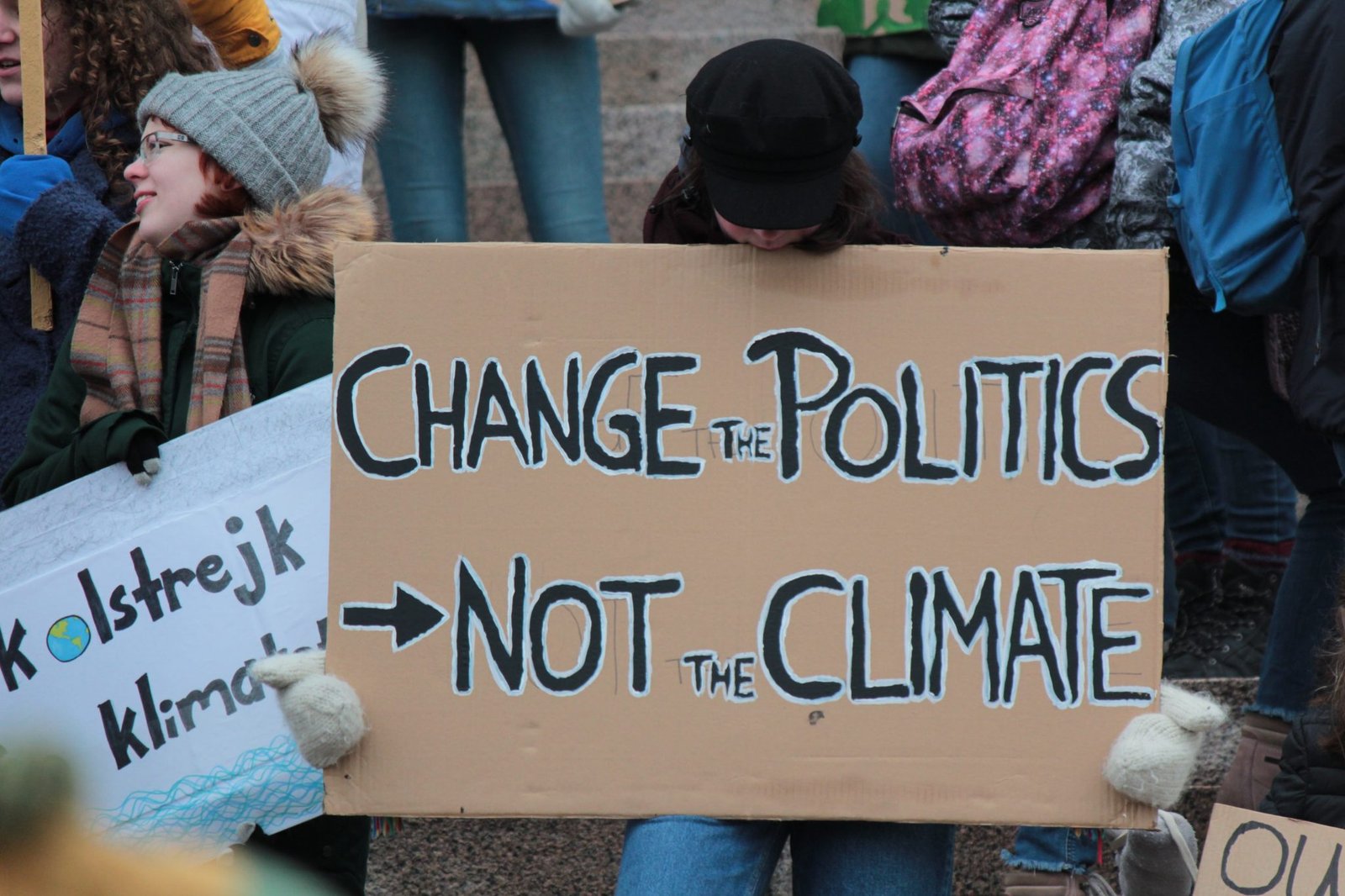

Climate activism has always been posed with a question, should it be primarily focused on the environment, or other social movements? This question is even more pressing today, because today climate change is related to nearly all the challenges society is facing. It impacts food systems, health, housing, jobs, migration, inequality, energy access, land, trade and even conflict. This means, at least when it comes to climate change, it is difficult to talk about carbon dioxide emissions or the temperature increase without also talking about the effects of climate change. Climate change is not isolated, it is occurring in societies already characterized by poverty, inequality, political divides and uneven development.
Climate activism should not exclude other movements. Workers’ rights, public health, food justice, indigenous rights, gender equality, racial justice, energy access and poverty reduction, among others, can all be relevant to climate action. Pollution-fighting communities are part of the climate conversation. Drought-stressed farmers are a component of the conversation on climate. Even as the conversation turns to shifting away from fossil fuels, workers who want protection are part of the climate conversation. Climate activism becomes stronger when it recognizes these connections. Other movements should not be a prerequisite for the climate movement, which is about keeping the climate stable and a climate package deal that would require people to agree with every other social movement. Climate change movements can become self-defeating. Some have a strong interest in clean air, renewable energy, protecting forests, or a living planet for their children, but not all the positions taken by progressive activists. That person becomes an enemy if made to feel unwelcome. It is not as if climate activism should turn its back on other fights. The point is, it should not require people to agree to all struggles to be in on climate action.
This climate crisis is not something that can be resolved by any one group of ideologues. It calls for a wide cross-section of persons with diverse values, backgrounds and political viewpoints. It requires students, farmers, workers, scientists, religious leaders, businesses, policymakers, local communities, and regular families. Some will join as a caring person towards nature. Some will join due to concerns about food costs. Some will sign up for energy security. Some will be part of the group due to the sight of floods, droughts, heat, pollution, etc., that impacted their communities. A successful movement for climate change will need to grapple with these various motivations and still be able to keep them united without asking everyone to think exactly the same.
When Caring About More Than One Thing Becomes a Problem
It is okay to have more than one thing to care about, but climate activism has to be about more than the environment since climate change affects agriculture, worsens health risks, impacts infrastructure, exacerbates water scarcity, and widens inequalities on a hotter planet, and when activists link climate change to other concerns they may be referring to actual relationships because damage to the environment rarely occurs in isolation from social and economic life, as flood conditions do not impact all people uniformly and those living without appropriate housing, health, and secure incomes are more vulnerable to a heat wave event, while clean energy can be a catalyst for opportunity but may also have adverse effects on workers if implemented poorly.
Climate activism thus should cultivate alliances with other movements because these partnerships contribute to the realness of climate change which many experience first as an abstract scientific problem but feel as droughts, increased food prices, illness from pollution, lack of water, loss of forests or unsafe working environments, and other movements can help activists learn about these lived realities and remind them that policies should not only reduce emissions but also protect people, yet it becomes an issue when caring about more than one thing means that every issue must be solved by the same movement at the same time under the same ideological banner since it is one thing to say climate change is linked to inequality and another to say that no one can be part of the climate solution unless they agree to an entire political agenda on inequality, and it is not the same to stand in solidarity with other struggles as it is to make climate activism a purity test because if activism becomes a test it loses the ability to reach people outside activist spaces.
It is important because people have different orientations when it comes to climate change because others have a scientific perspective on it, others may understand it in a religious sense, a family sense, a farming sense, an economic sense, a national development sense or a local sense. Some people may not even use the term “climate change” to refer to the changes that surround them. In many communities in the Global South, one might hear people talking about drought, floods, hunger, poor harvests, or seasons changing. Their challenges might be severely associated with the changing of the weather; however, they might not talk about them within the language of climate justice or progressive politics. Those who are most impacted may be excluded if climate movements demand that people use a specific activist language first. This is relevant in the context of the Global North and the Global South. Activists in the Global North may be able to link climate change to other social justice concerns as the language of rights, identity, historical responsibility, and justice is already part of the public discourse. However, in many areas of the Global South, climate change could be interpreted in terms of development requirements, land, food security, poverty, and survival. Inequality might not be viewed as a climate issue. They can perceive inequality as inequality. They do not necessarily think of unemployment in terms of climate politics. They might think of it as being out of a job. Any movement that seeks to be globally relevant must show respect for these differences.
The link between climate activism and not overloading it should therefore be made while preserving the connection. It should acknowledge the climate change is connected to other challenges, but not be so general that it loses its focus. Environmental protection, minimising greenhouse gas emissions, conserving resources, preserving biodiversity, and preserving a habitable planet continue to be the central issues of climate activism. There is already a need for significant shifts in energy, agriculture, transport, industry and consumption. Incorporating all social issues under one banner can seem like a complete movement in moral terms, but can also be confusing for average people about what the movement is asking.
The Cost of Asking People to Choose
A big problem with the modern climate activist is sometimes making the choice between climate action and maintaining one’s own political identity. People must not be forced to pick between protecting the environment and being a part of society because environmental attitudes are often shaped by social identity and group belonging . They should not have to opt for clean energy or stand against some progressive stances. They should not be forced to pick between forest protection and challenging some activist strategies. We should make it easier, not harder, for people to be involved in climate activism.
Educating people on climate issues within a broader package of ideology can cause them to back out because they think that it is not climate activism, it’s political tribalism. This is more than just a conservative reaction. Conservatives could refuse to uphold climate policies due to their link to liberal identity, elite politics, or government control. Some climate solutions may not be embraced by liberals due to perceived business interests, compromises, or lack of radicalism. In either case the evaluation of climate action is not based on its functionality but rather who it seems it belongs to. This is risky because those who agree with one another are not the ones who will be able to solve the climate crisis, but it requires persuasion and alliances. It requires cooperation of people who often disagree with each other on goals. The worldviews of a farmer, a student activist, a religious leader, a business owner and a left-wing organiser are not necessarily the same. They can all agree that air should be clean, forests should not be wiped off the map, communities should not be flooded and children should have a future in which to live. It is from these common concerns that a serious climate movement must start. The cost of asking people to choose is that it reduces the size of the movement and it also enables the climate action movement’s opponents to characterize the movement as extreme and irrelevant to the general public. As climate action is linked to a vast array of political demands, climate policy itself is excluded from the discourse by the opponents who are able to stay out of the conversation. Rather than discuss renewable energy, adaptation, public transport, or forest protection, they can go to work on its cultural image. This undermines public support and diverts attention from the pressing task of protecting the environment. It is crucial that movements recognize that people have views on climate change that are influenced by trust. Human beings hear messages from those they agree understand them. They have a family, religious, educational, media, political and community influence. People may turn off before the conversation has even started if it seems the climate message is insulting or rejecting their values in some way. If climate activism can be voiced in many different voices, it becomes not so easy to ignore.
This is not to say that there is a need to omit hard conversations in climate activism. There will need to be large-scale changes for some climate solutions. The transformation of some industries will be required and certain policies will be counter to strong forces. Adaptation is needed for some communities. Conversations that are hard to have are easier when there is not judgment. When climate activism starts off telling people that they are morally suspect unless they accept an entire worldview, it is shutting the door before any persuading can occur. The arguments for climate activism should therefore not be asking people to sacrifice climate action for taking any other action they believe. Rather, it should pose a more basic and potent question: How can we collaborate to safeguard conditions that enable life? That’s a question that can be answered in a variety of ways. It is not as if it wiped out all the other struggles, but it is not as if it made total agreement imperative either. It provides space for coalition without calling for uniformity.
Ideological Gatekeeping and Fractured Movements
When a movement tends to focus less on building power to win change and more on determining who is pure enough to be in, ideological gatekeeping occurs. It can occur in climate activism when someone is omitted due to failing to speak the same language, embrace the same methods, or champion all related causes. The movement shifts from attracting people in, to excluding people. This can be a sense of moral rectitude, but can also be a stumbling block for the movement.
One of the risks of gatekeeping is that it leads to fractured movements. Activists do not work to unite a wide array of groups but argue that some groups are too radical, some too moderate, some too compromised or some who do not belong. There should be internal debate, however, if it is a permanent suspicion then the movement is going inward. Speaks more to self. It can be very effective at figuring out the problems of society and less effective at turning society. It can be very effective at identifying what is wrong with society and less effective at persuading society to change.
The forces against climate action are strong for there to be fractured movements. Fossil fuel interests, poor political will, misinformation, short-term economics and public anxiety retard change. In such a context, more supporters of climate movements are needed, and not less. They must learn to bridge the gap between class, region, age, religion, party and nation. The movement has no time for exclusion of those who agree with the movement’s agenda on climate but not on other matters.
This does not imply all alliances will be okay. Climate movements must not be used by actors who do not believe in climate science, advocate for environmental destruction or feign support for climate action but actually obstruct real action. Boundaries are necessary. But the limits must be drawn according to the policy of the climate mission; not according to whether someone agrees with every broader political stance. The question ought to be: does this individual, group or movement contribute to real climate action? If yes, there should be a space for a more productive cooperation, even if there are other disagreements.
Progressive movements tend to be undermined by being too exclusionary. They can have the same general objectives, but disagree about the means, words, and purity of ideology. Some activists might wish to make their climate action contain everything that is lacking in society. Others might say that climate should be about emission and environmental protection. But it should not be to shut up either side. The solution is to establish a movement that is flexible for varying degrees of participation. Others will work on the climate and the labour. There will be those who will work on climate and gender. Others will be involved in climate and agriculture. Others will only work on conservation or energy. A mature movement should not be intolerant of these differences because they’re not a betrayal.
The climate movement must be an alliance, not an identity. Coalitions are formed by people who do not agree on all matters but agree on those that are sufficient to get them to work together. They need patience, compromise and discipline. They need activists to identify what they think is essential and what is not. They need people to realize that not all allies are the same, that not every ally has the same language, that not every ally has the same politics. This is not a lack of strength. It’s the way that big movements are made up. Climate change action needs to get back to the idea of its mission. It serves to safeguard the environment, mitigate climate risks, and ensure a sustainable future. Justice has to be linked to this purpose, which must be fulfilled, in the sense that climate change impacts people differently. Justice must be a stepping stone, not a wall, to the movement. It should enable people to understand the need to take action on climate change and not have to meet a political criterion to join in.
The question is not whether climate activism should involve other movements. It should. In the era of climate change, social life is too intertwined with the environment for environmental action to be isolated. However, inclusion should not be a matter of ideology as gatekeeping. Climate action must not be a ‘package’. It should not require all participants to take on all the causes. It must be wide enough for citizens and other stakeholders concerned with forests, clean air, food security, public health, employment, justice, energy, and future generations to be able to align themselves. The world doesn’t require any less agreement-minded population to move. It requires more people to move who are willing to take action.
Key words: Climate activism, intersectionality, social justice, climate justice, inequality





 Reston Dennis Juah
 Noor Ul Ain

 Hassan Barrie
 Hoby Nasandratra Andriamiandrisoa
Nhiều người vẫn hiểu lầm rằng tất cả các trang nhà cái đổi thưởng đều là cờ bạc trá hình và bất hợp pháp. Thực tế, 888SLOT hoạt động dưới sự giám sát của các tổ chức cấp phép uy tín trong ngành iGaming quốc tế. Nền tảng này tuân thủ nghiêm ngặt các quy định về chống rửa tiền, bảo vệ người chơi và chơi game có trách nhiệm. TONY07-03
The customer support is super responsive and helped me set up my account in no time. Really happy with the service at idkaviar88.