

Introduction
Climate change is one of the greatest policy challenges of the twenty-first century. Yet for many countries in the Global South, climate change is not the only crisis demanding their attention. For many countries in the Global South, their governments will have to deal with the challenges of poverty, unemployment, food insecurity, energy insecurity, and poor infrastructure, while coping with the rise in climate risks. Climate policy is thus usually framed as a trade-off between economic development and environmental sustainability. Those who support green growth believe that technological innovation, renewable energy, and market-based solutions can provide economic prosperity without compromising the environment. However, development justice advocates differ by arguing that development policy should seek to rectify historical injustices, inequitable responsibilities, and structural vulnerabilities that remain significant in development outcomes in the Global South (Conrad, 2009; Oomen, 2019).
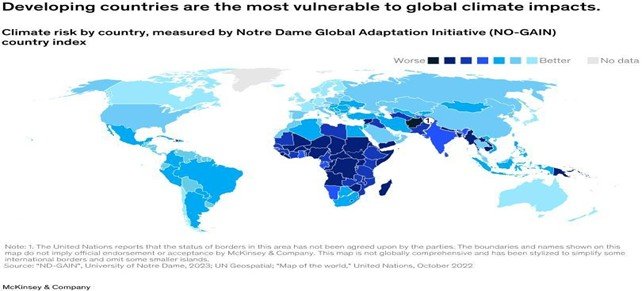
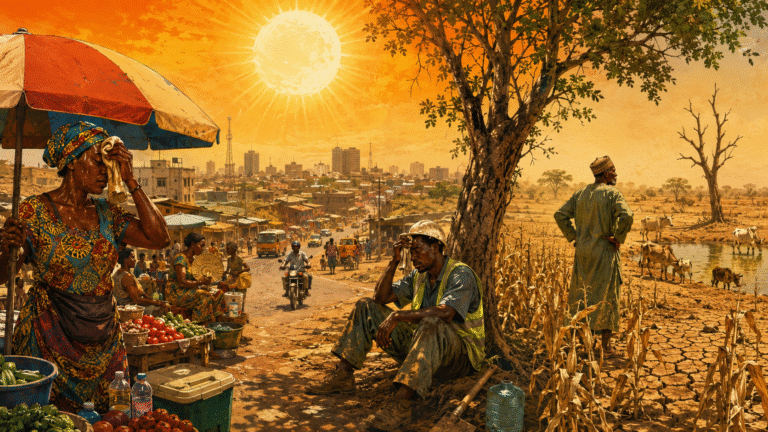
This blog argued that the green growth-development justice debate is often presented as a false dichotomy. Green growth provides a valuable pathway to low-carbon development, but tends to ignore entrenched and historical inequities that lead to today’s climate crisis. Figure 1 affirms this by outlining the major emitters of greenhouse gases; however, Figure 2 shows the vulnerability levels of countries that contribute least to greenhouse emissions. Development justice also acknowledges these disparities, and that developing countries should be given the leverage to pursue economic development amidst transition to a low-carbon economy because they contribute less to the crises.
Figure 1
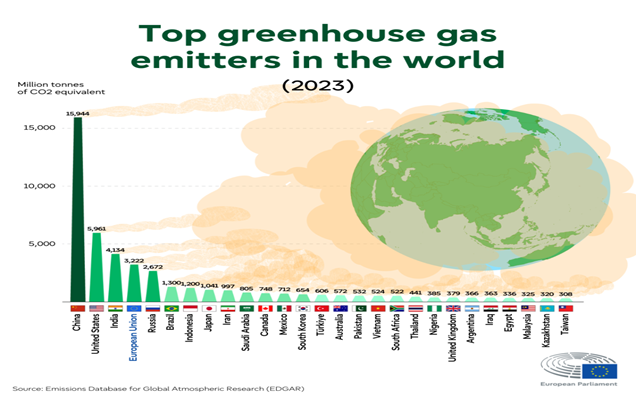
Figure 2
The Rise of Green Growth
The green growth development paradigm emanated from the idea that economic growth and environmental protection can be achieved simultaneously. Green growth is increasingly considered by international organizations, multilateral development banks, and climate finance institutions as a development paradigm that leads to sustainable development while lowering greenhouse gas emissions. Countries are supported to reduce environmental degradation from their economic growth by investing in renewable energy, climate-smart agriculture, green infrastructure, and technological innovation (Calvin et al., 2023; OECD, 2025) .
This is appealing due to its apparent ability to balance two critical goals – economic development and climate action. For many developing countries, they believe that the green growth development pathway can lead to industrialization, job creation, and poverty alleviation without having been necessarily leveraging a development pathway that is carbon-intensive. This logic has become more popular in the realm of climate finance, such as multilateral development banks and the Green Climate Fund, which finance investments in renewable energy and climate-resilient infrastructure (Calvin et al., 2023).
But the idea that economic growth is entirely independent of environmental degradation is still under debate. However, critics have suggested that Green Growth tends to focus on technical solutions to climate change, namely innovation and efficiency gains, whilst ignoring more fundamental issues of consumption, extraction, and economic injustice (Born, 2019). Therefore, green growth can enhance environmental outcomes without changing the fundamental economic systems that lead to environmental degradation and social inequality.
Development Justice and Historical Responsibility
Development justice has a different approach to climate policy. Development justice is more concerned with the concept of fairness, historical responsibility, and development opportunities rather than technological solutions and economic modernization. This view takes into account that the Global South countries have played a relatively small role in historical GHG emissions, but they are confronted with the worst impacts of climate change, such as droughts, floods, rising sea levels, and food insecurity (Calvin et al., 2023; Schlosberg & Collins, 2014).
This understanding is enshrined in the principle of Common but Differentiated Responsibilities and Respective Capabilities (CBDR-RC) in the UNFCCC. It recognizes that developed nations should have greater responsibility for climate change because of their historic emissions and have greater capacity to respond financially and technologically. Thus, climate justice scholars suggest that climate policy should not only focus on future emissions, but also on historical inequalities that remain today as drivers of vulnerability and development opportunities (Hickel, 2020; Schlosberg & Collins, 2014).
The Nutmeg’s Curse by Amitav Ghosh is a valuable historical perspective on this debate.(Ghosh, 2021) argues that the current environmental crises are a result of the legacy of histories of colonialism, extraction, and resource exploitation. The wealth that many industrialized nations have is the result of centuries of environmental change and colonialism. In this context, climate change is not just an environmental issue, but also a legacy of past systems of domination that remain prominent in the current development processes.
Climate Policy, Knowledge, and Power
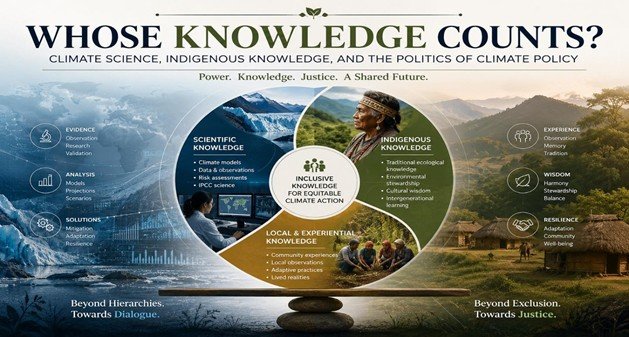
The issue of green growth and development justice is also an issue of knowledge and power. (Oomen, 2019) asserts that scientific knowledge plays a very important role in the field of climate governance because it offers a shared basis for understanding environmental change. Meanwhile, he warns that scientific power is entrenched in other social and political systems, which can exclude local, indigenous, and experiential knowledge.
In turn, (Born, 2019) argues that climate science and climate communication cannot be separated, but rather embedded in the broader political and economic frameworks within which they should be pursued simultaneously. She uses Critical Theory to criticize the modern scientific methods that tend to install an instrumental perspective on nature that equates an ecosystem with a resource to be managed, exploited, or optimized for economic gain. This critique is particularly relevant to the applicability of a green growth paradigm that often focuses on technological innovation and market efficiency, while paying less attention to justice, power, and inequality.
These concerns are particularly relevant in the Global South, where climate policies are formulated in frameworks that are mostly created in the Global North. While science is crucial for informing climate risks, a technocratic approach can fail to consider the local priorities and lived experiences. Therefore, beyond scientific knowledge, meaningful engagement with communities directly impacted by climate change is essential for effective climate governance (Born, 2019; Oomen, 2019).
The Global South Development Dilemma
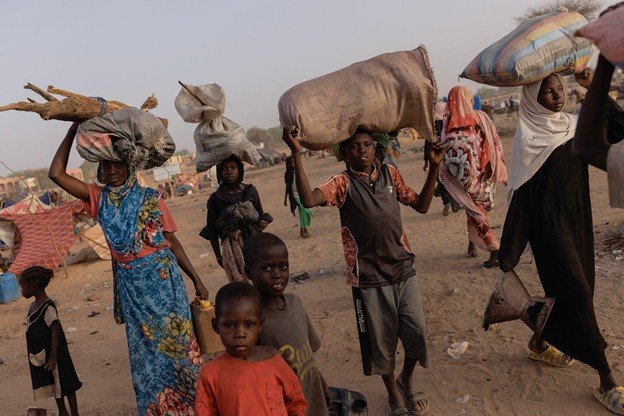
The debate between green growth and development justice is important because of the practical challenges faced by the developing countries. While many African countries emit a small proportion of global emissions, they are also highly climate vulnerable. Concurrently, these countries need investments in energy access, transportation systems, industrialization, and agricultural productivity for economic growth and poverty alleviation (Calvin et al., 2023).
This makes policy-making challenging. On the one hand, climate mitigation is necessary to prevent worsening climate impacts. However, there is a need for urgent development. The challenge is most pronounced in Least Developed Countries like The Gambia, where adaptation to climate change, food security, and economic development often take precedence over emissions reduction. Development realities must take into account policies that focus on mitigation, but ignoring development realities and solely focusing on mitigation may constrain opportunities for economic transformation and social progress.
The relevance of taking into account context is also emphasized by studies of climate attitudes and knowledge. (Armstrong et al., 2018) outlines that awareness of climate change does not lead to climate action due to the presence of structural barriers, economic conditions, and social contexts influencing behavior. People might know about climate risks in many developing countries, but they do not have the means or institutional backing to react appropriately. Thus, climate policy should go beyond creating awareness and reach out to the broader conditions that facilitate adaptation and resilience.
Beyond the False Choice
The dichotomy between ‘green growth’ and ‘development justice’ highlights the competing priorities that the global south finds itself trapped in. Economic growth is still necessary to fight poverty and enhance the living standard, but growth can’t solve historical inequalities and environmental sustainability. Similarly, development justice offers a crucial lens on climate inequality, but needs to also confront the complexities of economic transition and technological change.
Climate-resilient development is the panacea of today’s development because it is where climate resilience is embedded in the process of development, which is both social well-being, economic growth, and environmental sustainability. This is increasingly being recognized by the (Calvin et al., 2023), who state that climate action should be integrated within larger development agendas which strengthen development resilience, tackle inequality, and increase human wellbeing.
To realize this end, there is a need for increased climate financing, increased support for adaptation, technology transfer, and inclusive engagement of developing countries in global climate governance. There is a need for a paradigm shift from a more technical, scientific understanding of climate policy to a more comprehensive appreciation of the historical, political, and social context of climate change (Born, 2019; Oomen, 2019).
Conclusion
The question for the Global South is not “green growth or development justice. Instead, the enabling factors that can drive environmentally sustainable, socially equitable, and historically just development paths. Green growth can, and should, be used to provide opportunities for low-carbon development, but it does not necessarily solve structural inequalities that influence climate vulnerability. Development justice, on the other hand, argues that development should take into account the historical responsibility of greenhouse gas emissions in pursuing climate change policies because greenhouse gas emissions are transboundary.
Ultimately, climate policy should not force developing countries to choose between development and sustainability. Rather, it should establish a situation where both goals can be achieved at the same time. With the increasing impact of climate change, climate governance will rely not only on emissions reduction but also on the contribution of climate action to a more just and inclusive global development agenda.
Keywords: Green Growth, Development Justice, Climate Governance, Climate Resilient Development, Global South



 Reston Dennis Juah
 Noor Ul Ain
 Hassan Barrie
 Hoby Nasandratra Andriamiandrisoa
Điều tôi thích ở 188v là có nhiều trò chơi phù hợp với nhiều phong cách giải trí khác nhau. TONY06-18
The VIP treatment is real here. I feel valued as a player and the rewards are actually worth it. Quality service at f168svip.
Such a fun and exciting platform. The games load quickly and the graphics are stunning. I am having a blast on bhagobhago.
Best casino experience I have had in a while. The customer support is helpful and the game selection is huge. Try your luck at richbetcasino.
A hidden gem for anyone who loves online gaming. Everything is well organized and runs perfectly. Visit br3633bt now.