
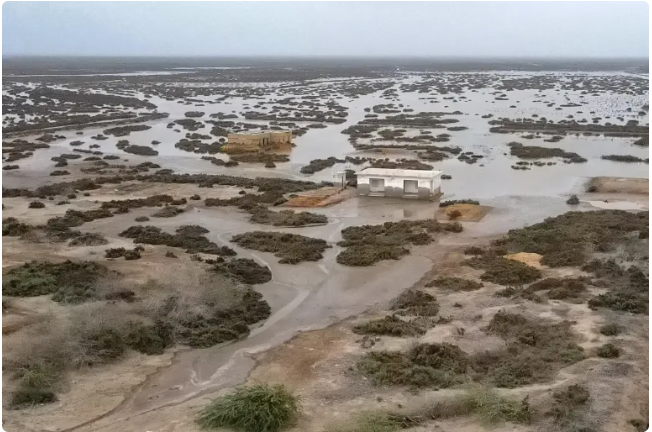
Abandoned dwellings within a village of the Indus delta [Source: Israr Ahmed Khan/AFP]
The Indus Waters Treaty is one of the few ‘diplomatic miracles’ of South Asia, having endured for over 60 years and withstanding wars, border crises, terrorist attacks, diplomatic freezes, and years of political tension between the two nations. Following the World Bank’s intervention, the Indus Waters Treaty was signed in 1960 by Indian Prime Minister Jawaharlal Nehru and Pakistani President Ayub Khan after 9 years of negotiations (World Bank, 2018). It divided the six rivers of the basin between the two countries on a simple geographical basis: the three eastern ones, Ravi, Beas, and Sutlej, were assigned to India, while the three western ones, Indus, Jhelum, and Chenab, were given to Pakistan, with India having limited rights to use the western rivers for irrigation, storage, and run-of-the-river hydroelectric power. The treaty had been proposed to establish the Permanent Indus Commission to exchange information annually and to provide a three-level dispute-resolution process when the parties disagreed (World Bank, 2018). This architecture survived for decades, even though relations between the two countries were tense, because it would have been too costly for either side to give up water cooperation.
Over 300 million people in India and Pakistan rely on the Indus basin for their water needs, as it plays a key role in agriculture, hydropower, drinking water, and livelihoods (Chatham House, 2026). Since the treaty was designed in a pre-climate world, growing climate change, such as glacier retreat, unpredictable monsoon patterns, higher temperatures, and extreme floods, is affecting the timing and dependability of river flows, posing simultaneous environmental, economic, and political challenges. It is important to note the hydrological paradox at the core of this crisis, in which glacial retreat first creates a series of dangerous droughts, during which rivers experience a “peak water” period as glaciers melt more quickly in response to rising temperatures. After that, flows will begin to decline structurally because the ice that has nourished rivers for millennia will simply no longer be there (Science/AAAS, 2025), leading to long-term, permanent water scarcity. The perennial snow and ice cover in the Indus basin declined by up to 24.8% between 2001 and 2021 (Chatham House, 2026). Recent studies suggest that the basin may experience water deficits of up to 50% during the critical period of 2030, and Himalayan glaciers could lose up to 75% of their total volume by 2100 (ORF Online, 2026). As glacier mass is lost, river runoff might be reduced by up to 70% in some sub-basins (Columbia Climate School, 2025).
Pakistan is particularly vulnerable because its food system, rural economy, and irrigation network are highly dependent on the Indus River, where the irrigation water for 35.58 million acres of cultivable land is required from the Indus basin (Hamidi et al., 2026) and is increasingly at risk of flooding and seasonal water deficits. River timing, storage, water supply to canals, and upstream information are essential for the sowing decision and have impacts on yield, rural incomes, and food prices. Therefore, suspension of the treaty should not be viewed as a limited diplomatic disagreement. Furthermore, water stress has been increasing in Pakistan due to poor water governance in the domestic sector, low water storage capacity, excessive dependence on groundwater resources, poor irrigation approach, and lack of provincial coordination. Per capita water availability has also been drastically reduced since the 1950s from over 5,000 m³ to an estimated 900 m³, which is close to or below the conventional water scarcity boundary (WAPDA, 2022; Zhang et al., 2020). Climate change, such as changing monsoons, glacier melt, higher temperatures, and increasing flood frequency, also contributes to this water scarcity (PIDE, 2022). The changes in the hydrological cycle are creating a water equation imbalance in Jammu and Kashmir, Punjab, and Himachal Pradesh due to the triggering of downstream disasters in Pakistan. India specifically mentioned ‘demographic changes and environmental challenges’ in its request to amend the treaty for 2023-24, acknowledging that the treaty’s allocations are no longer relevant to the dynamic nature of hydrology (NPR 2025). The tension is evident in the disputes over the Kishanganga and Ratle hydro power projects, where Pakistan has raised concerns over the designs of the dams under the treaty. However, India has contended that they are run of the river projects and therefore in compliance with the treaty. In a geopolitical conflict, both countries share a need for infrastructure to help them deal with the hydrological volatility caused by climate change, such as storage infrastructure, flood-forecasting systems, irrigation modernization, and real-time hydrological information networks. Resolving who owns which river is not enough if the real question is how both states can deal with an unstable river system.
Being unable to use water as a weapon increases the likelihood of tension between two nuclear-armed nations and reduces predictability for farmers, engineers, and disaster managers for national security reasons. The problems of over-allocation in flood years and under-allocation in drought years would be avoided if a shared reservoir management approach could be developed which is based on seasonal flow forecasts instead of fixed allocation formulas. The Permanent Indus Commission was not to be ignored but strengthened. Real-time digital data sharing should be implemented, rather than delayed reporting. The treaty’s working framework should include environmental flows, groundwater stress, flood-warning systems, and glacier monitoring in a joint climate-risk modeling.
The Indus basin is a “preview of global water politics in a warming world” (Penn State IEE, 2026) and a case for what to expect when old agreements fail in an era of climate uncertainty and political polarization. When the IWT is not restored, what comes next matters most for the Colorado River, the Nile, the Mekong, and all other transboundary river systems facing water stress in a changing world, where water diplomacy is being undermined by a new reality. So, it is not just a South Asian question whether India and Pakistan can find their way back to technical cooperation, even if they do not trust each other at the political level. It is a test of the viability of climate science everywhere else, on a platform of political conflict.
Key Words: Indus water treaty; Pakistan; India; Geopolitics; Climate Change; Water Scarcity.
References
Fact Sheet: The Indus Waters Treaty 1960 and the Role of the World Bank. (2018). https://www.worldbank.org/en/region/sar/brief/fact-sheet-the-indus-waters-treaty-1960-and-the-world-bank
Chatham House (2026). India and Pakistan still cannot agree to restore the Indus Waters Treaty – but re-engagement could help bring lasting peace. https://www.chathamhouse.org/2026/04/india-and-pakistan-still-cannot-agree-restore-indus-waters-treaty-re-engagement-could-help
Columbia Climate School (2025). Increasing Tensions in Kashmir Threaten Water Security for Over 200 Million People. https://news.climate.columbia.edu/2025/07/23/increasing-tensions-in-kashmir-threaten-water-security-for-over-200-million-people/
Dawn (2025). Water scarcity in Pakistan — a geopolitical ticking time bomb. https://www.dawn.com/news/1913435
NPR (2025). With Indus Waters Treaty in the balance, Pakistan braces for more water woes. https://www.npr.org/2025/07/08/g-s1-73122/pakistan-india-indus-waters-treaty
ORF Online (2026). The Indus Waters Treaty in a Warming World. https://www.orfonline.org/expert-speak/the-indus-waters-treaty-in-a-warming-world
Hamidi, A. R., Ford, J. D., Novo, P., Paavola, J., & Malik, I. H. (2026). Rethinking flood resilience: systemic risk, governance failures, and the social production of vulnerability in the Himalayan-Indus region. Journal of Disaster Science and Management (Singapore), 2(1), 8. https://doi.org/10.1007/s44367-026-00032-8
Penn State Institute for Energy and the Environment (2026). Why the Key India-Pakistan Water Treaty Is Under Strain and Why It Matters Globally. https://iee.psu.edu/news/blog/why-key-india-pakistan-water-treaty-under-strain-and-why-it-matters-globally
Science/AAAS (2025). Climate change threatens India-Pakistan pact over major river system. https://www.science.org/content/article/climate-change-threatens-india-pakistan-pact-over-major-river-system





 Reston Dennis Juah
  Noor Ul Ain
 Hassan Barrie
 Hoby Nasandratra Andriamiandrisoa
The login process is secure and fast. I never have issues accessing my account and the updates are frequent. jili4login is the way to go.
Good day! I know this is kind of off topic but I was wondering which blog platform are you using for this website? I’m getting fed up of WordPress because I’ve had problems with hackers and I’m looking at alternatives for another platform. I would be great if you could point me in the direction of a good platform.
I felt lucky the moment I joined. The odds are great and the community is very welcoming. Definitely my new favorite spot pkluckybet7