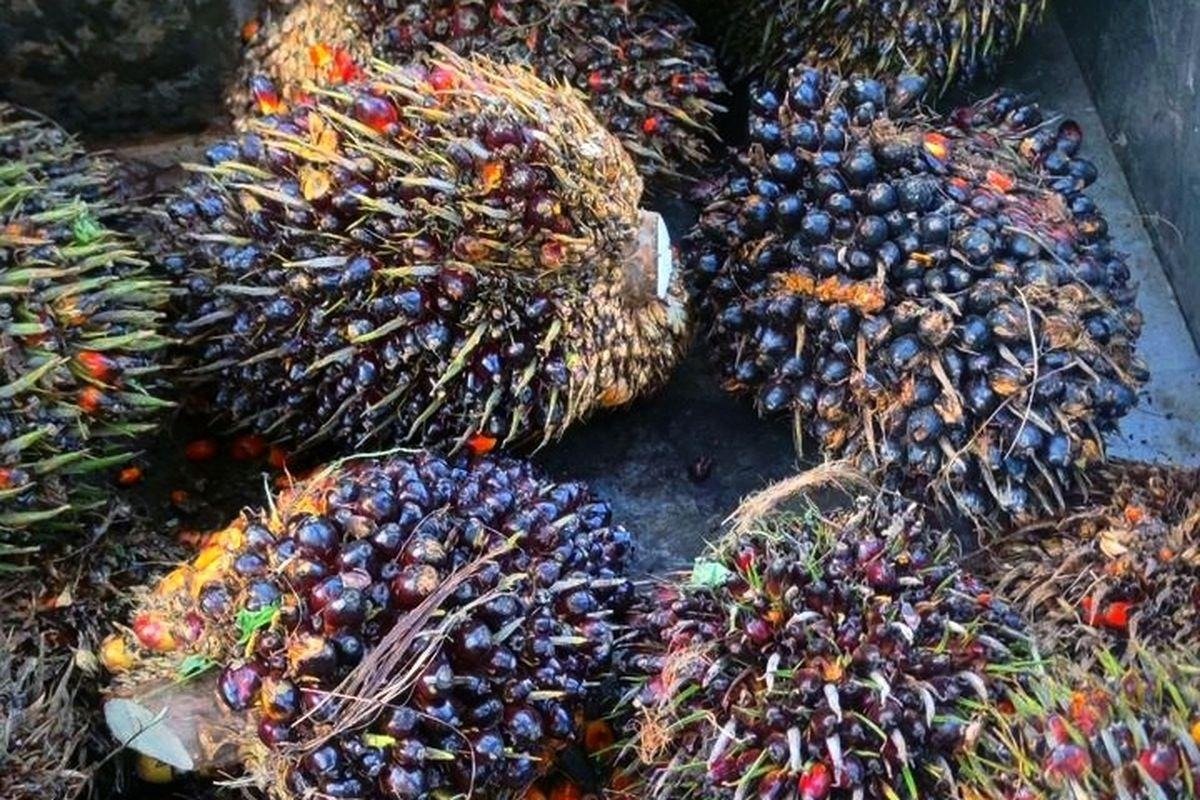

Caption: Fresh oil palm fruit bunches (credit: KOMPAS.com/Pandawa Borniat)
#SawitBaik emerged and became a trending topic on Indonesian social media, particularly Twitter (now known as X), in the months leading up to the end of 2019. The hashtag did not emerge organically, in the sense of being generated without orchestration by the public. The government played a role in bringing it to prominence (Khairiza & Kusumasari, 2020).
The hashtag appeared after negative narratives about Indonesia’s palm oil plantation industry became a concern for the global public. Before that, palm oil plantations, which continued to expand every year, were seen as a cause of tropical rainforest loss. The industry was also considered a driver of forest fires and the decline of orangutan populations.
Later, those allegations were proven by the floods and landslides that struck Aceh, North Sumatra, and West Sumatra at the end of 2025. The impact of the tropical cyclone that hit Sumatra was worsened by forest loss resulting from uncontrolled palm oil plantation expansion (BBC Indonesia, 2025).
Strong criticism of palm oil plantation expansion was voiced by civil society alliances, including Greenpeace. The European Union then began efforts in 2018 to restrict the entry of crude palm oil as a biofuel feedstock.
The Indonesian government responded. Diplomatic efforts to rally support from palm oil producing countries, as well as legal action against the European Union at the World Trade Organization, were undertaken. On the other hand, campaigns aimed at gaining public support down to the grassroots level were also carried out, one of them through social media using #SawitBaik. This campaign was conducted by the Palm Oil Plantation Fund Management Agency (BPDP), which operates under the Ministry of Finance.
This action was, in fact, understandable because the export value of palm oil and palm kernel products reached approximately US$15.99 billion, equivalent to around 1.4 percent of national GDP (BPS, 2020).
Indonesia’s position in defending its flagship commodity against the risk of unfair trade practices by the European Union cannot be considered wrong. However, promoting a narrative in defense of a commodity with extractive characteristics, without addressing the criticisms directed at it, cannot be justified either.
The #SawitBaik narrative was carried out through cherry-picking. Facts favorable to the CPO industry were highlighted, while the problems within the industry’s processes were not presented. Through the X account @sawitbaikID (https://x.com/SawitBaikID), it is evident that only narratives about macroeconomic benefits were promoted, while the externalities arising from deforestation were ignored.
Scientific facts were also presented selectively. One example is the assumption that oil palm trees absorb carbon emissions through photosynthesis. However, greenhouse gas emissions generated by fertilization, palm oil processing, and palm oil mill effluent were not mentioned.
This type of campaign demonstrates that the struggle to raise public awareness about the importance of environmental conservation amid the climate crisis has many dimensions, one of which is the dimension of competition for attention. Campaigns aimed at shifting public concern away from extractive activities that benefit a small group of people but produce destructive impacts experienced widely are very real.
Within the social media landscape, these partial voices can have broad disinformation effects because of the presence of buzzers. This is especially true given that the #SawitBaik campaign was carried out by the government, which possesses large scale resources.
Keywords: sawitbaik, greenwashing, cpo
Reference:
Badan Pusat Statistik. (2020). Statistik kelapa sawit Indonesia 2019. Badan Pusat Statistik. https://www.bps.go.id
Khairiza, F., & Kusumasari, B. (2020). Analyzing political marketing in Indonesia: A palm oil digital campaign case study. Forest and Society, 4(2), 294–309. https://doi.org/10.24259/fs.v4i2.9576



 Reston Dennis Juah
 Noor Ul Ain

 Hassan Barrie
 Hoby Nasandratra Andriamiandrisoa
Very stable connection and the registration was a breeze. I appreciate how they keep things simple and efficient. Big thumbs up for jili178login.
I’ve been trying a few different spots lately and this one really stands out. The interface is smooth and the payouts are quick. Definitely check out br234bet if you want a reliable experience.
Best betting experience I have had this year. The rewards program is actually worth it and the games are exciting. Try vnke789 now.