
Introduction
Cities were planned for business, communication and culture. However, with the warming global temperature, they have turned into something new called thermal traps. During the day asphalt absorbs heat and at night releases it slowly. The sun’s energy is reflected and focused by the glass towers. Concrete retains heat for several hours following the sun’s setting. The outcome is the Urban Heat Island (UHI) effect, which is a phenomenon that finds the average air temperature in cities 1 to 12°C higher than that in the rural areas. This is not a threat in the future. More than 50% of the world’s population has to face it every day. Even when income is accounted for, disadvantaged populations are exposed to 3-4°C more than wealthy communities, and have 26-45% higher heat-related mortality risk as confirmed by a new systematic review of 33 studies (2021–2025).
Why Cities Get So Hot: The Physical Science.
Multiple physical processes are involved in the creation of urban heat islands. Asphalt, concrete, dark roofing materials: Built surfaces with high thermal mass absorb solar radiation during the day and release it slowly at night, thus not cooling down at night. Natural vegetation is removed and replaced by impervious surfaces, thereby removing the cooling effect of the evapotranspiration from the plants. The building up of longwave radiation by the geometry of urban canyons (long, narrow streets with tall buildings lining them) acts as a positive feedback loop that enhances warming. The urban atmosphere is directly heated by anthropogenic heat from vehicles, buildings, and industrial processes. As a modern city, one ENEA researcher notes, “absorbs all the energy of a day like a giant stone left in a fireplace, and continues to give off energy, but in an invisible form, long after the sun has set, giving life inside no place to hide from the approaching heat. The situation is getting worse worldwide. The 2025 10 New Insights in Climate Science report from Future Earth, The Earth League and the World Climate Research Programme states that record-breaking heat extremes are occurring more frequently and intensively on all inhabited continents.
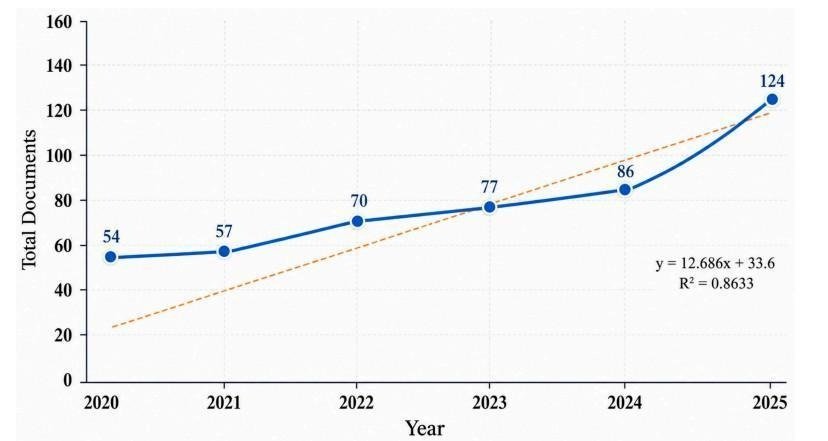
Figure 1: Annual growth of publications on Urban Heat Island research in polycentric cities and mega-urban regions (2020–2025). The number of studies increased from 54 to 124, demonstrating the rapidly growing scientific focus on this global challenge.
The human cost-physical health:
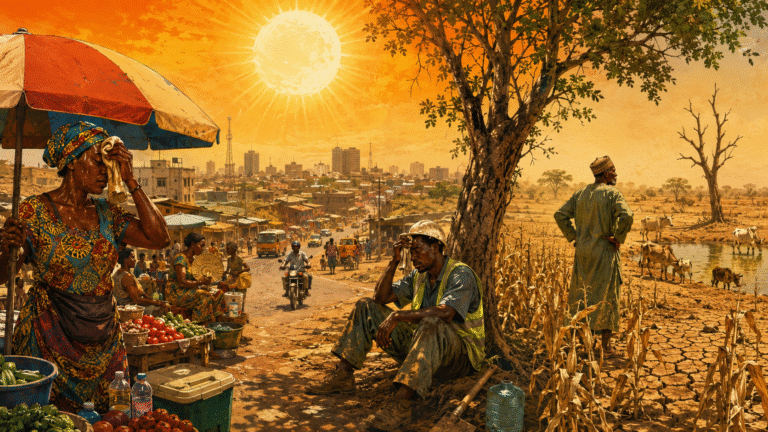
Urban heat poses significant health impacts. Previous studies record that during extreme heat events (EHE) deaths due to heat rise sharply, especially in vulnerable populations, including people who are older, children, outdoor workers, and those with pre-existing medical conditions.
There are well known physiological mechanisms. Excessive exposure to high temperatures is a strain on the cardiovascular and respiratory systems, raises core body temperature and can cause heat exhaustion, heat stroke and organ failure. Particularly important is night-time temperature: if urban areas do not cool down after sunset, the human body does not get a break from heat stress during the day, the review notes.
The Mental Health Toll
Extreme heat has a negative impact on mental health. Essers et al. in 2025 analyze the relationship between temperature exposure and psychiatric symptoms in 2 birth cohorts from Europe. The study revealed that raised temperature was positively correlated with psychiatric symptoms among youths. The discovery comes on the heels of a growing body of evidence that shows how climate change affects mental health outcomes. The report, 10 New Insights in Climate Science, 2025/2026, highlights climate displacement-related anxiety, depression and trauma-related disorders as key factors, especially in younger generations, who will be exposed to increasing climate hazards throughout their lifetimes.
Unequally exposed population
One of the most disturbing things is that the exposure is unequitable. UHI are random, we cannot say the whole population of a specific area is facing it, but it is randomly distributed and concentrated in areas where resources and power is not present. The systematic review reveals that in the overwhelming majority of the cities examined in the U.S., persons of color reside in census tracts that have a significantly higher SURF UHI intensity than non-Hispanic whites, even after controlling for income.
It has been observed that lower income urban neighborhoods are 3-4C warmer than higher income neighborhoods due to lower tree canopy, lack of parks, and higher density of asphalt and dark roofs. Across the globe, cities in the Global South suffer from an increased number of extreme heat days with very little contribution to the environment’s greenhouse gas emissions that are causing climate change. The review highlights that “disadvantaged populations are more exposed to heat and suffer a double burden in terms of resources to adapt.
What Works: Evidence-Based Mitigation Strategies
There are measurable cooling effects for a number of interventions, as identified in the Study.
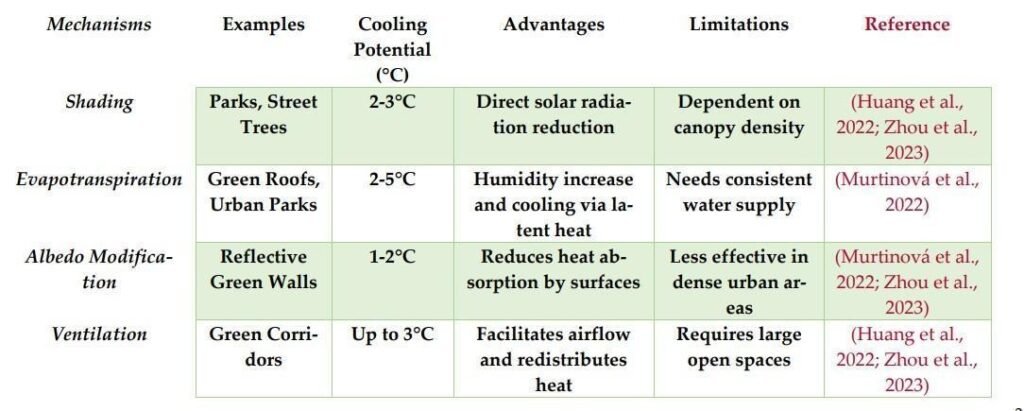
Figure 2: Comparison of Urban Green Space Mechanisms for Mitigating Heat. Different green infrastructure strategies provide cooling through distinct mechanisms, with varying effectiveness and requirements
Cool surfaces (reflective roofs and pavements) reduce surface temperature by 2-22°C while green infrastructure (parks, green roofs, street trees) reduce air and surface temperatures by 1-6°C. It is clear that there is a dose–response relationship in urban parks: the larger a park is, the greater its cooling effect.
But the effectiveness of mitigation is not consistent. The best interventions will depend on the socioeconomic environment. Cool roofs work best in wealthier neighborhoods with high maintenance, while urban trees work best in poorer neighborhoods with high gap in canopy cover. In a comprehensive meta-analysis of 202 studies across 51 different green-blue-gray infrastructure (GBGI) types, botanical gardens were found to be the most cooling (mean 5.0 ± 3.5°C) and interconnected green corridors were found to be more cooling (mean 4.5 ± 2.1°C) than any other other GBGI types. Nature-based solutions (NbS), such as urban greening and wetland restoration, also have many co-benefits for biodiversity, air quality, water and other resources, and community well-being and provide cost-effective adaptation investments, the 10 New Insights report notes.
The shift from ‘Isolated interventions’ to ‘Systems thinking’ in Policy Integration.
Studies suggest that a shift from piecemeal to more nuanced, equity-focused approaches to urban heat mitigation, acting alongside planning, transportation, energy, health, and governance must be translated across sectors, and that this work is still in its early stages. Planting trees without upkeep, cool roofs without community involvement, or parks without an awareness of gentrification risk are common examples of siloed approaches that don’t reach the population that requires cooling the most. The post-pandemic era is the perfect opportunity to integrate heat mitigation into the larger agenda of urban transformation. The 10 New Insights report highlights that there is a need for “urgent and accelerated action” in all sectors to reduce warming and to prepare for unavoidable impacts. Cities with strategies that bring together heat planning and affordable housing, public health, transportation and social services will have more resilient and equitable results.
Conclusion
Urban heat islands don’t have to be a price of urban living. They are a design failure which can be overcome by political will, specific investment and planning focused on equity. The results are now clear: Green infrastructure delivers results, cool surfaces deliver measurable benefits, and nature-based solutions deliver multiple co-benefits. However, if they are only used in the rich neighborhoods, it won’t matter. Urban heat is not just a technical issue, it’s a justice issue. Trees come to the poorest neighborhoods in the least quantity, infrastructure investment to those neighborhoods comes in the least quantity, and political attention to those neighborhoods comes in the least quantity. The first step to cooling cities is to cool the inequities. The window of opportunity is rapidly closing as the report by the 10 New Insights in Climate Science 2025/2026 comes to a close. The technology is in place. Science says that it’s a no-brainer. What is left is the courage to create cities that function for all, not just those who can afford to leave the heat behind.
Keywords: Urban heat island, extreme heat, health equity, urban planning, climate adaptation
References
- Zheng, Z., et al. (2026). A Systematic Review of Urban Heat Island (UHI) Impacts and Mitigation: Health, Equity, and Policy. Systems, 14(1), 82. https://doi.org/10.3390/systems14010082
- ENEA Italian National Agency. (2026). Advancing Resilience in the Nexus of Urban Heat Islands, Global Warming, and Human Health. Atmosphere, 17(3), 318. https://doi.org/10.3390/atmos17030318
- Essers, E., et al. (2025). Temperature Exposure and Psychiatric Symptoms in Adolescents From 2 European Birth Cohorts. JAMA Network Open, 8(1), e2456898. https://doi.org/10.1001/jamanetworkopen.2024.56898
- Future Earth, The Earth League, & World Climate Research Programme (WCRP). (2025). 10 New Insights in Climate Science 2025/2026. MIT Climate Science, Strategy & Solutions (CS3). https://doi.org/10.5281/zenodo.17328963






 Reston Dennis Juah
 Noor Ul Ain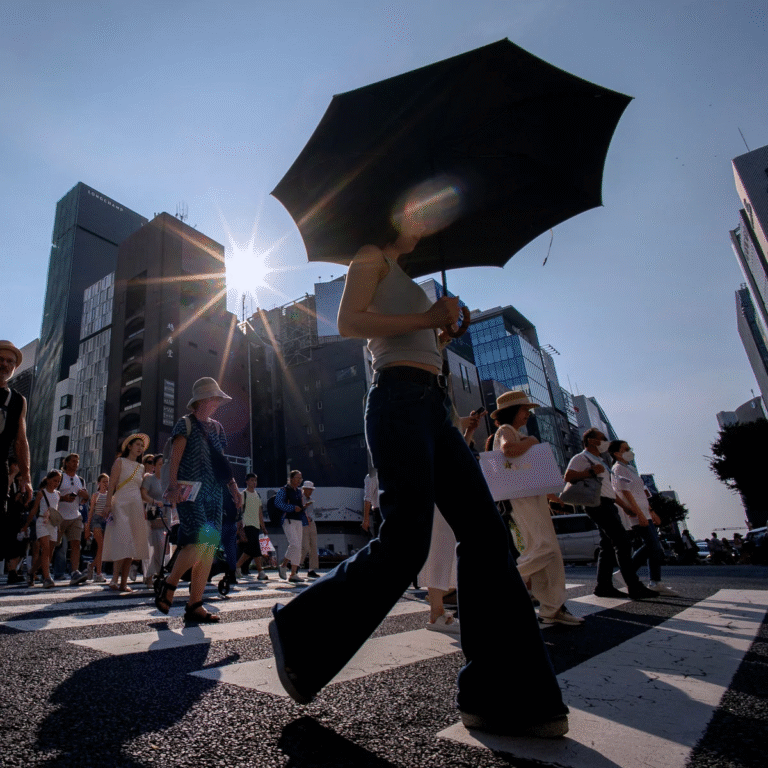
 Hassan Barrie
 Hoby Nasandratra Andriamiandrisoa
+ There are no comments
Add yours