
Introduction
If a farmer’s crop is destroyed by a drought or the coastal village is washed away by a cyclone, the first victims counted are the crops, houses, and livestock. However, another more subtle effect occurs behind the closed doors, that is young daughters are being married off to cut financial costs, to pay a bride price or to pass on the responsibility of sustenance. Climate change is not just an environmental threat; it is contributing to the rollback of progress towards child marriage and girls’ education over many years. This is particularly evident in Pakistan where the 2022 floods gave rise to a new phenomenon, the “monsoon bride.”
The 2022 Floods and the Rise of ‘Monsoon Brides’
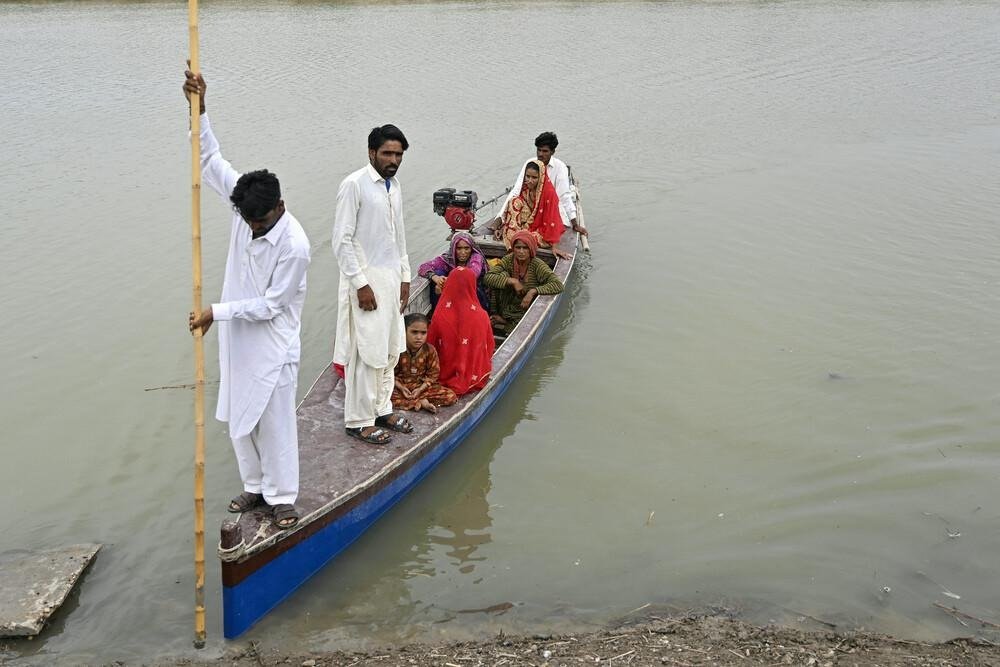
One-third of Pakistan was inundated with unprecedented amount of monsoon rainfall in the summer of 2022, displacing millions of people and ruining more than 4 million acres of farmland. The floods did not go away easily for many months, many villages in Sindh Province were looked like lakes. As finally the waters receded, they left behind ruined land, dead crops and families without means of livelihood.
The economic devastation was immediate and catastrophic. The families who were dependent on farming and fishing for years and years found themselves empty handed. In this desperation, a sad coping strategy brought itself into being. In 2024, when monsoon rains were again expected, Shamila, then 14 years old, and her younger sister Amina, age 13, were married off for cash at the pleasure of their parents who saw the prospect of flooding in the future. Shamila told AFP that she was pleased to hear she was getting married, but thought her life would become easier since she was marrying a man twice her age. But I’ve got nothing else,” but with the rain, I fear that I will have even less, if that is possible.”
The severity of the crisis
The rise has been witnessed by Mashooque Birhmani, founder of the NGO Sujag Sansar, which works with religious scholars to stop child marriage. Families will do anything to survive; and the easiest and most obvious is to exchange their daughters for a dowry. In the village of Khan Mohammad Mallah of Dadu district, Sindh, 45 underage girls were married since the monsoon of 2022, of which 15 were married just in the month of May-June 2024. Parents said they rushed the marriage of their daughters to get them out of the poverty cycle and usually paid $720-900 (200,000-250,000 Pakistani rupees) per bride. Village elder Mai Hajani, 65, explained how things had changed in their area before 2022 when there was no need to marry girls so young because there were always things to do, whether for farm work or rope making or for the men, fishing or agriculture.
The Broken Promise of Marriage
What makes the tragedy the more tragic is the lack of security that marriage brings to families. In 2022, Najma Ali got married at the age of 14 and started living with her in-laws. She told AFP: “My husband gave my parents 250,000 rupees (2,600 euros) for our wedding, but it was a loan from a third party and he has no means of repaying at present, with his six-month-old baby in his arms. I thought I’m going to use lipstick, make up, clothes and crockery; now I am at home with a husband and a baby and we don’t have anything to eat. Hakim Zaadi, 58, her mother, explained how the floods have impacted their village’s economy: “We had lush rice fields where girls used to work, they would grow many vegetables which are all dead now because the water in the ground is poisonous, this has happened especially after 2022”. Before then the girls weren’t a burden on us until they were the age at which they are supposed to be married, they now have five kids and they go back to their parents, as their husbands are jobless.
Five Years of Progress are erased.
The child marriage rate in Pakistan is the sixth highest in the world with UNICEF estimating 18.9 million child brides in Pakistan. Prior to 2022, the country has witnessed “significant strides” in efforts to curb children marriage rates.
However, the floods changed all that. Following the disaster, a UNICEF report had warned that it would likely be accompanied by an 18 percent spike in child marriage, corresponding to the loss of five years of gains. It is the purely economic mechanism. In bride price systems (which are prevalent in under nutrient Sindh), daughters are treated as assets and can be sold if the family is destitute. One father, Dildar Ali Sheikh, who spoke from an aid camp admitted: “I thought while I was there like ‘I should get my daughter married, at least she can eat, she can have basic facilities'”. His daughter Mehtab was just 10 years old.
The Education Connection
Climate shocks also keep girls out of school, and after they are gone, many don’t come back. Child marriage is intricately linked to school dropout. Sujag Sansar saved Mehtab from the early marriage by postponing the wedding and enrolling her in a sewing workshop, where she was able to earn some money and proceed with her studies. Mehtab has shared his wish to study with his father. I see girls around me that are married and have very tough lives and I don’t want to be like that. Her fear is well-founded. Child brides are at far greater risk of maternal mortality, intimate partner violence, mental illness (anxiety, depression, PTSD), and more. They are also denied access to education, friends, and work, and are thereby isolated in a vicious cycle of intergenerational poverty.
Why this link is neglected in the context of climate policy.
Even with these strong indicators, most climate policy measures, be they National Adaptation Plans, or the Loss and Damage Fund, fail to mention child marriage or education. Education is among the services that is most commonly affected by climate hazards, but is rarely mentioned in policy discussions, according to UNICEF’s report. The term “monsoon brides” is now part of the policy discourse, in large part due to the efforts of Pakistani researchers such as the physician-academic Mehr Muhammad Adeel Riaz, who has reported the phenomenon in BMJ Global Health. However, naming the problem is just the first step. Currently, the Loss and Damage Fund established at COP29 does not include funding for social protection measures that could help reduce the likelihood of child marriage following a climate disaster.
What Works: Promising Interventions
There has been some success in implementing interventions and these may be expanded. Child marriage can be prevented with conditional cash transfer programmes that include girls’ school attendance as a requirement. For Mehtab, vocational training and a bit of money meant she could delay her marriage. Child marriage in Dadu district has been effectively prevented through community-based monitoring which has harnessed religious scholars and elders similar to that of Sujag Sansar. The organization functions within culture, not against it, and it has been effective. The BMJ Global Health analysis offers two policy recommendations that could offer alternatives to marriage: Emergency shelters, and targeted education programs and microfinancing for families with daughters.
A Diplomatic Imperative
Chief Minister Murad Ali Shah’s spokesman stated that the Sindh provincial government has decided to hold an inquiry into the phenomenon of ‘monsoon bride’ and he explained that: “In my opinion, there is always been this trend of early marriage, but the flood situation has compelled people to be in great distress. A group of gender-inclusive organisations and climate vulnerable countries may suggest a Loss and Damage child protection window as a dedicated funding mechanism for cash transfers, school retention and family strengthening post climate emergency at COP30. The building blocks are already in place; proof of concept has been shown with community interventions, such as Sujag Sansar’s projects. Development grants or funding for climate adaptation should be established specifically to support the nexus of child marriage and climate change,” conclude Mehr Muhammad Adeel Riaz and colleagues in BMJ Global Health. These funds could be used to loan out families with daughters to run small businesses or invest in climate resilient farming, instead of marrying their daughters away.
Conclusion
Climate change is not only causing glaciers to melt and forests to burn it’s killing kids before they can even start. The 2022 floods and monsoons in Sindh province in Pakistan have left behind many ‘monsoon brides’ – young girls as young as 10 years old who have been forced to marry. According to UNICEF figures, child marriages will increase by 18%, undoing five years’ worth of progress. This can be done without new technology or complicated finance. It demands to see the girls left behind floodwaters and missed crops as part of the climate crisis and to make the protection of these girls a fundamental part of adaptation success. When monsoons return, questions need not just be how to reconstruct houses and crops, but also how to ensure that the girls stay in school and not get married.
Keywords: Child marriage, climate shocks, Pakistan floods, monsoon brides, adaptation, gender justice
References
- AFP. (2024, August 21). ‘Monsoon brides’: Extreme weather fuels Pakistan child marriages. 24 News HD. https://www.24newshd.tv/public/21-Aug-2024/monsoon-brides-extreme-weather-fuels-pakistan-child-marriages
- Human Rights Watch. (2022, September 1). Flood-Affected Women in Pakistan Need Urgent Help. ReliefWeb. https://reliefweb.int/report/pakistan/flood-affected-women-pakistan-need-urgent-help
- AFP. (2024, September 3). Heavy rains wash away childhoods. The Star. https://www.thestar.com.my/aseanplus/aseanplus-news/2024/09/03/heavy-rains-wash-away-childhoods
- Riaz, M. M. A., Awan, M., & Hoven, C. W. (2024, September 30). Monsoon child brides: The hidden cost of climate crisis in Pakistan. BMJ Global Health Blog. https://blogs.bmj.com/bmjgh/2024/09/30/monsoon-child-brides-the-hidden-cost-of-climate-crisis-in-pakistan/
- AFP. (2024, August 17). ‘Monsoon brides’: extreme weather fuels child marriages in Pakistan. The News International.
- AFP. (2024, August 20). Sindh govt orders inquiry into monsoon child brides. 24 News HD. https://www.24newshd.tv/index.php/20-Aug-2024/sindh-govt-orders-inquiry-into-monsoon-child-brides



 Reston Dennis Juah
 Noor Ul Ain
 Hassan Barrie
 Hoby Nasandratra Andriamiandrisoa
+ There are no comments
Add yours