
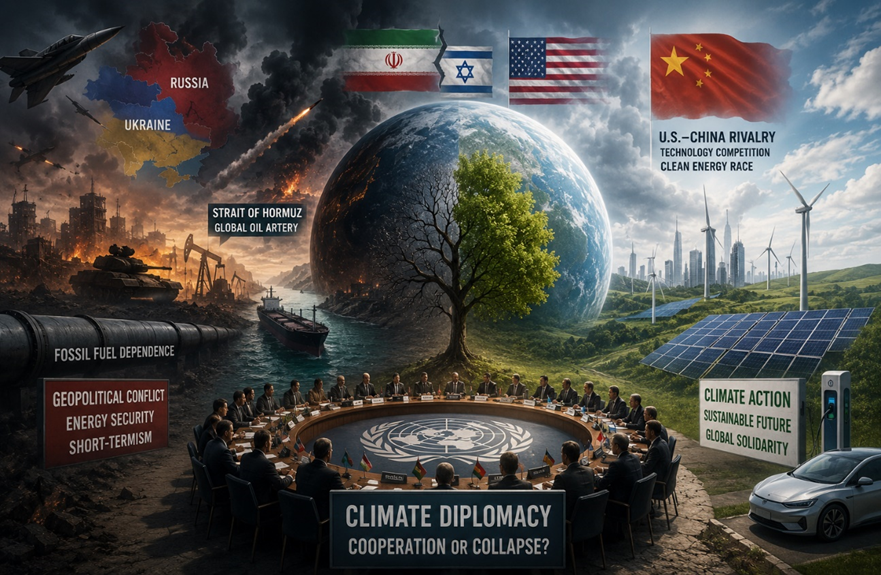
Climate diplomacy in today’s world is living in a world where cooperation is not limited by the absence of scientific consensus, but by the structural renewal of geopolitical realism. It’s not that the states don’t acknowledge the existential threat of climate change, it’s just that the international system does not reward states who survive in the long-term at the expense of short-term strategic gain. From this point of view, the idea of climate diplomacy is becoming a victim of two logics: a logic of ecological interdependence and a logic of political competition.
This contradiction is being brought to the fore at the very material level by the Russia, Ukraine war. That will show how Europe responded to energy, and how climate change is not a simple technological trajectory but one that is subject to political reversal and exists within security architectures. In this context, the IEA records an initial resurgence of coal consumption for this reason, and then it also shows how the investments in renewables are accelerated (IEA,2023). The second analytical takeaway is that climate policy is a secondary priority system it is maintained in times of stability but is reduced in times of systemic shocks. That undermines the principle of irreversibility and cumulativeness that lies at the heart of climate diplomacy.
The logic is further reinforced by the Iran, Israel, United States tensions in the Strait of Hormuz, which highlights the spatial fragility of the global energy system. Rather than climate ambition alone, climate governance is conditioned by the geopolitical geography of fossil fuels, particularly when nearly 20% of global oil trade through a politically unstable chokepoint. As tensions rise and the risks on the oceans climb, so do the prices of oil and the national policy reordering of energy security (S&P Global, 2026). The analytical implication is more structural than descriptive, Fossil fuel infrastructure is not only an energy system, but also a geopolitical impediment which is actively working against rapid decarbonization. Climate diplomacy is thus embedded in a system, where the goals of climate diplomacy are materially undermined by the energy system to be changed.
On the theoretical side, this shows a move from the liberal institutional theories to realism. Climate governance is based on the premise that states can engage in cooperation around existential threats, but realist logic holds that survival is always understood based on relative power instead of shared outcome. These tensions explains why even scientifically sound approaches, such as those proposed by the Intergovernmental Panel on Climate Change (IPCC), are difficult to convert into political coordination that is legally binding. This is not epistemic uncertainty in climate science, but the institutional incompatibility between global climate science and fragmented sovereign decision making (IPCC, 2023).
The United States, China rivalry is another example of the ‘techno-strategic competition’ that is washing over the governance of climate change. Clean energy technologies (batteries, rare earths and EVs) are no longer just weapons in the fight against climate change but weapons of industrial domination. That creates a climate diplomacy shift from a cooperative regime to a competitive innovation system. The point is that the analytical change here is that reduction in emissions turns from being a normatively desired outcome into a by-product of strategic competition. Cooperation continues, but in a geopolitical term.
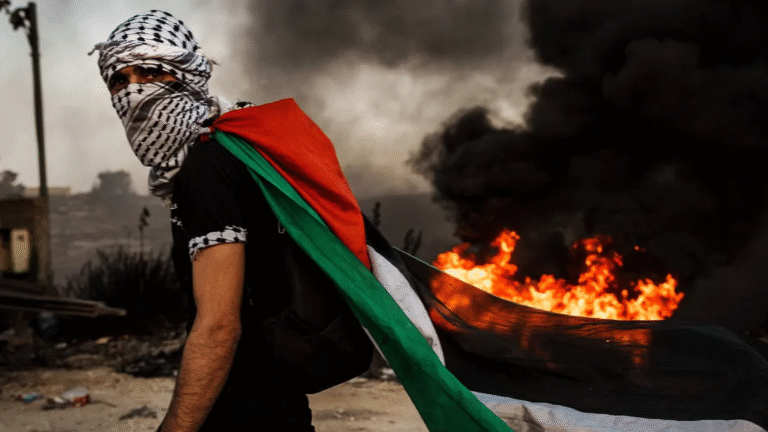
Another dimension to the Iran-Israel-USA dynamic is the securitization of infrastructures related to climate. The Strait of Hormuz crisis is a good example of how the energy corridor is being seen as a security asset, not a global asset. It is part of a larger shift in international politics, where climate and energy systems are becoming a part of the security landscape. This shows structural narrowing, once climate change is understood as a threat multiplier, policy solutions are given preference to the national rather than the global level and focus on national resilience rather than global distributive justice. That means a paradigm shift in the normative basis of climate diplomacy.
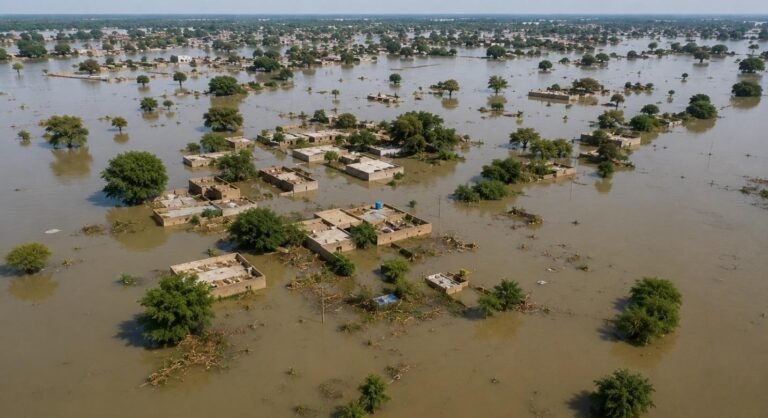
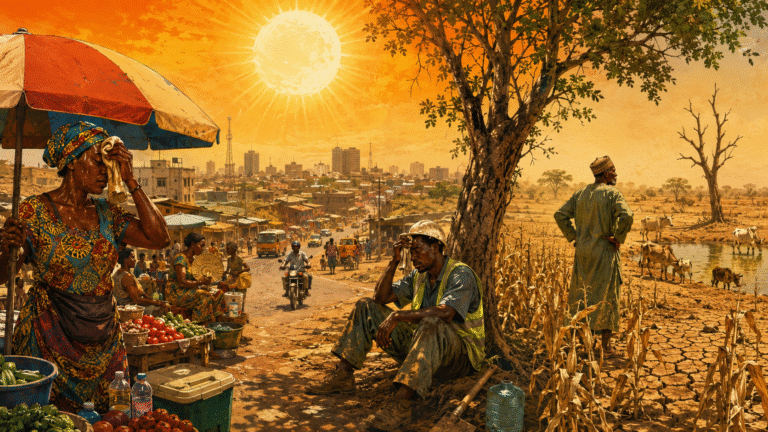
This structural fragmentation is further increased by economic inequality. The World Bank’s estimation of 216 million internal migrants by 2050 due to climate change highlights the spatial and geographical nature of climate impacts (World Bank, 2021). The United Nations Development Programme (UNDP) also points out lack of persistent financing for adaptation and mitigation in developing economies). The analytical challenge being posed is not just underfunding, but asymmetry of vulnerability and agency, that is, those least responsible for emissions are most exposed and have the lowest institutional capacity to respond. That is, it creates an issue of legitimacy in climate governance.
Although climate diplomacy is fragmented, it is far from dead, and has become polycentric. But this decentralization doesn’t solve the coordination problem, it simply shifts it. What used to be a single world-wide governance system is now a multi-layered system of partial governance: bilateral agreements, regional alliances, and private-sector decarbonization networks. Analytical tension, increasing breaking up means increasing activity, but decreasing coherence, thus dynamic but structurally not coherent.
Climate diplomacy in the era of geopolitical conflict should be viewed less as a broken system and more as a bounded one. The same dynamic has played out in the Russia, Ukraine war, the Iran, Israel, US tensions over the Strait of Hormuz and the US, China technological rivalry. The deeper lesson is that the climate emergency is a test not only of the environmental system but also whether the international system can overcome realist fragmentation. The unanswered analytical question is thus not if cooperation is feasible, but whether it is cooperative architecture or political architecture, which is feasible for the cooperation the climate crisis calls for.
Keywords: Climate Diplomacy, Geopolitical Conflicts, Global Governance, International Corporation, Climate Governance


 Reston Dennis Juah
 Noor Ul Ain
 Hassan Barrie
 Hoby Nasandratra Andriamiandrisoa
+ There are no comments
Add yours