
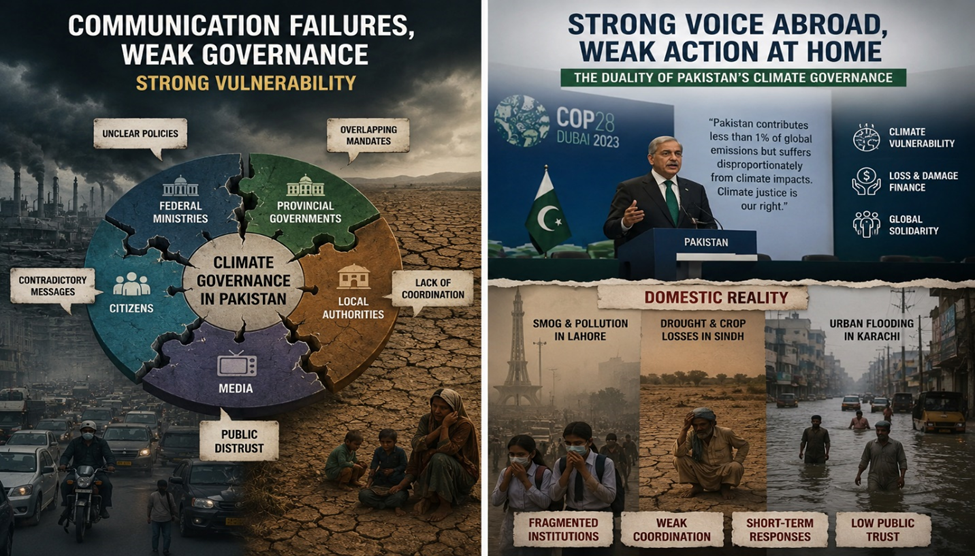
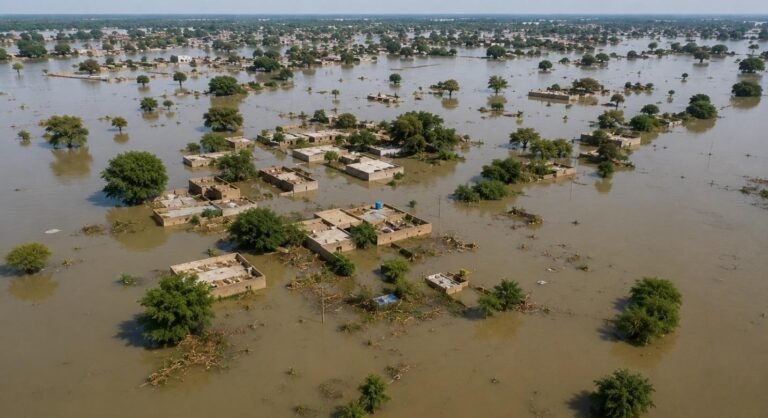
Pakistan has many climate policies. The genuine issue lies in the lack of effective communication, execution, and diplomatic presentation of climate policy. The distinction is important because climate governance is not merely a matter of policy-making; it is also about how well governments communicate risk, how well they coordinate institutions, and whether they build trust in long-term environmental policy decisions among the public. Communication failures consistently undermine climate diplomacy and domestic policy in Pakistan. The country’s voice on vulnerability to climate change is loud on the global stage, but weak within the country when it comes to internal communication, for example, between ministries, between provincial governments, between media institutions and citizens. Pakistan, as a developing country, is among the most climate-sensitive countries in the world, yet its share of global GHG emissions is less than 1%. That it is both highly vulnerable and low-emitting is central to the climate diplomacy narrative of this country, and is picked up in global climate assessments.
The failure of communication between federal and provincial institutions in the aftermath of the 18th Constitutional Amendment serves as a case in point to illustrate how communication failures became structurally integrated within climate governance. There was a lack of centralized environmental authority, although there were limited co-ordination mechanisms. National climate policies and frameworks have been developed by the Ministry of Climate Change, with implementation in the process of being delegated to provincial departments, each having varying capacities and priorities. Theoretically, it was expected that decentralization would enhance responsiveness at the local level. In reality it fostered disjointed communications and a lack of clarity around responsibility. The World Bank report pointed out that “institutional overlap and coordination gaps” exist between federal and provincial institutions in terms of climate governance in Pakistan (World Bank, 2022). This was evident during the smog management in Punjab, when there were conflicting statements from environmental agencies, transport departments, and local governments on the regulations of industries, school closures, and traffic restrictions. As a result, climate communication became reactive and uncoordinated, instead of coordinated.
Lahore’s frequent episodes of smog are not just an environmental problem, it is a failure of policy communication. Authorities declare emergency measures each winter, but these campaigns are seldom sustained when air quality temporarily improves. The emphasis in public messaging isn’t on building environmental awareness but in warning the public. The government of Punjab has repeatedly urged citizens to cut down on outdoor activities, but critics say that the state puts more emphasis on individual precautions rather than structural measures like industrial emissions, low standards for fuel quality, and inadequate urban transport plans. A Gallup(https://gallup.com.pk) Pakistan survey of 2023 revealed that a significant proportion of urban respondents did not consider government actions during environmental emergencies as ‘long-term plans’ but merely reacting to the situation on a temporary basis. For political reasons this perception is relevant given the importance of public trust for climate adaptation. Compliance and cooperation are reduced if citizens feel that the policies are symbolic acts for media consumption.
Climate diplomacy also showcases a communication paradox in Pakistan. Internationally, Pakistani officials depict the country as one of the most climate vulnerable countries in the world with a historical injustice and an unequal responsibility of emissions. Scientific data from the Intergovernmental Panel on Climate Change (IPCC) is also in favor of this argument, as it has placed South Asia as highly vulnerable to heat stress and water insecurity, along with climate related displacement (IPCC,2023). But, when it comes to climate diplomacy, there is a gap between communicating vulnerability externally and communicating accountability internally. Despite the fact that international fora are used to address global inequality, speeches by governments do not often mention how inadequate urban governance, uneven application of environmental laws and sectoral fragmentation increases domestic vulnerability. This selective communication results in a political imbalance, in which external narratives are centered on victims and internal governance failures remain less visible.
The Billion Tree Tsunami project is a good example of how climate communication can give issues a political label. The program was hailed internationally for the extensive reforestation efforts, and was extended to a national level. However, the discussions of the project revealed conflicts between transparency and visibility. Government campaigns focused on targets, recognitions on plantations, and less focus was paid to the survival rate of planted trees, monitoring systems, and ecological viability. UN analysts from the United Nations Development Programme noted that climate adaptation projects in developing countries tend to be more focused on short-term governance capacity development than on garnering publicity (UNDP, 2022). In the case of Pakistan, climate communication is now largely mediated by political narratives and media, with less focus on institutional changes. This is not a question of whether tree plantation is important, it is a question of whether climate policy should be judged by the amount of publicity it gets rather than its effectiveness as a mode of governance.
The other communication breakdown is in Pakistan’s approach to water governance. Climate communication about water is disjointed and politicized, and water scarcity is repeatedly referred to as a national security threat. There are sometimes conflicting statements from federal authorities, provincial governments and irrigation departments about dam construction, groundwater management and consumption of water by farmers. Water distribution issues under the framework of the Indus River System Authority (IRSA) have resulted in several conflicts between Sindh and Punjab provinces and have become a political dispute at an inter-provincial level. Asian Development Bank reports noted the lack of integrated coordination in policy-making as a major factor contributing to increased water insecurity due to weak communication between water institutions (ADP,2021https://www.adb.org/publications/climate-risk-country-profile-pakistan). This shows that governance fragmentation at home does not allow for climate diplomacy in the outside world.
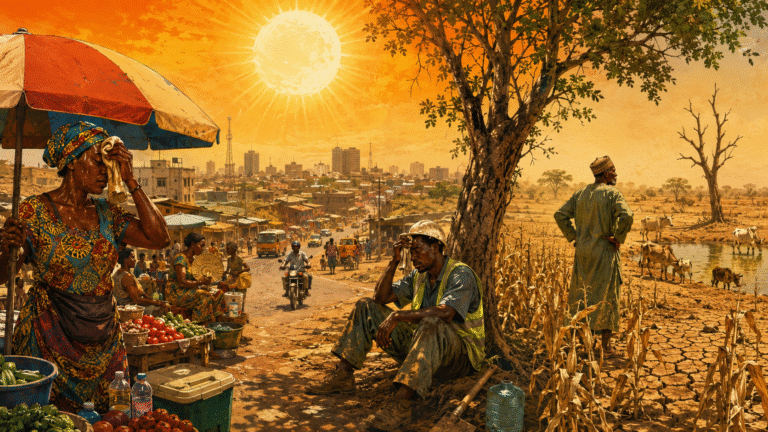
The problem is that, Pakistan’s climate communication is still very much elitist and urban. Government campaigns typically take place using English-language reports, televised statements or announcements on social media to urban audiences. The institutional involvement with rural populations in drought situations, crop instability and water scarcity is limited. If the communities most vulnerable to environmental stress are not engaged in the policy process, then a climate policy will not be successful. Communication failure is thus a governance failure because it is not important to have only technical planning documents but cooperation between citizens and institutions.
No doubt strong diplomacy at international level has compelled the world to look up to Pakistan for its climate solutions, but attention alone can’t build resilience. The real issue is that the climate communication within Pakistan is more about managing images than building institutional credibility. Ministries announce poorly coordinated policies, awareness campaigns exist for a time after crises, and sometimes international diplomacy are more competent than domestic governance. What this creates is a risky paradox, that is, Pakistan is becoming more aware of how to tell the world about its climate vulnerability, but still not very adept at telling its own people how to govern the climate. However, as this divide grows between the actual and the perceived, climate diplomacy may be increasingly being used to manipulate rather than to build resilience.


 Reston Dennis Juah
 Noor Ul Ain
 Hassan Barrie
 Hoby Nasandratra Andriamiandrisoa
Piece of writing writing is also a fun, if you be familiar with
afterward you can write or else it is difficult
to write.
When I initially commented I clicked the “Notify me when new comments are added”
checkbox and now each time a comment is added I get several
e-mails with the same comment. Is there any way you can remove people
from that service? Cheers!