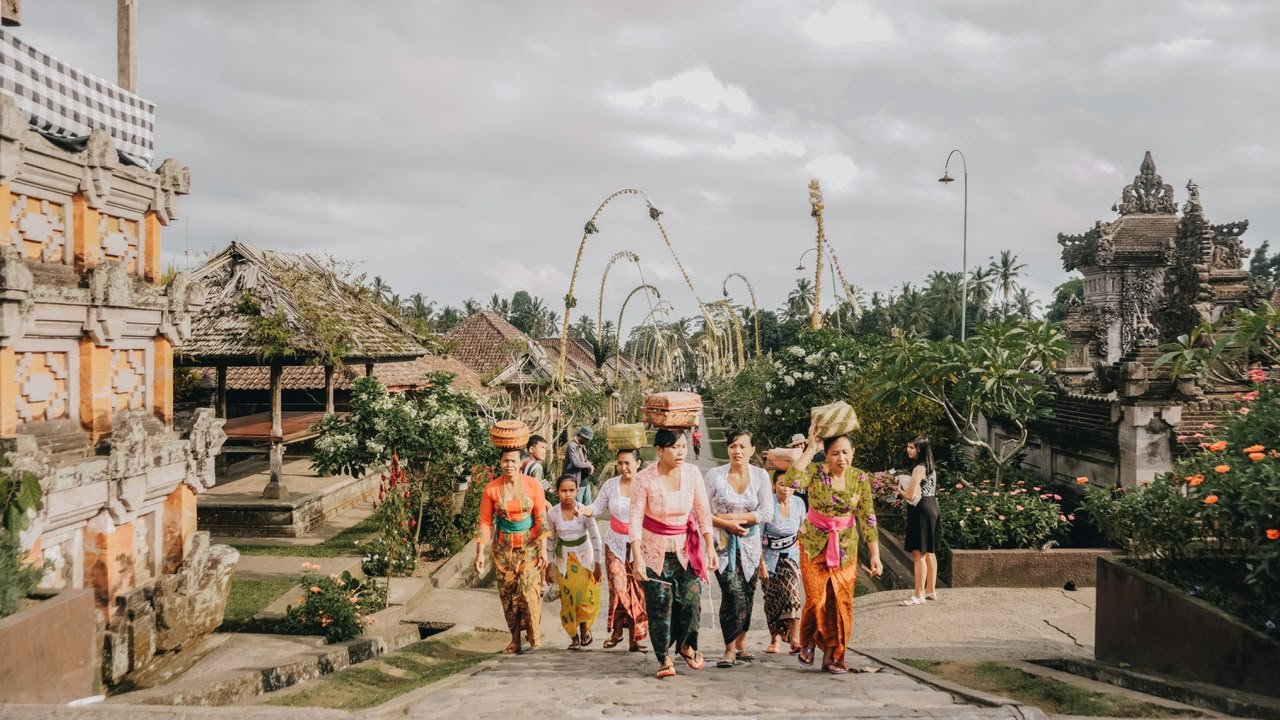

In Bali, environmental stewardship is a part of daily life. Island of Hindu community, woven into the cosmology itself and its priests, parades, and annual day of silence are proving it.
The local youth organization (Banjar Merta Jati) in Denpasar plan their ogoh-ogoh for the 2023 Nyepi celebration, they agreed on “no styrofoam allowed”. The tower-like effigy thing they would parade through the streets would be built from traditional sources as old newspapers, leafage, coconut palm, grains, and onion skin. The group called their creation Kali Citta Parlaya, and the materials they used were a brief statement that they care about environment. Yet to understand why a parade of demon-shaped sculptures might serve as a driver for environmental activism, you have to understand with the belief system that gives the island its soul.
Indonesia is home for around 4.7 million Hindus, the majority concentrated on the island of Bali. Unlike the mainland’s predominantly Islamic population, Bali’s majority of Hinduism shaped by Javanese, Buddhist, and animist that influence a tradition which preserved its ecological philosophy and rhythms within the daily life.
Three Main Pillars
The theological foundation for this environmental instinct sits in a concept called Tri Hita Karana, meaning “the three causes of well-being.” These three pillars are Parahyangan (harmony with God), Pawongan (harmony among people), and Palemahan (harmony with nature). The philosophy governs how villages are organized spatially, how rice farming is managed communally, and how sacred mountains, rivers, and coastlines are treated as living entities deserving of respect.
The most tangible expression of Palemahan in practice is the subak system a water management network in which Bali’s rice terraces are irrigated through a temple-based infrastructure. Farmers built water temples before each planting cycle, and the priests within those temples negotiate water flow across entire watersheds. The system is so effective, and so elegantly tied to spiritual obligation, that UNESCO inscribed it on the World Heritage List in 2012. A study founds that the Tri Hita Karana concept had been “adhered to in organizing the layout of landscape elements such as forest, temple, terraced paddy field, irrigation network, and settlement,” which has protected Bali’s agricultural landscapes from erosion and water scarcity across generations.
Alongside Tri Hita Karana, a related value cluster known as Catur Brata Penyepian governs the annual day of Nyepi through four prohibitions: no fire or electricity (amati geni), no work (amati karya), no entertainment (amati lelanguan), and no travel (amati lelungan). These are not suggestions. They are enforced by pecalang, village watchmen who patrol the streets on behalf of customary law. Even Ngurah Rai International Airport closes for 24 hours, the only airport in the world to shut down for a religious observance.
What the Faith See
For many Hindus, the environmental dimension of their faith is not a policy position. It is something closer to an inherited reflex. The Balinese belief that mountains are revered, oceans are sacred, and forests deserve protection is not an environmental argument in the modern sense. It is a cosmological position: destruction of nature is, in the most literal sense, destruction of the divine.
The Palemahan pillar of Tri Hita Karana teaches that people and nature exist in a symbiotic relationship, and by that Balinese people are “repaying the blessings given upon them by God” through their stewardship of the land. In theology, it manifests in the care given to rice fields, the protection of water springs, and the reverence shown to the banyan trees that shade village meeting halls. When a forest is cleared for a hotel, the Balinese do not merely see an environmental impact, they see a spiritual breach.
A research on the Bali Aga community, the oldest indigenous society in Bali, highlights how Tri Hita Karana and traditional ecological knowledge has been adopted into daily life. They had the best forest management such as awig-awig, a ratifying customary law which rules everyday aspects for indigenous community. For instance, Krama Tamia feedback regarding their rights and obligations to the Traditional Village Council at each level, with a copy addressed to the higher level.
When an Island Goes Silent
Nyepi is not just a religious holiday. It is arguably the world’s largest coordinated annual act of environmental restraint. In 2019, Bali’s electricity consumption fell from a daily average of 21,121 megawatt-hours to 13,427 MWh, a reduction of about 60%, equivalent to cutting costs by 4 billion Indonesian rupiah in a single day. The island’s greenhouse gas emissions on that day dropped by an estimated 5,462 tons of CO2.
The scale of the shutdown has caught the attention of environmental scientists. A research published using NASA’s Black Marble satellite product, found that total nighttime radiance on Bali falls by close to 100 percent on Nyepi. So, thorough is the shutdown that the Hindu holiday can be observed from space. The researchers noted that local greenhouse gas emissions decline by approximately 33 percent compared to typical days, a figure corroborated by earlier atmospheric measurements. A 2022 field study by Indonesia’s meteorological agency BMKG confirmed that concentrations of CO, NO2, and dust particles drop significantly during Nyepi, with PM2.5 levels falling by around 47 percent compared to the 2020–2022 average.
Another study found that underwater noise levels around the island’s coastline drop measurably during Nyepi, giving marine ecosystems a brief but genuine pause. Some environmental advocates have floated the idea of adopting similar collective silence practices elsewhere as a model for reducing urban carbon output. The concept has not taken hold outside Bali, which perhaps says as much about the difficulty of separating ritual from religion as it does about the limits of borrowing from another culture’s faith.
Between Demon Parades and Green Action
Back on the streets of Bali the night before Nyepi, the ogoh-ogoh movement illustrates how religious tradition can be turned into a vector for environmental change from within the community itself. Ogoh-ogoh are giant effigies, standing five meters tall, traditionally crafted from bamboo, clay, and paper, and paraded to cleanse the island of negative energy before the silence begins. In the decades after their popularization in the 1980s, styrofoam became a common shortcut for builders seeking lighter materials. The results, when thousands of effigies were burned or discarded after the parade, were predictably toxic.
In 2014, art activist Marmar Herayukti launched a public campaign calling for a return to natural materials. Five years of community advocacy later, the Balinese government made it official, styrofoam in ogoh-ogoh was banned in 2019. Today, youth groups across the island compete to build structures from jackfruit skin, eggshells, wood shavings, and dried botanicals. Some teams spend four months sourcing and assembling their materials. The competition has become a site of genuine eco-creativity, where the winner is as much about ingenuity as spectacle.
These shifts led broader government initiatives that draw on the same cultural authority. In 2018, Governor-issued regulation Pergub 97/2018 banned single-use plastic bags, straws, and styrofoam across the island. A stricter escalation came in April 2025, when Governor I Wayan Koster issued Circular Letter No. 9 of 2025, banning plastic bottles under 1 liter and mandating waste segregation across government offices, schools, businesses, and places of worship. The target is waste-free by 2027. In parallel, the Bali Net Zero Emission 2045 initiative, declared by the provincial government on August 4, 2023, commits the island to carbon neutrality within a generation. On the other side, there is a huge nonprofit organization as “Bye Bye Plastic Bags”, founded in 2013 by Balinese sisters Melati and Isabel Wijsen, became an internationally recognized model for youth-led environmental advocacy. Their campaign helped to pressure the government into the 2018 plastic regulation and drew global attention to a problem that is, in many ways, an island faith community’s environmental crisis. Reflecting that Bali currently generates an estimated 3,436 tonnes of waste per day, 40 percent of which is still burned or dumped illegally.
The challenge, as the primary landfill at Suwung struggles with capacity after four decades of operation, is the distance between philosophy and infrastructure. What we can learn from this is the theology is easy to understand. The priests have spoken and they carry legal weight. The cosmology places nature at the center of moral life. What remains harder to solve is the gap between a worldview that treats the ocean as sacred and a beach that receives 40 tonnes of plastic waste in a single week. Bali shows that religion can be a powerful tool of environmental motivation.
Keywords: Hinduism, green religion, environmental stewardship





 Reston Dennis Juah
 Noor Ul Ain

 Hassan Barrie
 Hoby Nasandratra Andriamiandrisoa
I love how easy it is to navigate through the different categories. It feels professional and secure. I will be sticking with idbatavia1 for a long time.