

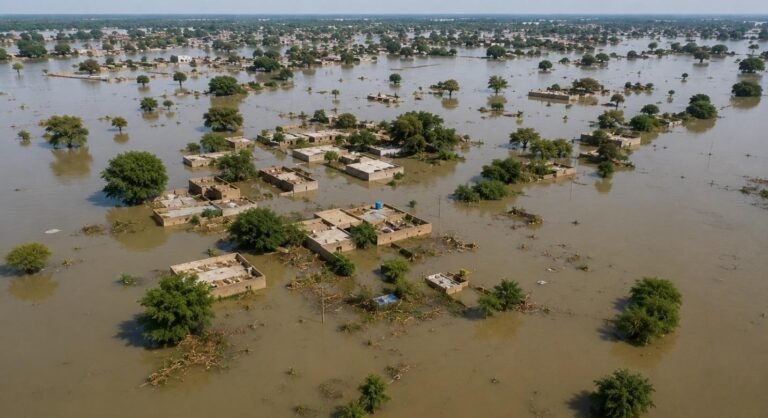
The paradox of Pakistan’s climate finance architecture lies in its simultaneous integration of innovative instruments like Green Sukuks and multilateral pledges, compared against an ineffective implementation chasm that threatens the credibility of its newly submitted Nationally Determined Contribution 3.0. NDC 3.0 submitted to the UNFCCC in September 2025, pledges a 50% unconditional reduction of business-as-usual emissions by 2030, and 75% with international assistance, accompanied by strong adaptation targets that are strengthened by the legacy of the 2022 floods: damages worth over 30 billion and displacement of 33 million. However, this gap of 348 billion in funding between NDC horizon highlights a structural dysfunction: domestic mobilization, though bold on paper, collapses due to fiscal vulnerability, and external inflows are intermittent and not consistent with long-term resiliency needs. As a researcher who has been deeply engaged in the Global South policy dynamics, this is not just negligence but a foregone conclusion of path-dependent fiscal conservatism that prioritizes debt servicing over the existential threats. The first Green Sukuk, which was issued in January 2026 and raised a Rs30 billion at a 9.5% yield, is oversubscribed threefold, and the first domestic climate debt securitization to be issued in Sharia-compliant form. Proponents herald it as a blueprint for scaling to Rs500 billion by 2030, channeling proceeds into flood-resilient infrastructure, solar irrigation in Punjab, and mangrove restoration along the Indus Delta. It is anchored in the Sustainable Financing Framework (2025) of the State Bank of Pakistan, which requires green project certification and impact reporting according to the ICMA principles, which is ostensibly risk-averse through sovereign guarantees. This is enhanced by multilaterals: The Climate Resilience Investment Facility by Asian Development Bank (350 million dollars, 2025) provides early warning systems in Sindh and Baluchistan, and the portfolio of the Green Climate Fund (304.5 million dollars, approved after COP29) funds coastal embankments. These inflows were cumulatively estimated to be 2.1 billion in 2025, which is an increase of 40% compared to 2024, according to the Climate Finance Tracker of UN Pakistan.
But behind this mask of development lie deep rifts which I think are based on a fundamental problem of misconception of finance as a technical fix for the problems that are, in fact challenges of political economy. To start with, the mobilization efficiency is low as the Rs30 billion of the Green Sukuk is a very small part (0.9) of the annual NDC finance requirement (40 billion/year), compared to the debt service burdens (60% of budget) and circular debt crises debilitating energy transitions. By examining the empirical data, there is an indication of over-investment in mitigation (solar auctions generating 1.2 GW in 2025) but adaptation remain underfunded such as glacial lake outburst floods (GLOFs) got less than half of Sukuk proceeds even though 2025’s heatwaves were anomalous and increased melting of glaciers. Moreover, multilateral financing are characterized by conditionality such as IMF-mandated fiscal tightening after 2023 bailout limits public investment, and ADB funds require procurement to foreign companies, which further promotes elite capture. The Climate Finance Strategy (2025) proposed by Pakistan projects an ambitious of a yearly leverage of 10 billion dollars of the privates through viability gap financing, but the FDI on renewables stagnated at 400 million in 2025 due to renegotiation of PPA and currency devaluation (PKR dropped 15 percent a year).
Using the policy sequencing lens, this paradox is reflected through a time misalignment: short-term financial necessities override long-run resilience, reversing the adaptation-mitigation balance required by the welfare-centric framing of NDC 3.0. As a climate policy researcher, I would assess the dependence on sovereign debt instruments such as Sukuks as innovative but increasing exposure to yield spikes in global markets; a 200bps raise in Federal Reserve rates would raise the servicing of climate bonds by 20 percent, crowding out climate bonds and revealing the naivety of the debt-based approach in low-credit sovereigns. I would argue this is not only risky but also completely unsuited to the profile of vulnerability of Pakistan where the irreversibility of adaptation requires grant-like facilities rather than yield-sensitive debt. More importantly, the lack of a sovereign derisking facility (e.g. in the model of India IIGCC) continues to create the missing middle in the private capital: blended finance pilots with IFC have raised 150 million dollars, but scaling requires explicit loss-sharing with multilaterals, which is a policy blind spot bordering negligence given the 0.85 vulnerability index in Pakistan. Similar is the case of Gilgit-Baltistan, where NDC integration of glacial surveillance is overridden by zero Sukuk appeals to high-altitude early warning systems, which highlights federal-provincial silos, as the Islamabad-based finance-focused prism fails to recognize periphery-specific hazards, an institutional failure I consider as indistinguishable to abandoning strategic national assets, squandering a frontline laboratory for high-altitude resilience.
The future depends on re-aligning incentives, but I remain strongly skeptical, based on decades of proved implementation inertia. First, make the Climate Finance Authority (2025 Act) a centralized aggregator, that 20% of Sukuk yields are restricted to be used in adaptation through provincial compacts, based on the example of the Green Fund in Bangladesh that derisked a billion dollars in bonds, but Pakistan has deep-rooted rent-seeking that can be easily subverted, which I have seen in similar renewable pilots. Second, incorporate economic damage functions into fiscal regulations: measure GLOF risks at 2-3% provincial level GDP loss under RCP6.0, requiring contingent reserves in national budgets. I believe that this is non-negotiable; without damage quantification, finance remains blind to true costs, perpetuating underinvestment. Third, negotiate forge Loss and Damage Finance Facility pacts at COP31 (2026), capitalizing on the vulnerability index of Pakistan (0.85/1.0) on grant-equity hybrids with a target of $5 billion to finance Indus Basin rehabilitation, negotiators will avoid short-termism, which has ruined V20 advocacy in the past (UNFCCC, 2025). In my understanding, these hinge on political will; absent a paradigm shift from fiscal fire-fighting to strategic foresight, such measures will remain aspirational, dooming NDC 3.0 to the graveyard of unmet pledges.
Finally, the path that Pakistan follows requires going beyond a finance paradox by institutional engineering: not mobilization, but sequencing that would prioritize the irreversibility of adaptation over the reversibility of mitigation. I believe that failure to do so will affirm my long-held belief that the architecture of climate delivery in Pakistan is designed to deliver optics, not results, and that floods will come before sukuks grow, a predictable tragedy of policy myopia. As Global South countries gather behind the V20 flag, Pakistan needs to be the forefront derisking compacts, making fiscal fragility into a shared leverage to fair transitions, otherwise it will lose leadership in its own made crisis. The test of the 2026 budget, which would be presented in June, is whether or not it passes; a failure here would prove the paradox as a structural fate and justify the cynicism of those who believe climate finance is neocolonial theater.
Keywords: Climate Finance, NDC 3.0, Adaptation-Mitigation, Institutional Fragmentation, Green Susuk, Implementation gap, Pakistan






 Reston Dennis Juah
 Noor Ul Ain

 Hassan Barrie
 Hoby Nasandratra Andriamiandrisoa
+ There are no comments
Add yours