
The Meme & The Moment
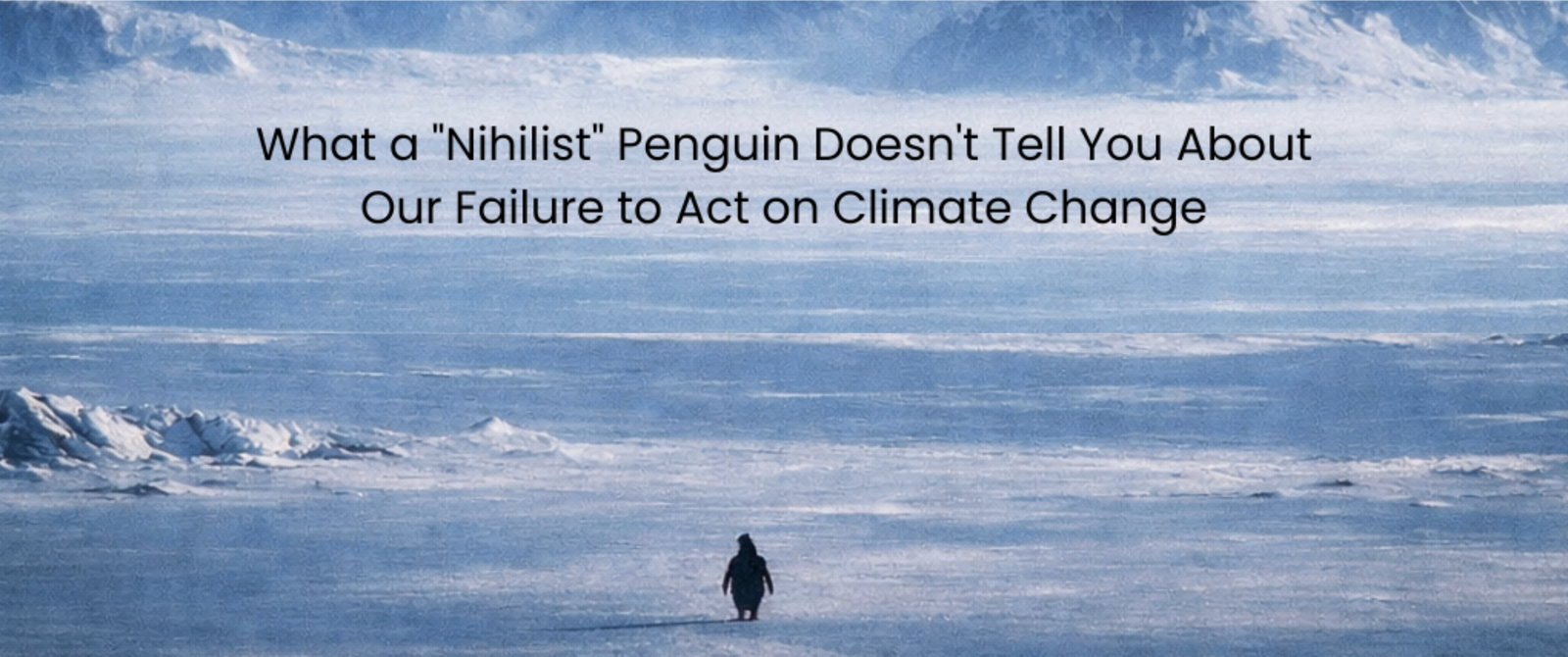
A few months ago, a viral clip captured widespread attention and emotion. It showed a lone penguin turning away from its colony, walking silently and deeper into the Antarctic continent as if marching toward its own death. The clip actually came from Werner Herzog’s 2007 documentary, the clip went viral in early 2026, recut into dramatic short videos and usually paired with a cover of Gigi D’Agostino’s Eurodance song “L’Amour Toujours”, the combination of sacred, religious tone and the image of a penguin walking away toward solitude and possibly its own death, creates a spectacle that feels deeply relatable to today’s era. In an era of overwork, exhaustion, and digital noise, the dramatic scene of the “nihilist” penguin mirrors feelings that many people saw in that penguin.
Herzog’s narration adds a dramatic touch:
“But he would not … he is heading towards the mountains. But why? … He will head towards the interior of the vast continent, with 5,000 kilometers ahead of him, and he’s heading towards certain death.”
Wildlife experts urge viewers not to over-romanticize the moment, arguing that penguins do sometimes stray from their colonies due to disorientation, changing ice conditions, or environmental disturbances. In some cases, this behavior may indicate stress caused by climate change or habitat disruption. But that explanation raises several questions: First, to what extent can the environment influence their behavior? Will changing ice conditions and climate disruption drive more penguins toward disorientation?; Second, how can a penguin “inspire” millions of people around the world through a single video clip?; Third, What efforts have international governments made to address the problem of climate change as a “shared problem”?
The Science Behind the Penguin
Based on the scientific fact: for thousands of years, emperor penguins molted on coastal sea ice until late summer, a few weeks of vulnerability before returning to the ocean. But as Antarctic sea ice shrinks and melts earlier each season, the penguin behaviour changes over time. According to British Antarctic Survey geographer Peter Fretwell, the condition forced these already-weakened birds to abandon millennia-long habits, leading to premature mortality on the ice. The scale of the change is striking. Before 2022, more than 100 penguin groups had been identified in the Marie Byrd Land region. By 2025, only 25 small groups remained visible in satellite image, despite more favorable sea ice conditions. Based on the explanation, climate change is not only altering penguin behavior and causing disorientation, but it is also pushing the species toward extinction. According to the IUCN Red List of Threatened Species, emperor penguins are endangered, and their population is projected to halve by the 2080s.
This reminds me of the wildlife expert’s point about not over-romanticizing the nihilist penguin. I largely agree, but only up to a point. If “not over-romanticizing” means removing the “emotional touch” that makes people feel “related”, then I disagree. Again, we need to remember that climate change is done, scientifically. What remains unsolved is how to communicate it in a way that actually connects with many people. Public policy on climate has been slow precisely because the issue still feels distant and abstract to many, due to lack of public pressure and even less urgency. However, back to the “nihilist” penguin, just imagine how can a clip of a separated penguin can “inspire” millions of people, meaning that the opportunity to communicate the urgency of climate change effectively is still opened, although there is a risk of misperception, so we need to concern about willingness to use it responsibly, with both scientific honesty and human feeling. This is what Fearns makes a point, where her argument is simple but easy to overlook: people do not respond to climate change not because they do not care, but because they rarely feel it. The impacts are slow, incremental, and almost never visible in daily life that make it a reasonable one. If we want more people to actually change their behavior, we need to make the crisis feel closer. More immediate, and personal, that means going beyond data and reports, into something that actually touches people where they live.
The Reality: Shared Problem Means No Problem
Climate change is everyone’s problem, as long as you live in earth, you will feel the consequence, and ideally, that shared fate would translate into shared problem and carry the same sense of urgency. But this is exactly where things start to fall apart. The term of “shared problem” is dangerously broad. It diffuses ownership and dissolves specific responsibility, with 195 sovereign nations, each with its own political interests and domestic priorities, where not all countries have felt the impacts of climate change equally, and not all of them are willing to take responsibility for a crisis they argue, sometimes not without reason, that they did not cause.
This is what Putnam concerns through the two-level game theory that explains why international climate negotiations so often produce agreements that look ambitious on paper and go nowhere in practice. At the domestic level, governments are pulled in every direction by interest groups, industries, and voters who have very immediate concerns, such as jobs, prices, energy costs. Meanwhile, at the international level, national governments seek to advance their interests by meeting domestic pressures while minimizing the negative consequences of developments abroad. Based on that, Shorr and Pearl make this tension very clear: international climate agreements tend to substitute for action rather than drive it, where countries show up, sign the document, and go home, while have great difficulty, or even refuse to implement domestically, where the domestic political costs are real and direct.
So what now? A Reflection
Based on this story, the nihilist penguin did not choose to walk away, but it was disoriented and pushed by a world that changed faster than it could adapt. And for me, is the real story behind the meme, where a species is losing its “home” in a habitat that is gradually disappearing due to climate change. This aligns with what Amitav Ghosh, in The Nutmeg’s Curse talks about, where the natural world has always been sending signals to warn us about the earth’s condition, through ecological disruption, species loss, and environmental collapse, but most of us are incapable of hearing them.
The science is “done” and the frameworks already exist, but what we are missing is the political will to make the gap closer between what we know and what we should do. Better climate communication is part of the answer, using emotional channels like the nihilist penguin not just for engagement, but for accountability, and stronger domestic pressure is another, because as Putnam and Shorr and Pearl both remind us, international agreements only hold when the people at home actually demand that they do.
Key words: Climate Change, Emperor (Nihilist) Penguins, Climate Communication, Environmental Politics, Two-Level Game Theory






 Reston Dennis Juah
 Noor Ul Ain
 Hassan Barrie
 Hoby Nasandratra Andriamiandrisoa
Hãy cùng 66B khám phá thế giới cá cược chuyên nghiệp, nơi mỗi kèo cược đều được thẩm định bởi các chuyên gia hàng đầu. Chúng tôi cung cấp những thông tin phân tích chuẩn xác, giúp quý khách nâng cao tỷ lệ thắng trong từng quyết định xuống tiền. TONY07-03