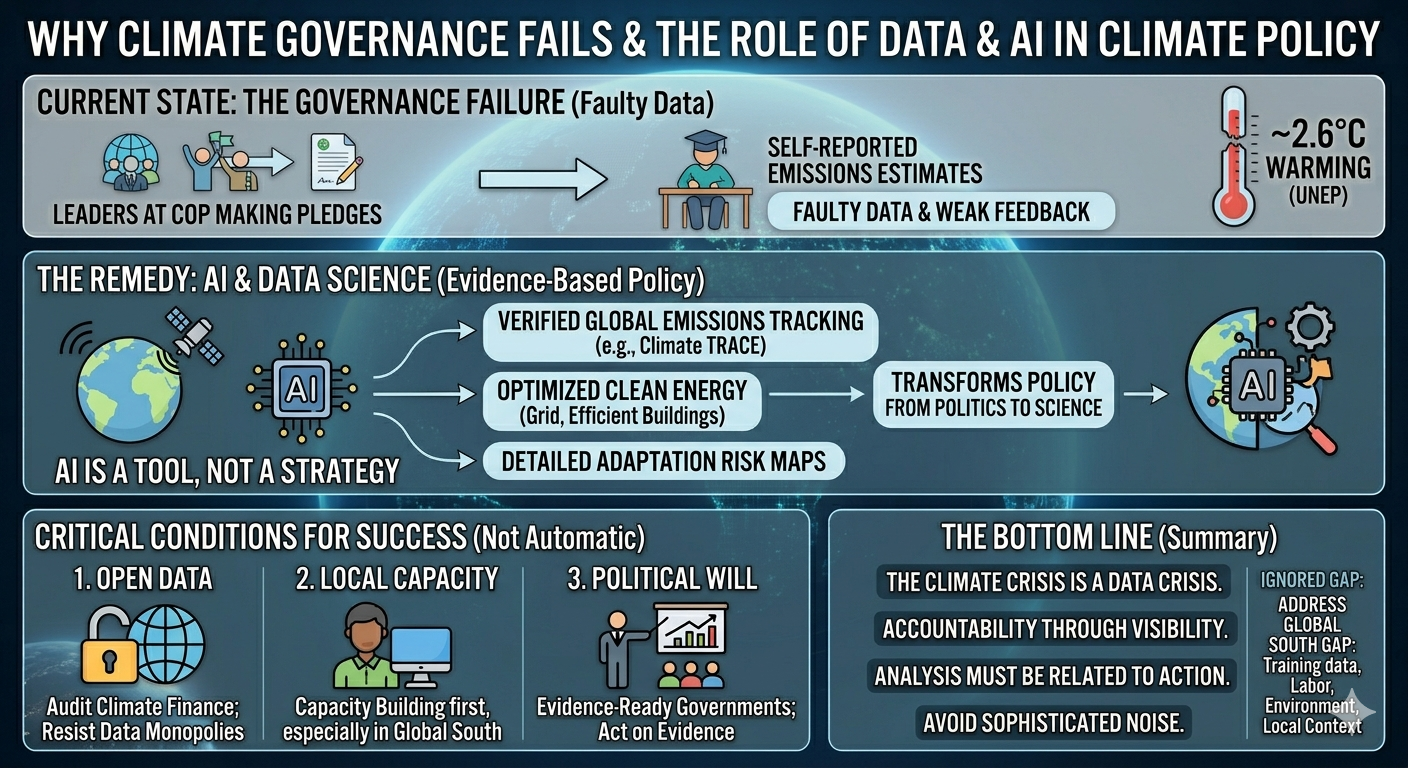

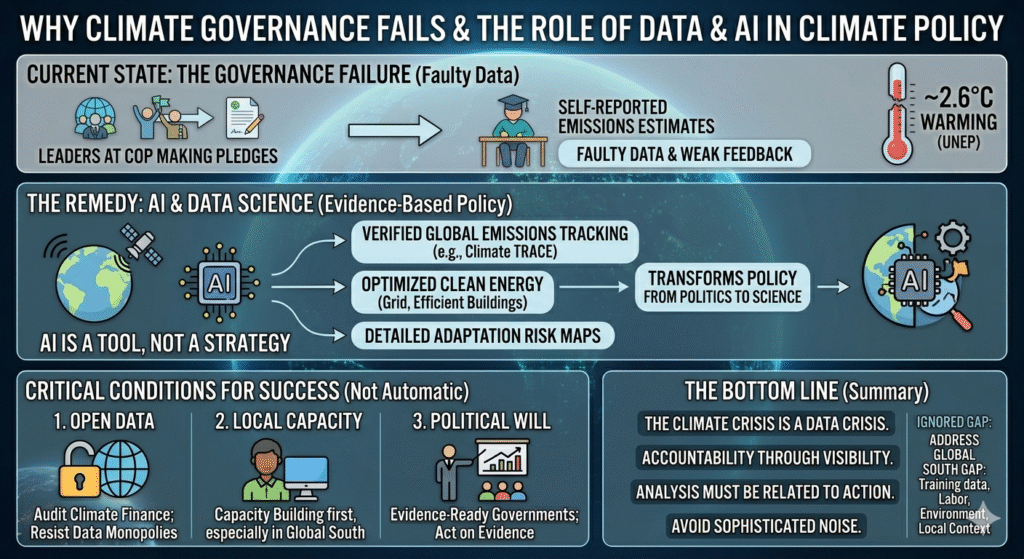
Summary of the Entire Image:
Every year, leaders across the globe gather at COP summits, sign agreements, and make lofty net-zero commitments, with emissions continuing to rise every year. Not that they do not care about climate change. The issue is that climate Policies are created from faulty data, slow analysis and weak feedback loops. AI and data science can remedy these issues, provided that we tell the truth about what they can and what they cannot do.
Climate data can be found everywhere: imagery of the Earth from satellites, sensors of the atmosphere, ocean temperatures spanning decades, deforestation trackers and emission databases dating back many years. The information comes late, is stored in silos and is not commonly used by the decision-makers. When it does, it is generally condensed into an unusable form. Sadly, most countries continue to give self-reported estimates of national emissions, which is pretty much like students marking their own exams. According to the 2024 UNEP Emissions Gap Report, national commitments (NDCs) currently in place would lead to about 2.6°C of warming above pre-industrial levels. That’s not essentially due to a lack of ambition. It’s a lack of measurement, accountability and weak feedback.
What the Research Shows
Rolnick et al. (2022) outline specific applications where machine learning can help lower emissions or aid with adaptation: optimising the electricity grid, building energy efficiency, precision agriculture, transport logistics, and enhanced climate modelling. Most critically, the authors make it clear that machine learning is a tool and not a strategy. Its usefulness is completely reliant on connecting to decisions that governments and institutions have to make. Another study in Nature Communications by Vinuesa et al. (2020) also found that AI could potentially support 134 of the 169 UN SDG Targets, which includes SDG 13 on Climate Action. However, the same study discovered that AI can also suppress 59 targets by consuming energy, inequality of data, and algorithmic bias. As a result, the question of how to control AI is as important as what it could do. They are already transforming the making of clean energy policy in practice, as Fronzetti Colladon et al. (2024) in Energy Policy demonstrate, allowing policymakers to create subsidies and regulatory approaches to clean energy, and then measure their impact on, for example, electricity consumption. That is what makes policy a science, rather than politics.
The Gap that exists, which is ignored
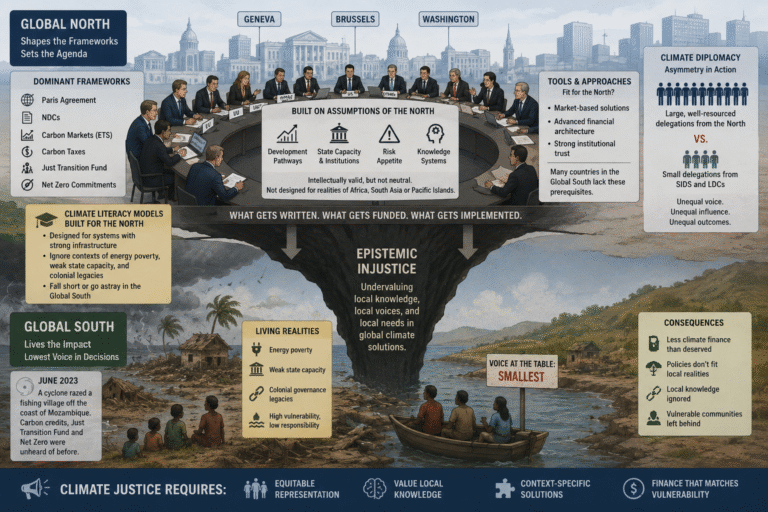
The AI-and-climate literature is dominated by research in Asia and on a global scale, with a 2025 systematic review in Frontiers in Climate analysing 385 peer-reviewed studies revealing such findings. However, the most climate-risk-exposed regions of the world, Africa and South America, are underrepresented in research and AI deployment (Ayadi et al., 2025). So as of 2024, only half of all countries in the world have access to multi-hazard early warning systems, and the coverage is even less in the least developed countries. It’s not a technical problem, but the failure of governance. The most vulnerable communities are the ones least equipped with data infrastructure and early-warning capacity.
In a 2025 paper in Climate Policy, they explore some of these potential uses of AI in the Global South such as precision agriculture in India, a flood warning system in Kenya, early warning for droughts in the Sahel and outline four structural risks: training data that does not reflect Southern realities, labour exploitation in AI supply chains, the environmental impact of AI infrastructure, and solutions that do not consider local institutional contexts. A model developed for a European flood prediction would not be suitable in the Niger Delta.
Areas where AI is already working
Climate TRACE is a group that includes Google and research institutions, and uses machine learning to analyse data from more than 300 satellites and 11,100 sensors to generate near real-time emissions estimates from more than 352 million individual sources around the world. These estimates are not based on national reporting. The near future ESA CO₂M satellite mission (2025-2026) takes this further. If the Paris Agreement is to work, there has to be trust in the data provided by countries. With AI-powered satellite monitoring, that trust is not only assumed, but verified; Development banks and climate funds decide in the face of immense uncertainty regarding where they will invest in adaptation. Climate models coupled with satellite land use and socioeconomic vulnerability indicators can generate detailed risk maps that help guide more precise allocation of finance; In high-income countries, machine learning models that predict short-term patterns of renewable energy output and demand are now commonplace. The opportunity to now leverage this capability to countries developing new electricity infrastructure from scratch is one of the most impactful policy opportunities for the clean energy transition.
These conditions must be met: This does not work automatically.
- Open Data is a political necessity. When using AI models with proprietary data, the insights generated are privately owned. Any policy decision that comes out of a data system dominated by a few companies or rich nations will be in their interest. By 2030, developing countries will require $2.4 trillion per year in climate finance, according to the IMF. To hold that finance to account, there needs to be open and transparent data systems that can be audited independently.
- Without analytical capacity, there will be no decisions. The model for climate risk mapping has been developed in a research laboratory in Europe and could be technically correct, but local planners might not have the tools, training, or institutional capacity to implement it. Capacity building is not an afterthought to deployment of AI; it must be a prerequisite to deployment.
- Political systems need to be evidence-ready. Governments are known for ordering research to validate what they want to do regardless, and they ignore research that doesn’t support the conclusion they want. That’s not something that can be solved by better data or better models. The problem of making evidence matter in policymaking is a political, not a technical, issue.
The Bottom Line
The climate crisis is as much a data crisis as it is a politics or economic one. AI and data science can’t provoke the political will to act, the institutions to ensure commitments are fulfilled, or the finance to support vulnerable countries. What they can do is render evidence clearer, make accountability more difficult to escape, and bring more visibility to the people who must address the gap between what they say and what they do. According to Reichstein et al. (2025) in Nature Communications, AI-driven early-warning systems are possible which are based on the principles of Fairness, Accountability, Transparency, Ethics and Sustainability and can detect compound climate risks before they become reality. However, an evacuation model that communities don’t trust will not yield life-saving evacuations. The analysis must be related to action. Additions to the list of announcements are not necessary for climate governance. It requires the infrastructure to have an idea of what is actually happening, the tools to analyse and understand it quickly, and the institutional willingness to do what the evidence dictates.
All the rest, no matter how technically advanced, is very sophisticated noise.
Keywords: Climate Policy, Data Transparency, Artificial Intelligence, Accountability, Evidence-Based Policy
References:
Fronzetti Colladon, A., Pisello, A. L., & Cabeza, L. F. (2024). Boosting the clean energy transition through data science. Energy Policy, 193, 114304. https://doi.org/10.1016/j.enpol.2024.114304
Mathur, V., & Chamuah, A. (2026). Navigating AI and climate change in an unequal world. Climate Policy, 26(3), 502–508. https://doi.org/10.1080/14693062.2025.2503373
Reichstein, M., et al. (2025). Early warning of complex climate risk with integrated artificial intelligence. Nature Communications. https://www.ncbi.nlm.nih.gov/pmc/articles/PMC11910612/
Rolnick, D., Donti, P. L., Kaack, L. H., Kochanski, K., Lacoste, A., Sankaran, K., Ross, A. S., Milojevic-Dupont, N., Jaques, N., Waldman-Brown, A., Luccioni, A., Maharaj, T., Sherwin, E. D., Mukkavilli, S. K., Kording, K. P., Gomes, C., Ng, A. Y., Hassabis, D., Platt, J. C., … Bengio, Y. (2022).
Tackling climate change with machine learning. ACM Computing Surveys, 55(2). https://arxiv.org/abs/1906.05433
Shahid, M., & Khan, M. (2025). Navigating AI and climate change in an unequal world. Climate Policy. https://www.tandfonline.com/doi/full/10.1080/14693062.2025.2503373
United Nations Environment Programme. (2024). Emissions gap report 2024. UNEP. https://www.unep.org/resources/emissions-gap-report-2024
Vinuesa, R., Azizpour, H., Leite, I., Balaam, M., Dignum, V., Domisch, S., Felländer, A., Langhans, S. D., Tegmark, M., & Nerini, F. F. (2020). The role of artificial intelligence in achieving the Sustainable Development Goals. Nature Communications, 11, 233. https://www.nature.com/articles/s41467-019-14108-y
West, P., et al. (2024). Machine learning for climate policy: Understanding policy progression in the European Green Deal. University of Bristol. https://arxiv.org/pdf/2510.16233
Zhang, Y., et al. (2025). Enhancing system resilience to climate change through artificial intelligence. Frontiers in Climate. https://www.frontiersin.org/journals/climate/articles/10.3389/fclim.2025.1585331/full


 Reston Dennis Juah
 Noor Ul Ain

 Hassan Barrie
 Hoby Nasandratra Andriamiandrisoa
I’ve been playing here for a few weeks now and the payouts are surprisingly fast. Definitely one of the smoother experiences I’ve had lately. Check out may888bet for a great time.