

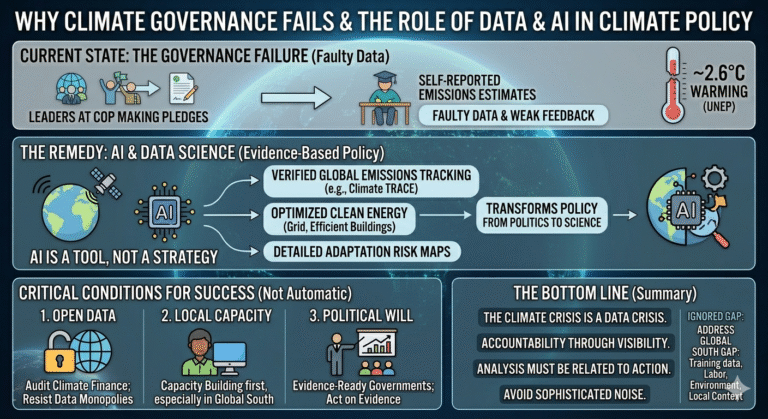
Over the last 30 years, climate policy has been based on some assumptions. Policymakers set targets using incomplete emissions data, limited projections and a healthy dose of diplomatic optimism. The rationale was that if they were not precise, they could become so through ambition. It rarely did. With the SDGs and the pledges under the Paris Agreement approaching urgency in 2030, the room for ‘soft targets’ and strategies that don’t align is rapidly disappearing. It is not a new round of talks, but a more subtle and technical shift as if machine learning (ML) and artificial intelligence (AI) were being woven into the fabric of climate policymaking itself.
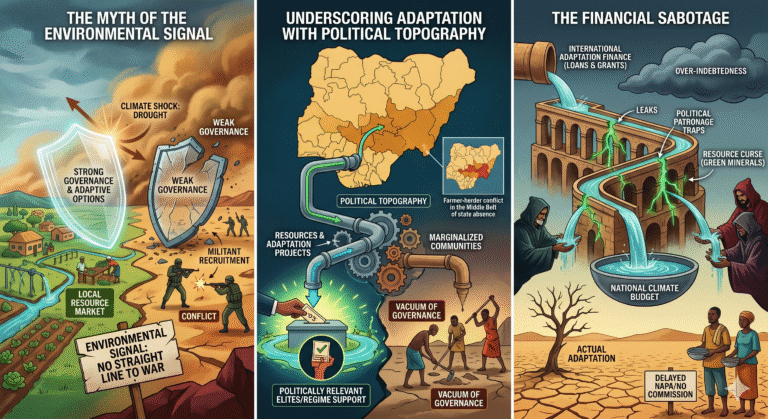
Not a primary tale of carbon tracking apps or satellite monitoring systems, but they are important. It’s about something fundamental: AI tools are revealing the institutional conditions that condition the effectiveness of any climate policy, regardless of its design. The results of this stream of research are hardly reassuring for those who thought that some magic formula of economic incentives and national commitments would suffice. They argue rather that the quality of governance the strength and integrity of a country’s institutions; is the most important factor in determining the success of a policy on climate change and that there would be no point in being technologically advanced on mitigation schemes if the institutions are weak and corrupt.
Institutions as the Real Variable.
Fig. 1: Showing different institutions’ dependence on AI-driven decision-making
The most explicit expression of this is in von Dulong and Hagen (2025), who used machine learning to analyse decades-long cross-national climate policy stringency data. They consistently conclude that institutional factors such as the rule of law, control of corruption and regulatory quality are more predictive than GDP or current emission levels. In general, a well-governed poor country is not more likely to yield to strong climate policy than a poorly-governed middle-income country. Although the money is important, the institutions are more important.
This is not a new debate in political science, but it is a new form of evidence in that the precision of the ability of machine learning to quantify these relationships now changes how the evidence lands. The previous studies were based on regression analysis involving only a few variables and significant uncertainties. The advantages of ML-based analysis, as described in von Dulong and Hagen (2025), are that it can process far larger datasets, detect non-linear interactions between variables, and surface predictors that a human analyst may not be able to. The outcome is a far less favourable view of how high-income countries are doing on climate policy than the common view held.
The take-home message is that the emphasis of climate finance and international technical assistance on clean technologies could be systematically failing to finance the institutional prerequisites for policy implementation. In their detailed machine learning review for climate action, Rolnick et al. (2022) suggest that “data-based tools” can uncover precisely these structural gaps to give decision makers a clearer idea about where interventions will have the most leverage. The same is true for governance, where institutions forecast better outcomes than wealth; building institutions is a form of climate action.
The Alignment Gap and What AI Reveals About It
Fig. 2. How AI and ML help in predictive measures and smart climate solutions
One of the related problems involves climate commitments and development objectives. As part of the Paris Agreement, countries make emission reduction and adaptation commitments, called Nationally Determined Contributions (NDCs). As an independent group, they compile Voluntary National Reviews (VNRs) as part of the SDG process. In theory, these should dovetail (to fit together exactly): climate action (CAs) and sustainable development reinforce one another in several places: for example, in the SDG 7, access to clean energy, the SDG 1, end poverty, and the SDG 10, reduce inequalities.
They often don’t in practice, though. The NDCs and VNRs of 67 countries were analysed by Cho and Ackom (2025) through Natural Language Processing (NLP) and ML classifiers. While integrated policy is a rhetorical goal in high-income countries, they found that such thematic coherence is not always as apparent as in middle- and low-income countries in their climate and sustainability policy. This is an unexpected discovery, and more attention should be given to this. The more capable countries in terms of resources tend to make less coherent policy, as evidenced by the lack of coherence between climate and development forums on average.
The story for lower-income, higher-emission countries is not as simple. Cho and Ackom (2025) noted that these countries tend to have low ambition in terms of their NDC and that their VNRs contain a significant amount of thematic overlap with climate themes, indicating the technical alignment in content but limited ambition due to other considerations such as financing, capacity, and political economy. It is not about solving the alignment problem, but making it legible to AI. It provides us with information on where the gap is and how our NDC can be related to SDG clusters and where co-benefits are being lost. Similarly, Adegbite et al. (2024) point out in a review of the application of AI in emissions reduction that predictive models can reveal synergies between emissions reduction and development outcomes that are not captured by iterative policy analysis by sector.
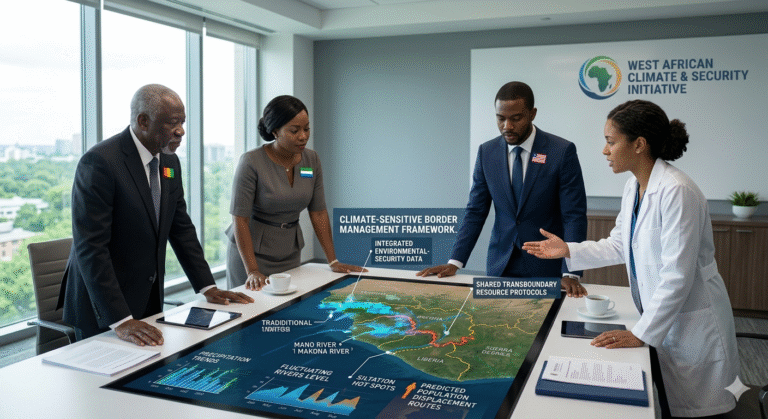
This is important for nations such as those in Sub-Saharan Africa, where climate policy cannot be enacted without considering access to energy, agricultural productivity, and economic diversification. Agan et al. (2025) investigated ML-based carbon neutrality models for Sub-Saharan countries and identified the complex interdependencies between the factors that shape emissions pathways in Sub-Saharan countries, exactly those that linear policy models struggle with, but machine learning excels. Likewise, the use of ML-based models was shown to have a significant advantage over traditional models in predicting the adoption of renewable energy in developing countries, partly due to its ability to determine the interactions between the various economic, social and infrastructural factors that vary greatly from country to country.
Equitable Governance and the Shift from Reaction to Prediction
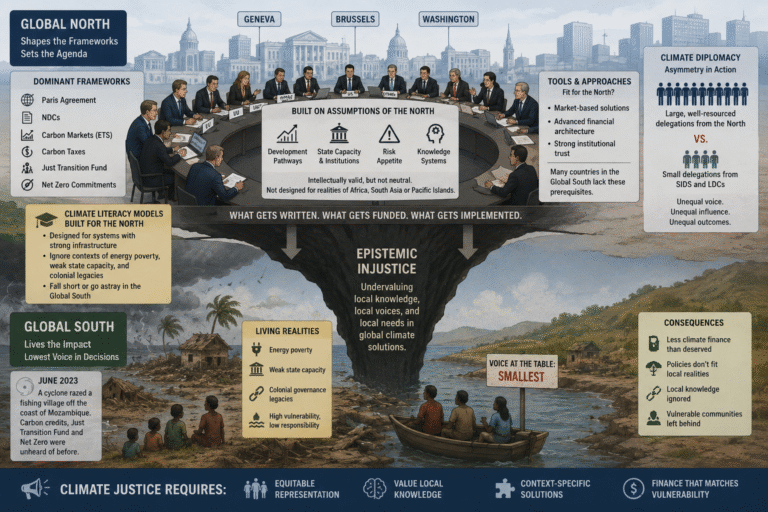
There is a third dimension to this story and it has nothing to do with the policy, but rather who pays the price for the policy being wrong. The impacts of climate change are not equitably shared. Those who are least responsible for emissions that cause them vulnerable populations, such as the rural, smallholder farmers, and sea-level rise-affected coastal populations in low-income countries, suffer the greatest losses from extreme weather, disrupted agriculture and sea-level rise.
This is typically dealt with by ex-post redistribution, in the form of disaster relief, reconstruction funding, and humanitarian aid. However, as argued by Ukoba et al. (2025), it is possible to adopt a different approach by leveraging AI-powered predictive modelling. Governments can create models of the spatial effects of certain policy choices with a high degree of spatial and temporal detail, thus enabling them to identify where and when certain populations will be most impacted by certain climate scenarios before they actually occur. S. language (statistical programming language) used by Ukoba et al. (2025) is “equitable governance,” or governance that “predicts harm and incorporates it into policy design rather than responding to harm when it occurs. This isn’t just a minor upgrade to operations; it’s a shift in theory on how policy should operate.
A similar version of this argument is put into practice by Gawusu et al. (2024) in the context of energy poverty. They then demonstrate that socioeconomic drivers of energy poverty, income, electricity grid stability, access and availability to credit, land tenure, and household structure can be modeled with adequate accuracy to guide targeted policy interventions at the subnational level using ML ensemble models. The granularity of this is just what is needed in countries where the energy poor are not a homogeneous group and where national level averages hide vast differences. Barrie et al. (2024) apply this to renewable energy integration, showing how ML models can help integrate renewables into local grids in developing economies, taking into account local conditions, demand, and economic considerations not captured by generic technology roadmaps.
The agricultural part of climate vulnerability is also significant and Mupangwa et al. (2020) provide a tangible example of how predictive modelling can help with this. When comparing the accuracy of maize yield prediction in the context of conservation agriculture in Eastern and Southern Africa, ML algorithms were more accurate than simpler agronomic models by producing more accurate yield predictions, which would help farmers and agricultural policy makers to better calibrate their expectations of yield given a range of weather and management conditions. When scaled up, this type of prediction becomes the backbone of climate-resilient food systems information to drive action.
Implications for how we discuss climate policy.
The body of research thus indicates a strong shift in the focus of climate policy design and assessment. The current framework, in which a target is set, a pledge is made, and emissions are monitored, is an essential but not adequate basis. What machine learning is revealing is the layer below the framework: the institutional context in which policy is implemented, the integration and congruence of various policy commitments, and the distributional impacts of various choices of interventions.
None of this is easy or simple in the realm of climate politics. The clean-up of the institutions is more difficult than the installation of solar panels and has a longer time horizon. Political will and administration are needed to align NDC and SDG processes, and many countries are lacking in these capacities today. Predictive governance is dependent on a data infrastructure that is not widely found in the Global South. These are not factors that can be avoided, and AI tools cannot remove them.
These tools help to enhance the questions being asked. Instead of asking if a country has a climate target, they ask if the institutional conditions are present that allow a country to reach that target. Instead of questioning the ambition of NDCs, they question their coherence with the development pledges being made in parallel. Instead of simply responding to the effects of climate change, they ask who is most vulnerable and what can be done to decrease the vulnerability of those who are most vulnerable before the damage.
The institutional mechanism of climate policy exists, and has always existed. Thanks to machine learning, it’s visible enough to work on.
Keywords: Climate Policy, Climate Diplomacy, Artificial Intelligence (AI), Machine Learning (ML), Nationally Determined Contributions (NDCs).
References:
Adegbite, A. O., Barrie, I., Osholake, S. F., Alesinloye, T., & Bello, A. B. (2024). Artificial Intelligence in climate change mitigation: A review of predictive modeling and data-driven solutions for reducing greenhouse gas emissions. World Journal of Advanced Research and Reviews, 24(01), 408–414.
Agan, B., Celik, S., Damak, O. I., & Miba’am, B. (2025). Evaluating the machine learning-based models for predicting carbon neutrality in Sub-Saharan African Nations. Environment, Development and Sustainability. https://doi.org/10.1007/s10668-025-06289-y
Barrie, I., Agupugo, C. P., Iguare, H. O., & Folarin, A. (2024). Leveraging machine learning to optimize renewable energy integration in developing economies. Global Journal of Engineering and Technology Advances, 20(03), 170–182. https://doi.org/10.30574/gjeta.2024.20.3.0170
Cho, H., & Ackom, E. (2025). Artificial Intelligence (AI)-driven approach to climate action and sustainable development. Nature Communications, 16(1), 1–13. https://doi.org/10.1038/s41467-024-53956-1
Gawusu, S., Jamatutu, S. A., & Ahmed, A. (2024). Predictive modeling of energy poverty with machine learning ensembles: Strategic insights from socioeconomic determinants for effective policy implementation. International Journal of Energy Research, 2024, 1–18.
Mupangwa, W., Chipindu, L., Nyagumbo, I., Mkuhlani, S., & Sisito, G. (2020). Evaluating machine learning algorithms for predicting maize yield under conservation agriculture in Eastern and Southern Africa. SN Applied Sciences, 2(5), 952. https://doi.org/10.1007/s42452-020-2711-6
Rolnick, D., Donti, P. L., Kaack, L. H., Kochanski, K., Lacoste, A., Sankaran, K., Ross, A. S., Milojevic-Dupont, N., Jaques, N., Waldman-Brown, A., Luccioni, A. S., Maharaj, T., Sherwin, E. D., Mukkavilli, S. K., Kording, K. P., Gomes, C. P., Ng, A. Y., Hassabis, D., Platt, J. C., Creutzig, F., Chayes, J., & Bengio, Y. (2022). Tackling climate change with machine learning. ACM Computing Surveys, 55(2), Article 42. https://doi.org/10.1145/3485128
Ukoba, K., Onisuru, O. R., Jen, T. C., Madyira, D. M., & Olatunji, K. O. (2025). Predictive modeling of climate change impacts using Artificial Intelligence: A review for equitable governance and sustainable outcome. Environmental Science and Pollution Research, 32, 10705–10724. https://doi.org/10.1007/s11356-025-36356-w
von Dulong, A., & Hagen, A. (2025). Institutions make a difference: Assessing the predictors of climate policy stringency using machine learning. Environmental Research Letters, 20(1), 014056. https://doi.org/10.1088/1748-9326/ada0cb


 Reston Dennis Juah
 Noor Ul Ain

 Hassan Barrie
 Hoby Nasandratra Andriamiandrisoa
Really impressed with the bonuses they offer for new players. It gives you a great head start to explore the platform. Visit vn23vin for the best deals.