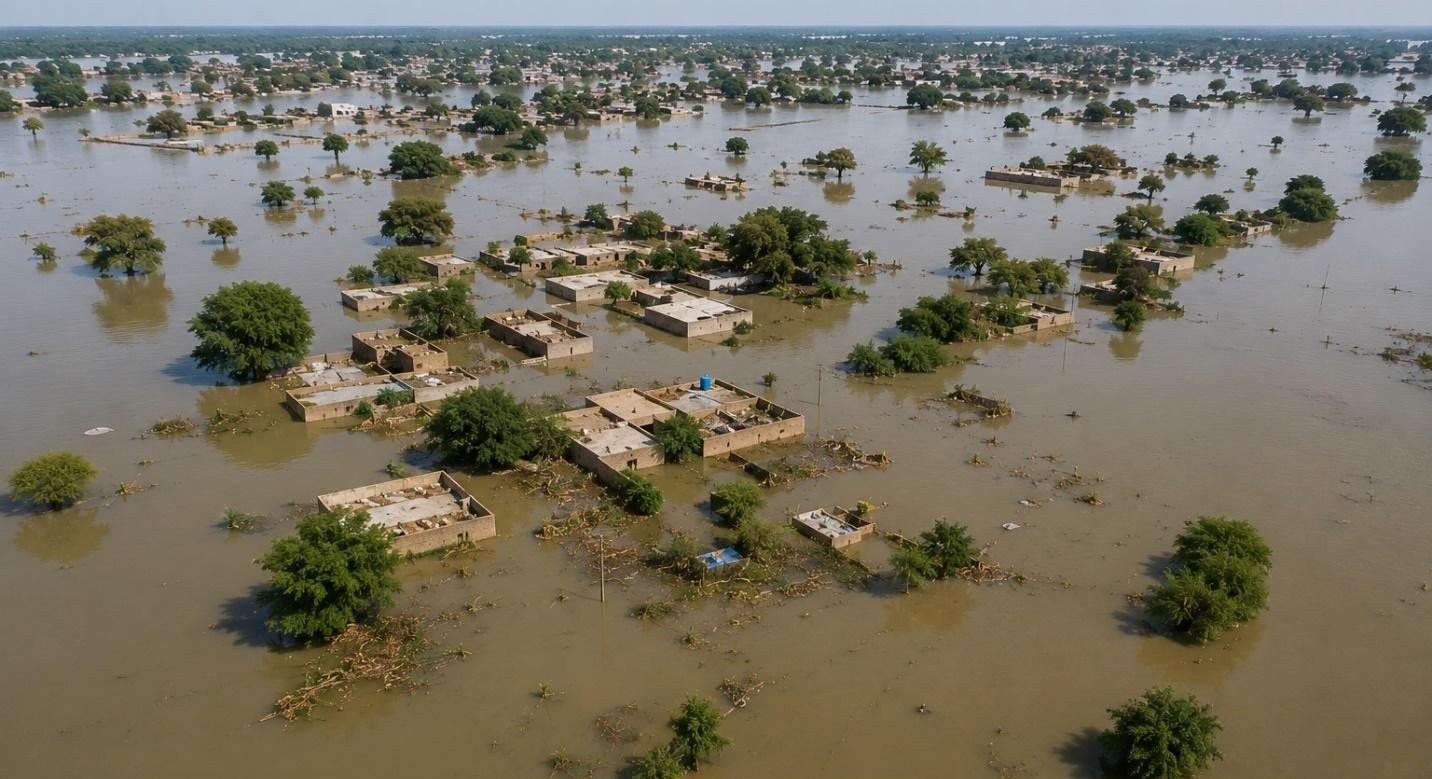

In 2022, almost a third of the country was flooded due to devastating monsoon floods which forced millions of people to flee their homes and incurred economic losses of over $30 billion (United Nations Development Program. In 2022, almost a third of the country was flooded due to devastating monsoon floods, which forced millions of people to flee their homes and incurred economic losses of over $30 billion (United Nations Development Program [UNDP], 2022). But, within a few months, water shortages were again experienced in several areas. This paradox is the truth of Pakistan’s climate crisis: no longer is the nation faced with floods or droughts alone. Climate change is jeopardizing the political and ecological framework of water access, distribution, and control. The threat is not just environmental degradation, but that water scarcity, climate stress, and poor governance could intensify internal disruptions and regional tensions. This is increasingly transforming the climate crisis into a political and security threat for Pakistan.
Climate diplomacy is frequently formed in the process of policy-making, which is influenced by policy communities, a group of governments, NGOs, international organizations, researchers, and private actors. These communities are vital because governments alone cannot solve climate problems. Governance of water in Pakistan is a multi-actor process where competing actors have different priorities: Provincial governments argue over river sharing, international organizations invest in adaptation projects, local NGOs push for climate justice, and agricultural elites oppose reforms that could compromise their economic status (World Bank, 2021). The political struggle for resources in climate policy is then complemented by a struggle over political influence and institutional power.
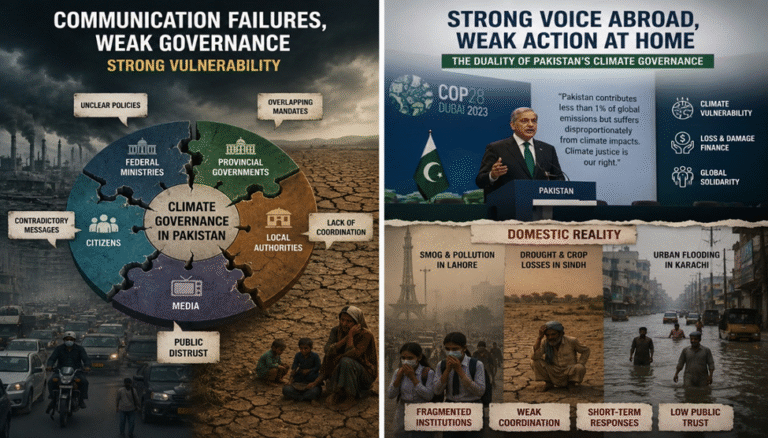
The climate policy community is very fragmented in Pakistan. Sindh has consistently asked Punjab to provide Indus River water in its proper proportion, while Balochistan has repeatedly complained that the federal policies do not take provision of water and infrastructure in the province into account. While climate diplomacy is sometimes seen as planned action at the international level, in Pakistan water governance is defined by provincial competition, patronage and political mistrust. The issue is further complicated by economic elites. Existing irrigation systems give an advantage to bigger landowners, and so any major improvements risk vested interests. Following the flooding of 2022, local newspapers like Dawn and critics have asked why the aid was given in disproportionately large amounts to certain regions, while the rural areas that were most affected and vulnerable waited for several months (Khan,2022). The conflict between international donors, state actors, and local communities highlights how climate governance can also be a source of inequality, even though it aims to address it.
mme [UNDP], 2022). But, within a few months, water shortages were again experienced in several areas. This paradox is the truth of Pakistan’s climate crisis: no longer is the nation faced with floods or droughts alone. Climate change is jeopardizing the political and ecological framework of water access, distribution and control. The threat is not just environmental degradation, but that water scarcity, climate stress, and poor governance could intensify internal disruptions and regional tensions. This is increasingly transforming the climate crisis into a political and security threat for Pakistan.
Climate diplomacy is frequently formed in the process of policy-making, which is influenced by policy communities, a group of governments, NGOs, international organizations, researchers, and private actors. These communities are vital because governments alone cannot solve climate problems. Governance of water in Pakistan is a multi-actor process where competing actors have different priorities: Provincial governments argue over river sharing, international organizations invest in adaptation projects, local NGOs push for climate justice, and agricultural elites oppose reforms that could compromise their economic status (World Bank, 2021). The political struggle for resources in climate policy is then complemented by a struggle over political influence and institutional power. The climate policy community is very fragmented in Pakistan. Sindh has consistently asked Punjab to provide Indus River water in its proper proportion, while Balochistan has repeatedly complained that the federal policies do not take provision of water and infrastructure in the province into account. While climate diplomacy is sometimes seen as planned action at the international level, in Pakistan water governance is defined by provincial competition, patronage and political mistrust. The issue is further complicated by economic elites. Existing irrigation systems give an advantage to bigger landowners and so any major improvements risk vested interests. Following the flooding of 2022, local newspapers like Dawn and critics have asked why the aid was given in disproportionately large amounts to certain regions, while the rural areas that were most affected and vulnerable waited for several months (Khan,2022). The conflict between international donors, state actors, and local communities highlights how climate governance can also be a source of inequality, even though it aims to address it.
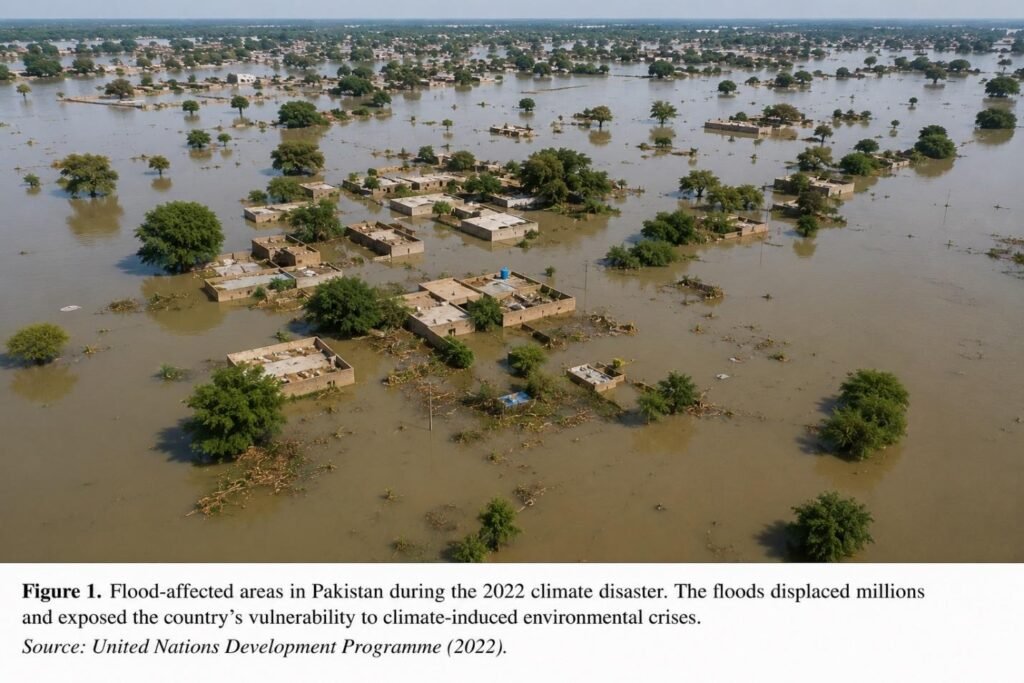
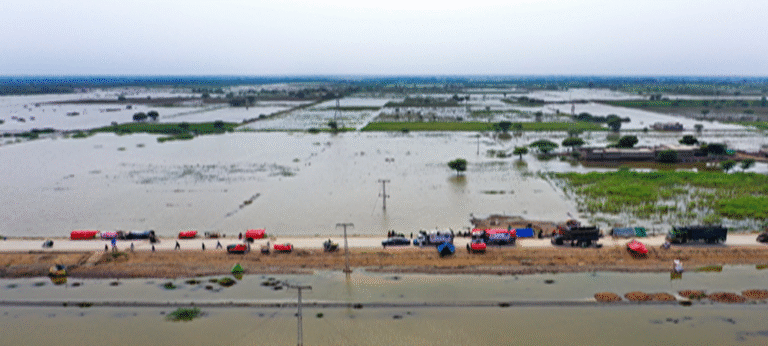
In 2022, following the flood events, the interaction of these actors has become very visible. (UNDP,2022) estimates that millions of Pakistanis were displaced, lost their livelihoods and agricultural holdings as a result of climate-related flooding. The reconstruction was supported by international institutions like the World Bank and International Monetary Fund, and local NGOs were critical of the slow response and inadequate disaster preparation by the government. Climate scientists have called it an unprecedented disaster, which was caused by rising temperatures, glacier melt and increased monsoon systems, argued the Pakistani journalist Rina Saeed Khan in Dawn (Khan,2022). The floods showed that environmental factors are not responsible for making Pakistan vulnerable to climate change. Poor urban planning, corruption, poorly designed infrastructure, and government failures, greatly worsened the damage.Local disputes over water resources in Pakistan are also taking a political turn. The Punjab and the Sindh are constantly fighting over water distribution of the rivers, and the smaller farmers suffer most as irrigation is controlled by the powerful landlords. The inequalities are further increased by climate change as the changes in rainfall and melting glaciers also lead to increased uncertainly regarding water flows in the Indus basin (Intergovernmental Panel on Climate Change [IPCC], 2023). The scarcity affects political behavior. As the governments start to see water, food systems and energy infrastructure as strategic assets which are essential for the survival of the nation, ecological systems are also being securitized. Water scarcity has become linked with migration, high food prices, joblessness and loss of trust in the government institutions in Pakistan. The situation is complicated by regional tensions with India as well.
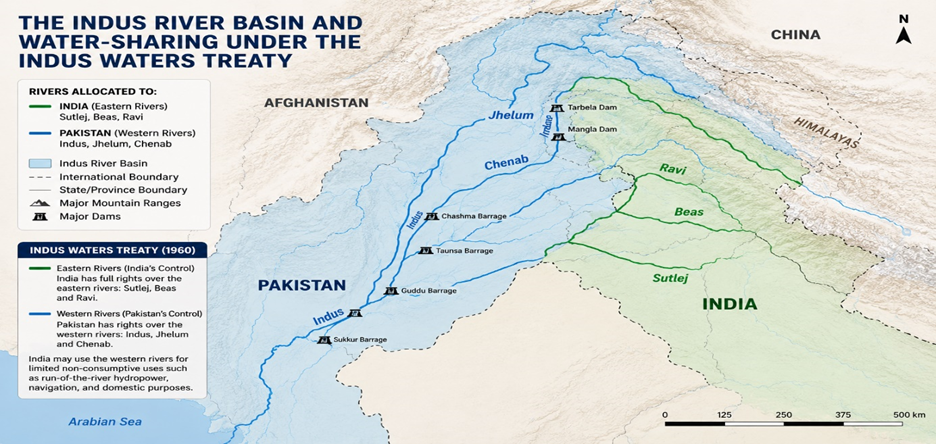
The Indus Waters Treaty has been a longevity diplomatic agreement, which has been able to outlast wars and diplomatic crises between the two nations. But the treaty’s being tested, as climate change takes its toll. According to Rehman et al, (2025) water insecurity has been a growing issue in South Asia that is now being ‘securitized’ or discussed in terms of national security rather than collective ecological cooperation. Indian leaders have, on a few occasions during when tensions have flared, indicated that they might want to look at parts of the treaty again, while Pakistani officials have increasingly seen upstream HEP projects as a means of strategic pressure. Even in the absence of an armed conflict, the securitization of water alters the rules of diplomacy. Cooperation is more difficult as ecological interdependence is perceived as a vulnerability rather than a necessity.
Pakistan thus requires a climate policy that views water governance as an environmental and political challenge. There needs to be better coordination on water management at the provincial level with a coordinated water management system that allows for the sharing of transparent data and better regulation of the extraction of water for non-legal uses. Investments in climate-resilient agriculture, rainwater collection, and infrastructure resistant to flooding are also crucial. There should also be further strengthening of technical cooperation and dialogue between Pakistan and India on glacier monitoring and flood forecasting under the framework of the Indus Waters Treaty.
Pakistan’s climate crisis is perhaps unsettling, coming into conflict not just as a result of ideology or territory, but as a result of ecological breakdown itself. The rivers, dams, and irrigation systems are no longer just tools for the environment, but also tools for political pressure and political leverage. Climate change is not just changing Pakistan’s environment; it is changing the whole equation of governance, security and survival. The next major crisis in Pakistan could not be a political one, but could be because its ecosystems are faltering, water systems are breaking down, and its government is unable to properly deal with the consequences.
Keywords: Climate change, Water Conflicts, Water scarcity, Climate Security


 Reston Dennis Juah
 Noor Ul Ain
 Hassan Barrie
 Hoby Nasandratra Andriamiandrisoa
Sau vài ngày trải nghiệm 888slot poker , cảm giác dùng khá mượt và ổn định. TONY05-29
Tính công bằng tại xn88 được đảm bảo thông qua hai cơ chế chính: hệ thống RNG đã chứng nhận và chính sách minh bạch thông tin. Mọi tỷ lệ trả thưởng (RTP) đều được công khai và được kiểm toán định kỳ bởi các đơn vị độc lập. TONY05-28