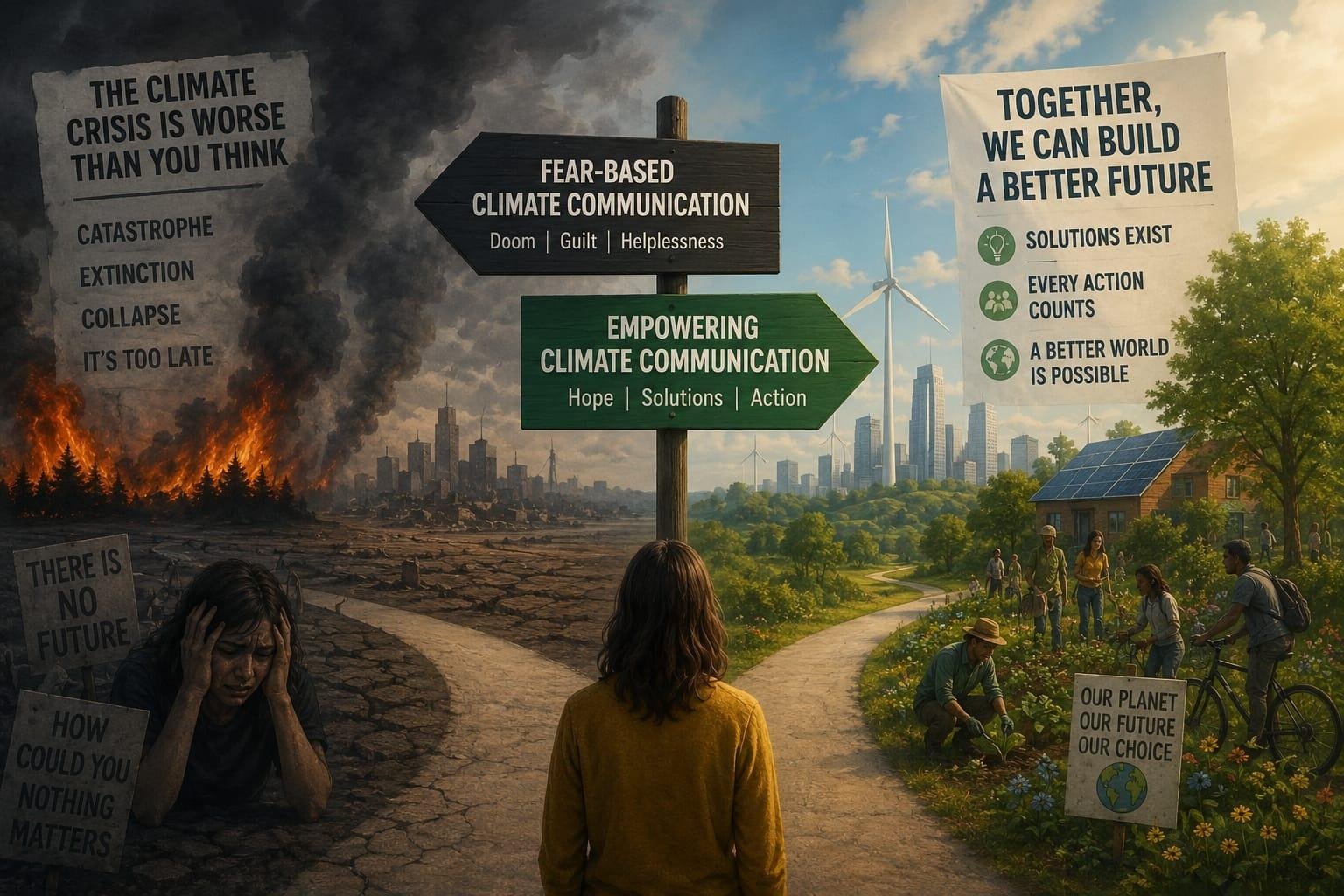

In 2019, images of the Amazon rain forest burning circulated worldwide through media channels in few hours. Politicians declared the fires as a threat to humanity itself. Climate activists warned that the “Lungs of the Earth” were collapsing. International leaders debated sanctions against Brazil, and social media transformed the crisis to a world of fear, urgency and moral outrage. Climate communication had once again found its most powerful language that is “Catastrophe”
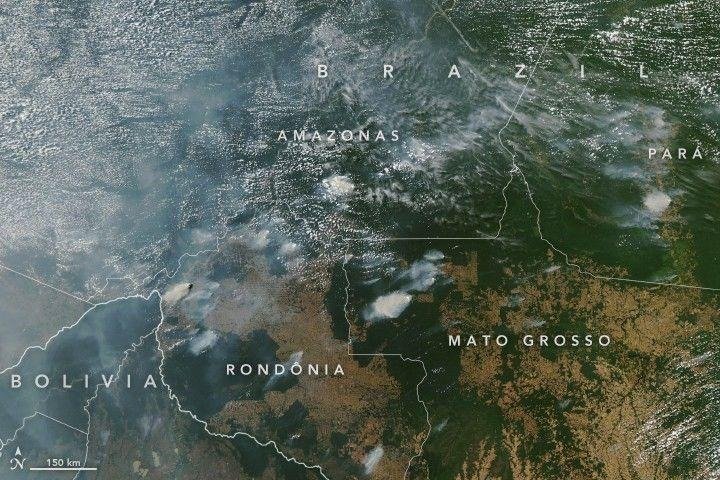
Amazon fires in Brazil 2019. Source: NASA Earth Observatory, 2019
But did fear lead to an actual and effective response to climate change?
Fear-based climate communication has become central to modern climate diplomacy (Jankovic & Schultz, 2017), because it captures public attention faster than scientific reports or policy discussions ever could. Governments, environmental groups, journalists, and international institutions often rely on alarming narratives to call out to get people to take action on climate change. But fear is a two-edged sword. It can raise political pressure and prompt action, but it can also oversimplify climate issues, deepen public anxiety, and reduce complex structural issues into emotional reactions. Fear may start conversation, but on its own it rarely sustains long-term political transformation. It is this tension that has become the heart of the climate policy debates of today. Climate diplomacy is shaped through what scholars describe as Policy communities: groups of government, scientists, NGOs, businesses, financial institutions, and international organizations that collectively influence climate decision-making and shape climate diplomacy. These communities are not just responding to climate change, but they are creating the way that the public understands climate change. Their choice of language matters politically because communication influences which policies become acceptable, urgent, and morally necessary.
This fear can often be a useful strategical tool within these policy communities. The world’s scientific institutes give more and more alarming reports of warming climate, loss of biodiversity and extreme weather risks (IPCC,2023). Environmental NGOs strengthen these warnings with emotional campaigns which aim to attract media attention and public pressure. Government frame climate change as a security threat that can impact economies, borders, and food systems. Meanwhile, corporations and financial actors begin to alert investors to climate-related economic damages and supply-chain constraints. The Amazon fires of 2019 are one of the best examples of fear-based climate communication in these international policy communities.
The Amazon Forest has been a symbol of global environmental politics since long due to its carbon absorption and conservation of biodiversity. In 2019, fires spread throughout Brazil, and international media quickly framed the disaster as a planetary emergency (NASA Earth Observatory, 2019). The headlines were warning of irreversible ecological collapse. The French president, Emmanuel Macron, described the fires as an “International Crisis” during the G7 summit in 2019. He uploaded on X with the picture of the Amazon fire, saying “our house is burning. Literally. The Amazon rainforest, the lungs which produce 20% of our planet’s oxygen, is on fire. It is an international crisis. Members of the G7 summit, let’s discuss this emergency as a first order in 2 days”. Activist groups described the Amazon as being in an irreversible state of ‘tipping’ toward catastrophic collapse.
A number of short-term objectives were met with this communication strategy. Awareness of the world grew manyfold. Pressure on the Brazilian government increased at an international level. Climate advocacy was picked up in Europe and Latin America. The fires also helped push the agenda for environmental governance into place in trade talks between the EU and South American countries. But the Amazon case also revealed the weaknesses and limitations of fear base climate communication.
Fear made an extremely complex issue into a morality play of villains and victims. Although the crisis was linked to decades of demand for beef, soy, mining, and infrastructure developments from around the world, it was often presented as driven by the actions of one government or one political leader. The spotlight is particularly on Brazil, and there was little attention paid to the direct impacts of global consumption trends in wealthier economies on deforestation. Fear has further polarized political and social relationships, rather than fostering cooperation. Brazilian authorities blamed Western governments and NGOs for meddling in the country’s sovereignty and economic progress through the guise of environmental issues. In Brazil, many local communities saw international pressure as nothing more than foreign interference. Fear-based communication led to confrontation but not necessarily trust.
The constant use of apocalyptic language had the potential to generate public fatigue. Consistently presenting every crisis as the “last warning” will exhaust the audience’s emotional reserves. The Yale Program on Climate Change Communication and similar institutes have found that fear without concrete steps can lead to helplessness and disengagement rather than sustainable action. This is particularly important for the Global South. Developing countries often experience climate diplomacy through unequal power structures where wealthy nations dominate financial systems, technological access, and global narratives. In many cases, fear-based communication allows richer countries to present themselves as protectors of the planet while avoiding deeper discussion about climate justice, historical emissions, and unequal development.
The Amazon debate reflected these tensions clearly. Brazil faced international condemnations for deforestation, but many Global South policy makers argued that the industrialized countries have already attained their wealth by centuries of deforestation. Call for forest protection thus got caught up within the issues of sovereignty, development rights, and economic disparity.
So, fear is not a bad thing in the context of climate communication. Politically, fear can be useful as it can break the public’s complacency. Many environmental issues received serious attention only after dramatic event force government and media institution to react. Without emotional urgency, climate diplomacy often moves slowly and cautiously. It is human nature to ignore problem until it becomes serious. Fear based climate communication create a sense of urgency (Stern, 2012). It makes climate change immediate rather than distant. As a result, both government and people are more likely to take action.
Without action, fear is not enough to support effective climate policy. When climate communication includes action steps, it is more effective. Policy communities need to focus more on the realistic options for transitioning to renewable energy investment, resilient infrastructure, sustainable agriculture, and climate adaptation measures rather than just catastrophic imagery. Individuals feel more comfortable with policies when they think solutions are feasible and socially fair.
Beyond narratives of environmental risks and or environmental victims, climate diplomacy should also shift to move beyond the Global South. Expanding policy communities would enable developing nations, Indigenous communities and local communities to have more influence in climate governance, as opposed to being affected by the pressure of wealthier counterparts. The bottom line is, fear grabs attention more easily than it encourages people to take action. It can force climate change into headlines, influence diplomatic negotiation and create moment of urgency. But fear, without trust, fairness and creditable solutions, can generate anxiety rather than change. The future of climate diplomacy depends not on making societies permanently afraid, but on convincing them that collective action remains possible before crisis become irreversible.
Keywords: Fear-based communication, Policy communities, Climate Diplomacy, Amazon Rainforest Fires.

 Reston Dennis Juah
 Noor Ul Ain
 Hassan Barrie
 Hoby Nasandratra Andriamiandrisoa
Been playing here for a week and the winning streaks are real. The atmosphere and the game mechanics are just spot on. Love ph33jili so much.