

How Island Quietly Disappeared
Having lived in Bali and witnessing how the economy of the island is heavily dependent on tourism, I really understand how climate change can threaten the sustainability of the island, economically and culturally. For example, I used to play on the beach, where much of the coastline in the Nusa Dua area was still open and safe for local children to play, but now, the area where we used to play is completely submerged, and even the surrounding hotels and resorts are now only one meter above sea level. It seems sudden, but it’s not, the water has risen gradually and slowly, where we don’t even notice it, and that’s precisely what makes it so dangerous. Bali contributes 44% of the country’s foreign exchange to tourism, a sector from which 80% of the population relies. Despite this, Bali is a small island, covering only 0.3% of Indonesia’s land area, meaning that coastal erosion along Bali’s 593 km coastline is making the situation even more concerning, especially in the largely southern tourist areas of Kuta, Seminyak, Legian, and Nusa Dua, where illegal coral mining, hotel waste, and overdevelopment have stripped the coast of its natural defenses.
This is even more compelling that Bali has experienced the COVID-19 pandemic, which has halted tourism, lost livelihoods, and devastated the island’s entire economy, the same thing could happen with the threat of climate change, perhaps even worse, and in this situation, Bali needs to rethink its tourism model, which is currently highly vulnerable. In my opinion, Bali already has the answer: through its culture, how it has governed the relationship between nature and its creatures for centuries. Indonesia is a country very familiar with natural disasters, and our ancestors have passed down knowledge for adaptation and survival long before any formal policies existed.
The Water Is Rising & The Threat is Coming
As a crucial sector for Bali’s economy, the tourism sector is directly exposed to the impacts of climate change, not just hypothetical, but already felt in daily activities, this is evidenced by a survey conducted by the Bali Matangi Initiative between October 2023 and January 2024, which found that 97.5% of respondents felt very anxious about climate change, with 53% concerned about health impacts, and 47% concerned about the availability of food and clean water. This means that when this anxiety reaches the community, the damage and impacts are already beginning to be felt. Compounding this anxiety, data shows that Kuta Beach has lost 30% of its beach width over the past two decades, and more than 80% of Bali’s luxury tourism infrastructure is located within 500 meters of the coastline. We can imagine how nearly 100% of Bali’s tourism infrastructure is under threat.
Furthermore, Bali is threatened by extreme temperatures that could make the island even more inhospitable to tourists during peak tourist hours. Bali’s average annual temperature has risen by 0.3-0.8°C over the past 30 years, potentially increasing by 1.5-2°C by 2050. Furthermore, Bali is also projected to face a 30% water deficit by 2025, much of which is consumed by the tourism sector. The water deficit effect is not only affecting the tourism sector, but also can increase food prices, and indirectly forces villagers to seek additional income in cities to cover their living expenses. Moreover, the tourism infrastructure is also very vulnerable, regarding many tourism infrastructure concentrated in Southern Bali, such as Kuta, Sanur, Seminyak, Nusa Dua.
The Role of Balinese Adat for Climate-Resilient
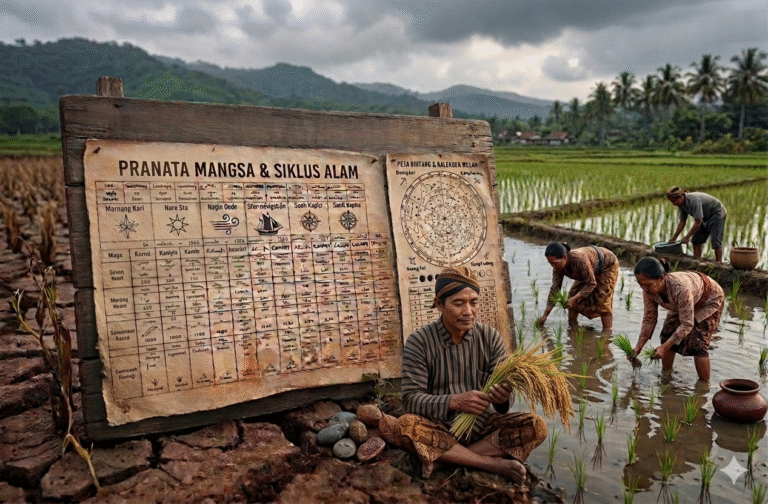
Bali is not just a tourist destination, but the place where a strong tradition and cultural system (Adat) is embedded in the daily lives of the Balinese people which protects the balancing between human and nature; governing land, water and community that have already existed for centuries. Uniquely, adat tends to be more trusted rather than any formal regulation, because it is embedded in how people actually live. That spirit is rooted in the value of Tri Hita Karana, or the “Three causes of harmony”: the balance between humans (pawongan), nature (palemahan), and the divine (parahyangan). Furthermore, Bali also has a traditional irrigation system recognized by UNESCO as a World Heritage Site. This system, called Subak, is a farmer-managed association that regulates irrigation water across rice paddies based on cooperation and equality. Subak prioritizes equitable water distribution and the protection of upstream and downstream water flows. This system can be an alternative to modern climate risk management strategies, while remaining rooted in local wisdom.
Based on the examples above, Adat systems effectively protect and organize communities. These include areas around temples, water sources, and ancestral sites designated as forbidden by custom, often coinciding with ecologically sensitive zones. For example, the areas around sea temples like Tanah Lot and Uluwatu help absorb waves and reduce erosion. Benoa Bay, long recognized as a sacred site by the local community, has been designated a 1,243-hectare Marine Protected Area. These are all the result of centuries-old indigenous environmental governance, only now beginning to be recognized by formal policy. At the community level, institutions such as banjar (village councils) and desa adat (traditional villages) facilitate collective decision-making during times of environmental crisis, decisions that tend to elicit more trust and compliance than top-down government directives. It is treated as cultural heritage rather than what it actually is: a climate adaptation asset. Integrating adat into formal regulation is not romanticism, but it is an alternative strategy.
The Sea Won’t Wait for Another Five-Year Plan
The impact of climate change on Bali is already happening, it’s not something who would come. The shrinking Kuta Beach and the submerged Nusa Dua coastline are the real evidence that can raise awareness. So, the question is no longer whether climate change will impact Balinese tourism, but how Bali will respond by taking action to address the issue that has already happened.
What Bali needs is not “infrastructure”, but a governance model that understands the island the way its Balinese ancestors always did.
The subak system, sacred zoning, Tri Hita Karana, and banjar governance, these are not relics of the past, but they are functioning systems of environmental management that have kept Bali’s ecosystems intact for centuries, often more effectively than any formal regulation. Integrating them into Bali’s official climate adaptation and tourism planning framework is not a distant ideal, but it is a choice to build resilience from the bottom up, using knowledge that is already here, already trusted, and already proven.
Key words: Climate-Resilient, Bali Tourism, Adat System, Environmental Governance, UNESCO Subak System, Tri Hita Karana



 Reston Dennis Juah
 Noor Ul Ain
 Hassan Barrie
 Hoby Nasandratra Andriamiandrisoa
+ There are no comments
Add yours