
Keyword : Food Security, Pranata Mangsa, Javanese Adaptation
All the minerals and natural resources stored inside the earth have played an enormous role in the history of human civilization, especially when it comes to industrial and technological change. When the First Industrial Revolution began between 1760 and 1840, humans seemed to enter an era of ease where physical effort was no longer the only way to get things done, because technology started taking over much of that work. That era marked the end of absolute dependence on physical and biological energy, replaced by technological power that has kept evolving right up to today. Even though this was a real achievement of the Enlightenment period, when humanity placed great value on knowledge and science as the foundation of building civilization across generations, it also opened a new chapter that quietly threatened human survival. Behind the grandeur of modern thinking, the use of technology began loading the earth with ecological consequences that are not easy to recover from.
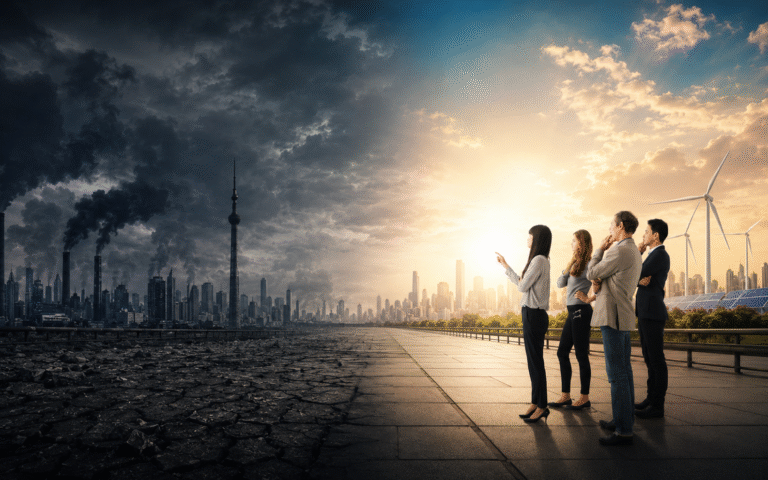
Today, global warming has reached a critical point. The average temperature of the earth has gone up by more than 1.1 degrees Celsius, getting close to 1.43 degrees Celsius above pre-industrial era averages. This trend is expected to keep climbing because the economic systems of many countries, especially developing ones, have fallen into a state of carbon lock-in. Carbon lock-in is a condition where an economy and all the sectors tied to it become stuck relying on fossil fuel-based technology and infrastructure to generate energy. In this situation, energy transition becomes very hard to carry out, and emission levels in the atmosphere become difficult to control because of the structural barriers created by a fossil fuel-based economic system that has been in place for a very long time. Coal power plants in several countries including Indonesia are also relatively young, with an average age of under 11 to 15 years, while the typical lifespan of a coal power plant runs between 20 and 30 years. This means carbon emissions will keep being produced for a long time to come, because the energy infrastructure that has been built cannot simply be shut down, especially when it has not been running for very long. Even if coal power plants were shut down immediately, this would cause massive losses for the countries involved, directly affecting domestic economic stability. Yet coal use urgently needs to be reduced on a large scale, since coal is one of the biggest contributors to rising carbon emissions.
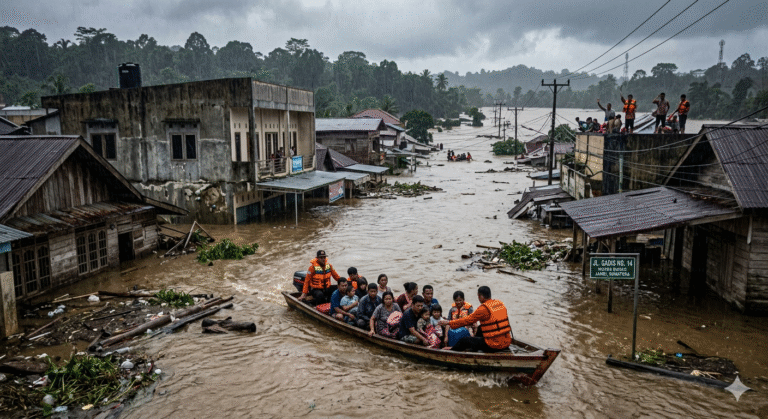
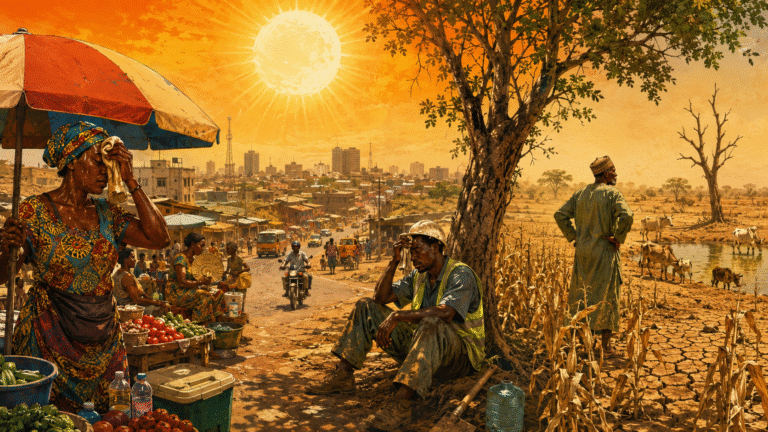
Experts have agreed that the rise in average global temperature due to climate change cannot be avoided in the near future, and its wide-ranging impact on human life will come sooner rather than later. IPCC reports state that climate change brings serious threats to health, increases the frequency of natural disasters, raises average sea levels, damages ecosystems, and triggers food chain crises that will leave millions of people hungry. The same reports warn that an additional warming of just a tenth of a degree could lead to species extinction, a serious risk that humanity will have to carry into the future. The IPCC also estimates that the risks from climate change will produce cascading impacts when they occur simultaneously in the same regions, making the situation increasingly difficult to manage. In tropical regions, for example, climate change has caused agricultural output to drop significantly in a short period of time due to long dry spells that are hard to predict. This leads directly to production losses that are hard to overcome and ends up pushing food prices up due to shrinking stock. At the same time, the number of deaths from extreme weather will rise, reducing the available productive workforce. When both of these conditions hit at the same time, poor communities find themselves under enormous pressure with very little room to respond. On one side they cannot afford food that keeps getting more expensive. On the other hand, household income keeps falling because people cannot work harder to make up for the losses. This combination threatens food security and worsens the risks of hunger and malnutrition.
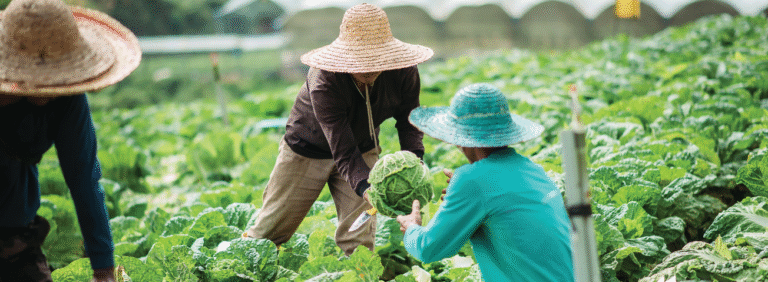
It is from this very real threat that experts and policymakers have called for the crucial step of large-scale nature conservation that must be pursued without delay. Even though conservation efforts cannot guarantee that humans will be fully shielded from the impacts of climate change, given how large the accumulation of carbon emissions in the atmosphere already is, they can at least serve as an adaptation action that minimizes the risk of greater harm. One of the forms of ecosystem conservation that is strongly emphasized as a way to help people adapt amid climate change is the protection of agricultural land. The agricultural sector is one of the areas hit hardest by climate change, and yet it is a sector that contributes relatively little to carbon emissions, accounting for only around 8 percent. Despite that, the damage it receives from climate change is enormous. Shifting rainfall patterns and rising average temperatures have caused agricultural output to fall significantly. Climate-related natural disasters such as floods and droughts have also become triggers for crop failures in rice, secondary crops, and other farm produce. On top of that, rising sea levels have narrowed available paddy fields in coastal areas and caused crop damage due to increasing soil salinity. These real threats to the agricultural sector ultimately push humans to keep pursuing science-based transformation and innovation so that farming can remain sustainable in the face of the climate crisis. Keeping the agricultural sector going is critically important because it is the backbone from which food supplies come.
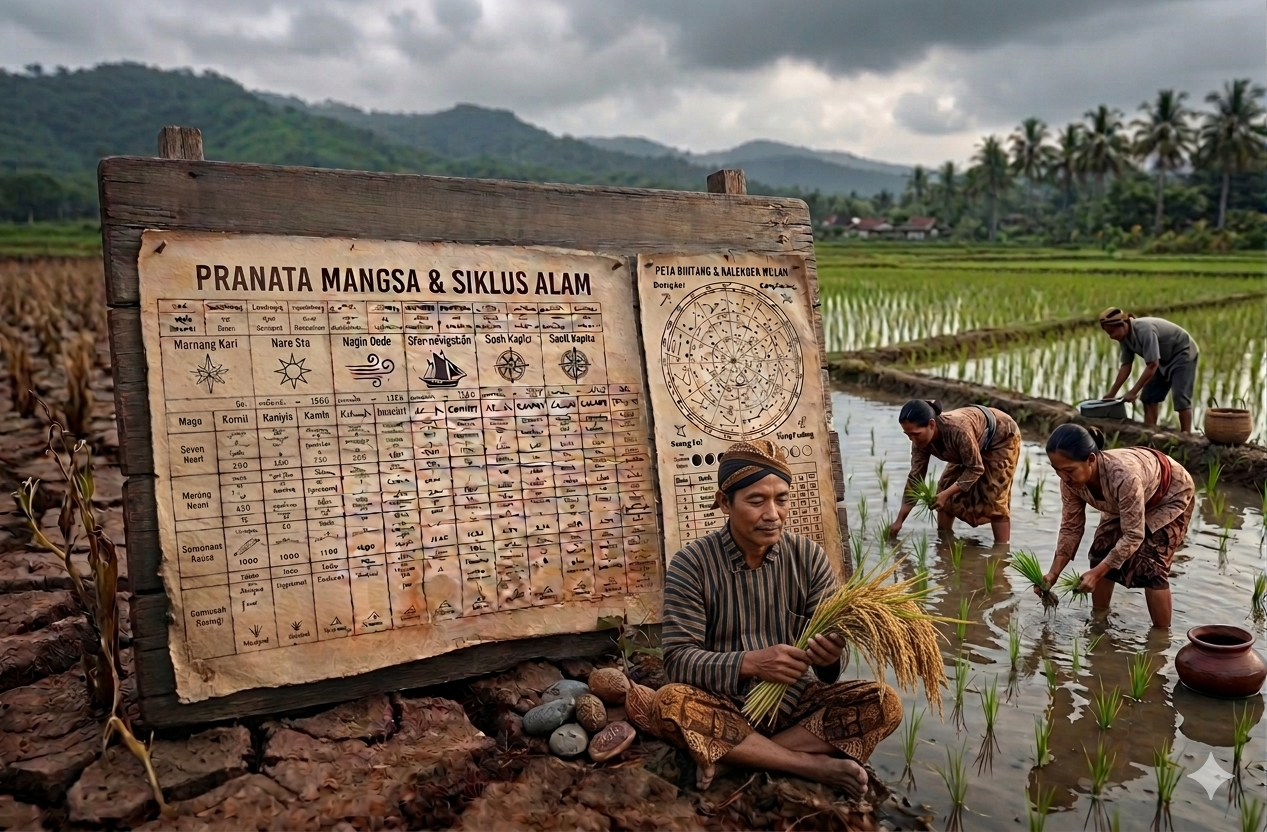
The urgency of protecting the agricultural sector goes beyond just maintaining stock of basic food supplies. Sustaining agriculture is also part of the key to climate mitigation. In the climate change mitigation process, farmland plays a dual role as both an absorber of CO2 from the atmosphere through photosynthesis, storing carbon in the soil, and a means of suppressing the release of methane and nitrous oxide gases. Climate and agriculture experts have developed various adaptation technologies to create climate-resilient farming systems, including flexible irrigation management, early warning systems and weather information for farmers, agricultural finance and insurance mechanisms, and many other adaptation scenarios. But long before modern humans began developing these sustainable farming scenarios, the people of Java had already been practicing a sustainable agricultural system for thousands of years through an ancient calendar system known as Pranata Mangsa.
In terms of language, Pranata Mangsa is made up of two words: pranata, meaning rules, and mangsa, meaning season. Together, Pranata Mangsa means the rules of the seasons. This seasonal system takes the form of a traditional calendar that has long been familiar to farming communities on the island of Java. It is based on the apparent movement of the sun and has served as a reliable guide for farmers in determining when to start planting, when to switch crop types, and when to conserve the availability of irrigation water. Even though it has been in practice for thousands of years, Pranata Mangsa was formally introduced to Javanese society starting in 1855 by the Surakarta royal court. The Pranata Mangsa calendar system is as complex as other ancient calendars found around the world, such as those of ancient Egypt, China, the Maya, and Burma. It carries a unique essence by combining cosmographic and climatological aspects, both of which have historically shaped the way Javanese people live. In its application, Pranata Mangsa uses readings of natural signs to indicate the right time for agricultural activities, including observing plant behavior, changes in animal behavior, and the movement of star constellations in the sky. Over the course of one year, the Pranata Mangsa system divides the seasonal period into 12 parts, each with its own symbol and its own meaning as a guide. The character and traits of each season are the result of observations and interpretations of events that repeated themselves across decades of seasonal cycles in Javanese communities.
For example, the Pranata Mangsa calendar indicates that when the period has entered Mangsa Kawolu, the frequency of rain begins to decrease even though thunder and lightning can still often be heard. In the Pranata Mangsa system, this season is marked by avocado, mango, wuni, and kepundung trees beginning to bear fruit. The arrival of this season is also marked by changes in animal behavior, such as cats becoming more active in breeding, and various crawling animals beginning to appear at the surface. This season is also marked by the appearance of the Milky Way galaxy stretching from north to south. Once farmers see these signs appear, they know it is time to start conserving water supplies, because the rice plants have grown tall and harvest time is not far away. Through these natural signals, farmers understand that rainfall intensity is beginning to drop and they need to manage irrigation water more wisely so it lasts until the harvest arrives.
Then there is Mangsa Kanem, which marks the end of the transitional season and the beginning of the rainy season. This season is marked by trees like mango and rambutan beginning to ripen their fruit, insects such as cockroaches and water beetles breeding in the ditches, and birds starting to hunt for prey in the water. This season is also marked by the Milky Way appearing to stretch from the eastern to the southeastern sky. When farmers read these natural signs, it is a signal that a great gift from nature is arriving. During this season, farmers commonly come together to express their gratitude for the blessings nature has given them. That gratitude is felt because during Mangsa Kanem, farmers can begin being productive in their rice fields again. At the start of this rainy season, farmers begin plowing their fields in preparation for planting rice once more and start sowing rice seeds.
There is also Mangsa Kasa, which marks the dry season. In the Pranata Mangsa system, the arrival of this season is signaled by trees beginning to shed their leaves, and plants like guava, durian, mangosteen, sugar apple, and kedondong beginning to flower. In terms of animal behavior, this season is marked by insect eggs beginning to hatch, fish in rivers showing behavior of hiding from the surface, and animals like buffalo, cows, and horses beginning to look tired and reluctant to help farmers in the fields. When reading star constellations, the arrival of Mangsa Kasa is marked by the Milky Way appearing to stretch from north to south. Once Javanese farmers of that era began seeing these signs, they would start preparing to burn the leftover rice stalks in the fields from the previous harvest. The paddy fields would then be readied for planting again, but in this season farmers would switch from rice to secondary crops that do not require much water, such as beans, corn, sweet potatoes, and wheat, so that the farmland could remain productive throughout the dry season.
Pranata Mangsa in Javanese community life was not just an ordinary calendar. It was a guide for living that was deeply respected and followed by Javanese society at the time. Even though the system is no longer fully relevant today because of the influence of climate change, which has made the 12 seasons of Pranata Mangsa irregular and hard to predict, it carries an environmental ethic that is worth adopting by modern humans as an important form of climate adaptation. From examples like Mangsa Kawolu, Mangsa Kanem, and Mangsa Kasa, we can see that Javanese people of the past held an ecocentric perspective in how they treated the natural world around them. They carried out farming activities based on how well they could align with the rhythms of nature. If natural signs pointed to a dry season, they would switch crop types. If natural signs pointed to the rainy season, they would begin plowing the fields. If natural signs pointed to a transitional season, they would plan the management of natural resources like water so there would be enough to use in the fields. This shows that the character of Javanese society at that time already had its own built-in system for adapting to climate change in order to maintain agricultural productivity.
Within Javanese society there is a belief that the universe is not a lifeless object with no influence on anything. For Javanese people, nature is a living, sacred entity with a soul. The Javanese call it Jagad Gede, the macrocosm, and Jagad Cilik, the microcosm. Nature occupies the position of the macrocosm while humans occupy the position of the microcosm, and the two are bound together. Javanese people believe that as the microcosm, humans must align their behavior with the patterns and laws belonging to nature as a far greater entity, so that balance can be maintained. They believe there is a force existing outside of themselves, and that force is the sacredness of nature itself. They believe that if they are able to negotiate with that force, their lives will be supported by the presence of nature. That negotiation is put into practice through the way they regulate when to plant and when to harvest, as described in the Pranata Mangsa system. That negotiation carries the meaning that Javanese people must not force nature to keep producing agricultural output endlessly. There are times when nature must be allowed to rest and humans must hold back from farming. Javanese communities believe that if humans violate the rhythm that nature holds, they will bear the consequences of that disruption and suffer losses for having disturbed the natural order.
The negotiation that Javanese people practiced in relating to nature through the Pranata Mangsa system was aimed at protecting farmers in Java from losses during seasonal shifts. This was a pattern of climate change adaptation designed to maintain food security. What stands out most as the difference between the reasoning behind Pranata Mangsa and the reasoning of modern humans today is that modern humans tend to force nature to keep producing whatever they want. Farmland is pushed to keep generating output no matter the season. In the name of economic demands, modern society tries to go beyond the rhythm of nature through various forms of agricultural engineering and technological innovation that force nature to keep giving what humans need. This modern mindset has been going on for years and has led to a wide range of environmental problems, including pollution from industrial systems that are unfriendly to the environment, soil degradation from land conversion, natural disasters like forest fires and floods from deforestation, ecosystem damage from mining activities, and much more. When farmland was not suitable for planting, Javanese farmers of the past chose to wait until conditions allowed them to plant again. In modern society, the opposite happens. When farmland is not producing at the volume people want, they do not wait. Instead they turn to other methods, such as opening new land, which often disturbs the balance of the ecosystem.
In the end, the negative effects of humanity’s push to force natural productivity without regard for what nature can actually carry have created the serious problem of climate change, which continues to cause damage and loss. Perhaps what Javanese society believed through the Pranata Mangsa system is true after all, that if humans act without ecological ethics, they will face great losses, and the impacts of climate change are living proof of the losses we are staring at right now. Climate change has raised the earth’s temperature, reduced agricultural productivity, and as stated in IPCC reports, the real threat that awaits in the future is food insecurity, because the climate crisis is having a significant impact on global food security. The climate crisis can affect the distribution and availability of the natural resources that form the basis of food production, such as water and land. As many environmental observers have pointed out, the impacts of this climate crisis are becoming increasingly hard to control because ecosystems that once served as carbon absorbers and buffers against extreme weather have lost their natural functions due to various forms of human intervention carried out in the name of economic interest.
This ultimately calls for sustainable policies in natural resource management and environmental protection to maintain long-term food security. But it is worth remembering that no matter how impressive any innovation or scenario may be, it will never be able to fully restore the environment to what it once was. It is also worth remembering that no matter how great any innovation effort is, it will not work effectively without a genuine shift in human awareness to stop being greedy in how we use nature. This is the point where we as modern humans need to learn from and adopt the spirit of environmental ethics found in the Pranata Mangsa system. Because what is really driving the food crisis is not the climate that nature naturally possesses. It is human greed that has disrupted the climate system and made it increasingly hard to predict. Maintaining climate stability is critically important because so many of our basic food sources come from plants that depend heavily on climate quality to produce.
If human greed in exploiting nature is not changed soon, the adaptation efforts that have been designed through various scientific innovations will never reach the heart of the problem. If those innovations are applied as climate adaptation measures but the greedy practices of natural resource exploitation are still allowed to continue, it is no different from patching one hole while digging another. In other words, adaptation solutions that do not address the root cause will be hard to rely on in the long run. True climate change adaptation is an effort where humans can create long-term sustainability solutions for food security by reducing the exploitation of nature that has been the root cause of climate change all along. The spirit within Pranata Mangsa teaches us that viewing nature as an inseparable unity with humanity has given rise to an environmental ethic that keeps nature alive and well. This matters deeply, because this way of seeing the world is becoming increasingly rare among modern humans. Adapting to the climate crisis will not get very far if it is carried out only through technological innovation breakthroughs. Climate change adaptation must truly reach the core of the moral relationship between humans and nature for adaptation efforts to work effectively. Human ethics toward the environment will ultimately determine the fate of the earth going forward, because humans are the most powerful creatures on this planet. The spirit of Pranata Mangsa that lives within Javanese society is important to adopt as an environmental ethic today, because it is precisely this kind of spirit that will genuinely allow humans to save a world that grows more critical with every passing day.



 Reston Dennis Juah
 Noor Ul Ain
 Hassan Barrie
 Hoby Nasandratra Andriamiandrisoa
Great selection of games and the loyalty rewards are actually helpful. I am really enjoying my time on 98jililogin.