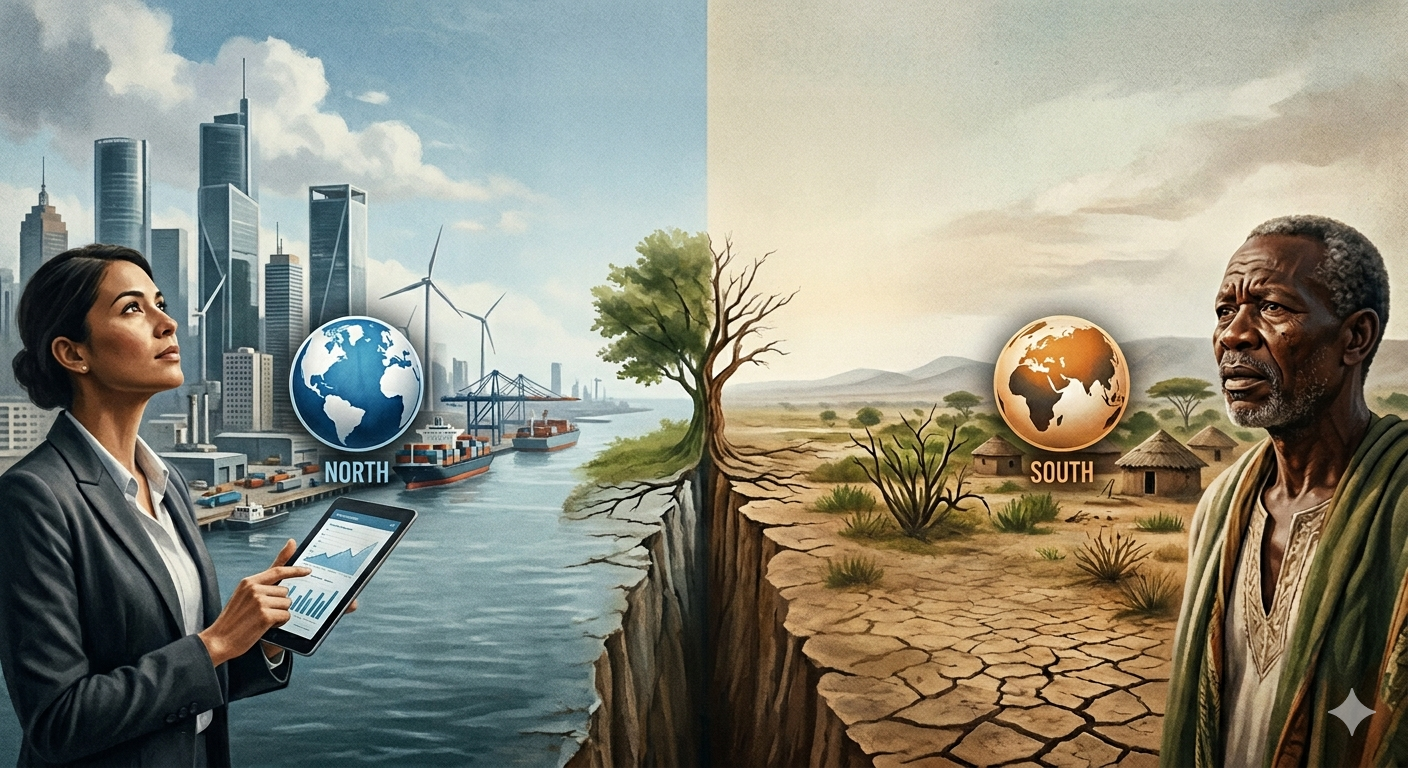

What is the first thing that comes to mind when we hear the terms Global North and Global South? Some of us might immediately picture the Global North as a group of wealthy, developed countries, home to the world’s elite, full of advanced technology and industrial systems, where life is easier because the structures that support it are already in place. On the flip side, when we hear Global South, we tend to think of developing countries with low prosperity levels, places tied to hunger and humanitarian crises, where getting by is harder because the systems and technology needed to support everyday life are either missing or not fully there. Using the terms Global North and Global South has become the easiest shorthand when we want to assess or group a cluster of nations. The world is enormously complex, with countless differences in geography, culture, ethnicity, religion, and systems of government, yet our minds seem built to simplify all of that into two straightforward clusters based on the most powerful measure of all, which is economic strength. Through this economic lens, the world gets instantly divided into two broad categories that immediately give us a picture of what a country’s situation looks like.
In the early days of global political thinking, people grouped countries into the first world, made up of Western nations, the second world, made up of communist states, and the third world, made up of developing countries, or more broadly, neutral nations that did not side with either the Western Bloc or the Eastern Bloc under the Soviet Union. After the Soviet Union fell apart, the idea of a first, second, and third world lost its relevance because only two clusters of nations remained. Beyond that, world leaders began to feel that the term third world had picked up connotations that tended to look down on countries in that group on the international stage, carrying with it the implication of being backward, poor, or uncivilized. So world leaders agreed to adopt the terms Global North and Global South, which were first introduced through a United Nations report. The terms themselves were originally coined by Carl Oglesby as a way to criticize American dominance during the Vietnam War. The birth of this new terminology also came with a spirit of liberation, so that people around the world would no longer be weighed down by an outdated ideology that sorted countries according to their national idealism, and could instead use a fresh perspective focused on the reality of economic inequality.
In climate discussions, the Global North and Global South framework has been used in academic and international policy circles for a long time, roughly since the late 1970s and into the 1980s. The terms refer to an imaginary line called the Brandt Line, which divides the earth into two halves. The upper half is the Global North, home to countries with strong industries and economies such as the United States, Canada, Japan, and the Netherlands. The lower half is categorized as the Global South, which is mostly made up of former colonized nations that remain economically behind. On one hand, this framework does help academics and international policymakers build a shared identity to advocate for the needs of countries, especially developing ones. But on the other hand, it also falls short when it comes to capturing the real voices of the most marginalized groups, the subaltern, at the grassroots level. This shortcoming was highlighted through a study published in the journal Climate Justice, the Global South, and Policy Preferences of Kenyan Environmental NGOs by Christopher Todd Beer. That research looked at how environment-based nonprofit organizations view and choose priority policies for climate action. Kenya was selected as the research subject because it fit the data needs of the study well, including being the largest center of environmental movement in Africa, having a high dependency on Western donor funding, and adopting an ambivalent approach to climate policy, on one side demanding compensation from the West for the emissions it has produced, while on the other side also adopting Western market mechanisms.
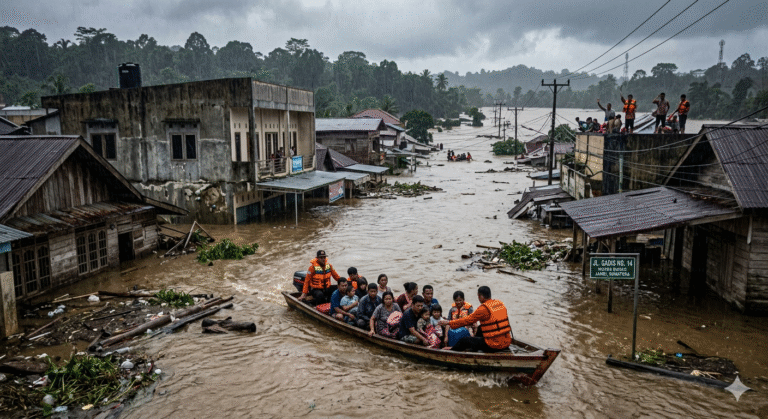
The findings showed that even though the Global North and Global South framework has been seen as capable of representing the shared historical experience of developing nations in climate advocacy, the voices carried by domestic elites, specifically NGO elites, do not always reflect the broader communities they claim to represent. There is a gap between the advocacy positions that elites bring to the international stage and what grassroots communities actually want. On the issue of energy transition and cutting emissions, developed nations are the ones fully expected to provide financing and support to developing countries. This is because Global North nations have historically been the biggest contributors to global emissions through their industrial activities. The wealth and economic progress they enjoy today is the result of a long industrialization process that frequently pushed ecological concerns aside. Meanwhile, countries in the Global South, which have historically contributed little to global emissions, end up being the ones who bear the consequences of climate change caused by the ecological damage left behind by industrialization, colonialism, and extractivism carried out by Global North nations. Global South countries are essentially paying a heavy price for a crisis they barely helped create, facing things like forest fires, rising sea levels, and even loss of life due to food scarcity. The burden of being climate change victims is made doubly hard for Global South communities because they simply do not have enough resources to adapt and mitigate on their own.
Because developed nations have played such a large role in creating the climate crisis on earth, the Paris Agreement decided that the Global North has a responsibility to help developing countries cover the costs of dealing with the effects of climate change. This obligation is written in Article 9 of the Paris Agreement, which states that developed country Parties shall provide financial resources to assist developing country Parties with respect to both mitigation and adaptation in continuation of their existing obligations under the Convention. Global climate negotiations tend to push for uniform accountability from Global North countries to cut emissions, while for Global South countries the expectations are adjusted based on their capacity, given the historical inequality in greenhouse gas emissions. Because of this fundamental difference in perspective between North and South, Global South nations often negotiate as a single bloc known as the G77. Together, the Global South countries in the G77 argue that any climate agreement must include emission reductions based on historical responsibility, financial compensation to developing nations, and a direct link between climate change and sustainable development. They argue that Northern countries should carry the main burden of emission reduction commitments and cover the costs of dealing with climate-related damage, while Southern countries should be compensated and at least given support to handle the extra challenges they face in adaptation and mitigation (Christopher Todd Beer, 2014).
Based on those demands, through the Kyoto Protocol designed at the COP 3 conference in Japan in 1997, a legal instrument was introduced to make it easier to implement those funding demands. The Kyoto Protocol followed the principle of Common but Differentiated Responsibility, meaning all countries share responsibility for climate change, but the targets for reducing greenhouse gas emissions are set differently for each. The mechanism for this was the Clean Development Mechanism, or CDM. This mechanism was essentially a form of cooperation between developed and developing countries, where developed nations were required to help developing nations meet their emission reduction targets and support developing countries that were not in Annex 1 in carrying out sustainable development. This mechanism was later replaced by a newer instrument through the Paris Agreement, which came into force in 2021 and is regulated under Article 6.4 of the Paris Agreement. That article officially replaced the CDM from the Kyoto Protocol with a carbon market mechanism under the Paris Agreement.
The carbon trading mechanism itself is a system of buying and selling carbon credits that happens when a buyer produces carbon emissions beyond the set limit. The idea is that industries producing high emissions are held accountable by being required to reduce their emissions, and if they do not, they have to buy carbon credits to offset what they have produced. However, this mechanism essentially allows companies to buy and sell the right to pollute the environment from one another. For example, if one country has an industry producing greenhouse gas emissions while another country has natural resources capable of absorbing carbon, carbon trading allows the emitting country to buy carbon credits from the absorbing country as a way to balance out the emissions produced. One part of how this works is through offset credits, a mechanism that reduces carbon in one place to compensate for emissions in another. It works by paying for emission reductions somewhere else where it is more cost-effective than investing in the country where the emitting company actually operates. A European steel producer, for example, might choose to invest in a clean development project in India to offset its own emissions. This option lets industries in the Global North buy their way out of emissions at a much lower cost because carbon prices in Global South markets are significantly cheaper.
The carbon trading mechanism sounds like it could be a shared solution between the Global North and Global South in fighting the climate injustice that has been happening for so long. But the reality of this transactional system is far more complicated, and if you dig deeper, it may not even touch the root of the problem at all. In his study in Kenya, Christopher Todd Beer (2014) found that this scheme actually triggered a new kind of class division within Kenya itself. For a long time, the Global North has been positioned as the perpetrator, the capitalist, the wealthy, the selfish polluter, while people in the Global South have been positioned as the victims, the poor and oppressed, the ecological casualties receiving the damage from Global North emissions. But Beer’s research brought new facts to light, showing that elements within the Global South cannot be fully categorized as the wronged party genuinely seeking justice to reduce emissions. The motivation to demand climate justice, which has long been championed by Global South communities, has experienced a kind of distortion, though not entirely. This distortion happens especially among domestic elites who benefit financially from carbon market regulations.
The survey Beer conducted showed that the radical narrative pushed by the Global South about demanding climate justice does not hold up the same way when looked at from a micro perspective. The macro perspective that has been circulating carries a generalization, an assumption that all actors in the Global South will stand together and demand climate justice. They would push for climate action to be adjusted to each country’s capacity, meaning the level of emission reduction contributions should not be equal across the board. But this claim fell apart when faced with the survey results from Kenya. The data showed that Kenyan NGO support for policy priorities around climate justice had a percentage not far from their support for emissions reductions for all, with figures of 42 percent versus 38 percent. That slim gap reveals an anomaly where not all environmental NGOs in Kenya actually stand behind the principle of fair emission burden sharing. Instead, a large portion of their voices split to support the idea that all countries should reduce emissions equally, which is actually an agenda that benefits the Global North’s historical accountability the most.
The slim gap in policy priority support comes down to the fact that some leaders of environmental NGOs in Kenya view carbon trading policy as not being a real solution to the climate crisis. They see this mechanism as something that simply allows emitting nations to keep industrializing freely after making their carbon payments. Those payments can be seen as a way of buying forgiveness for their emissions, and once that payment is made, the Global North just keeps releasing emissions without any real intention of shifting to greener technology. NGO leaders who rejected climate justice as a policy priority argued that carbon trading will never solve the core of the climate problem, because what the earth actually needs is more ambitious action in the form of drastic emission reductions, not a transactional system that just moves the right to pollute from one country to another. But at the micro level, the reasons for rejection go even deeper. There is a layer of skepticism among environmental NGO leaders about what actually happens to the money flowing in from Global North carbon payments. They expressed disagreement with the financial compensation system for emission reductions because they simply do not trust their own governments and politicians. They worry that the compensation money received will never actually reach the marginalized communities they represent. They are aware that their domestic governance is deeply shaped by a culture of corruption and nepotism, so if climate compensation funds like 100 to 200 USD billion were released, that money would likely end up in the pockets of political elites and be corrupted. They even went so far as to say that the compensation demands made by African leaders are nothing more than political theater.
Going further, the rejection of compensation money is also rooted in the awareness that Kenya and most other African nations do not yet have the technological or bureaucratic capacity to manage that scale of funding. So the compensation money ends up feeling pointless. Domestic elites can demand as much compensation as they want out of personal interest, but because the capacity to manage it properly is absent and corruption culture runs deep across African nations, that money will never truly reach and change the lives of the most vulnerable rural communities who are hit hardest by the climate crisis. Most environmental NGO leaders worry that the money will simply be corrupted, and the domestic elites speaking in the name of oppressed communities will essentially become an extension of the Global North, helping keep emissions flowing. Through financial compensation, developed nation industries gain moral legitimacy to keep polluting. Meanwhile, local elites get to freely enjoy the flow of funds. The result is a vicious cycle where the real demand of poor communities for drastic emission reductions that would protect their living spaces never gets properly heard or acted upon.
From these empirical findings, we are ultimately invited to rethink the premise of the Global North as perpetrator and the Global South as victim that has long shaped the architecture of international climate politics. Domestic dynamics in Kenya have shown that the boundary of exploitation, meaning who is the perpetrator and who is the victim, has now shifted and is no longer between nations but between classes. The existence of carbon markets and compensation schemes has created a kind of mutually beneficial relationship between capitalist elites in the Global North and domestic elites in the Global South. Both elite groups profit financially from the arrangement: one buys legitimacy to keep emitting, while the other chases gains from donor funding. The claim of a clear dichotomy between the Global North as perpetrator and the Global South as victim no longer holds empirical weight when placed in a micro context, because within the structure of developing nations there are many unequal power relations where the voices and needs of grassroots communities are actually silenced by their own elites. What is happening in Kenya signals a new dynamic and the need to rethink who the real victims are in the climate disaster we are all facing. Categorizing the Global South as a homogeneous group is not entirely accurate, because this old way of seeing things risks obscuring the reality of power relations happening internally, where bureaucratic elites actually act as an oligarchy benefiting financially from climate compensation. The truth is that the real victims of the climate crisis are not all people living in the Global South. They are not state institutions or elites within a country. They are the poor communities in rural areas whose voices are being silenced by class interests within their own nations.
Keywords: Global North, Global South, Climate Dichotomy

 Reston Dennis Juah
 Noor Ul Ain
 Hassan Barrie
 Hoby Nasandratra Andriamiandrisoa
+ There are no comments
Add yours