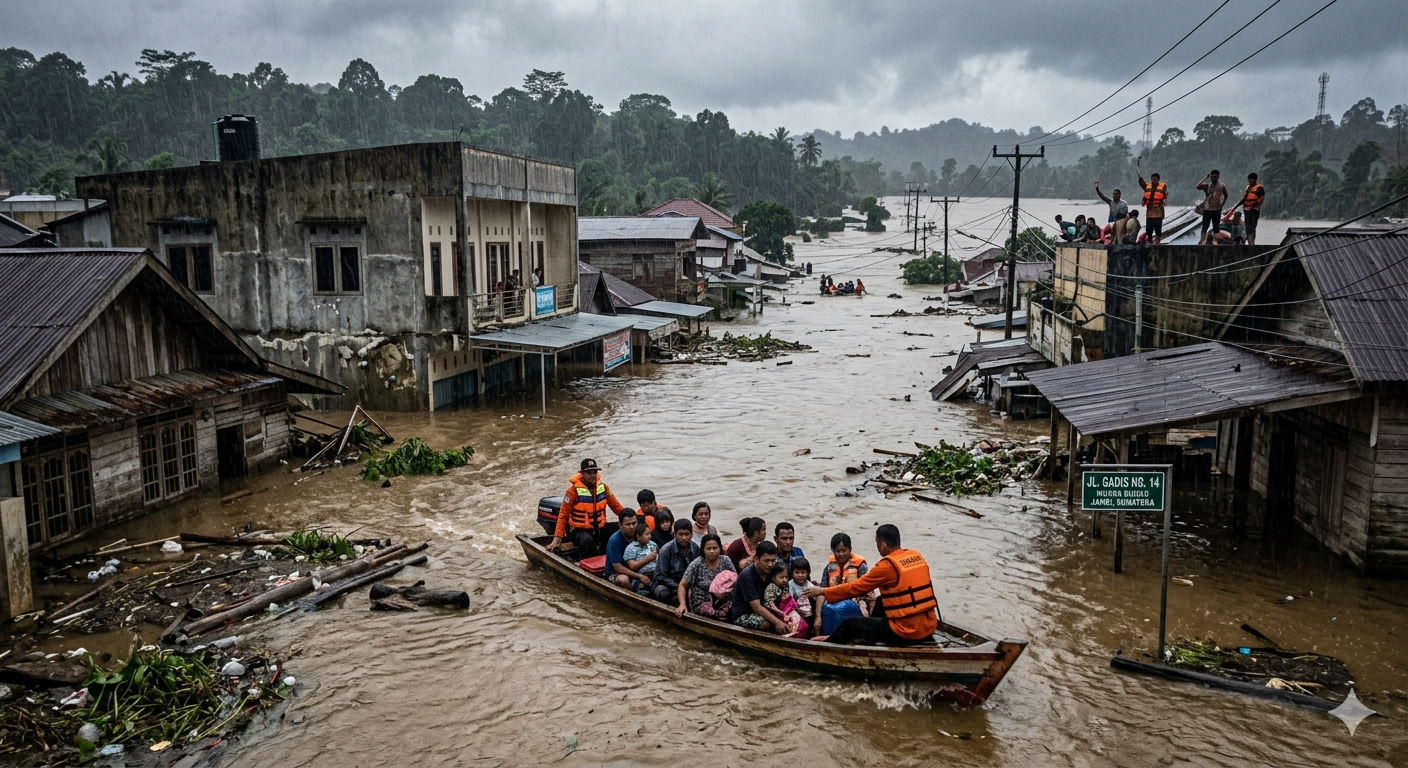

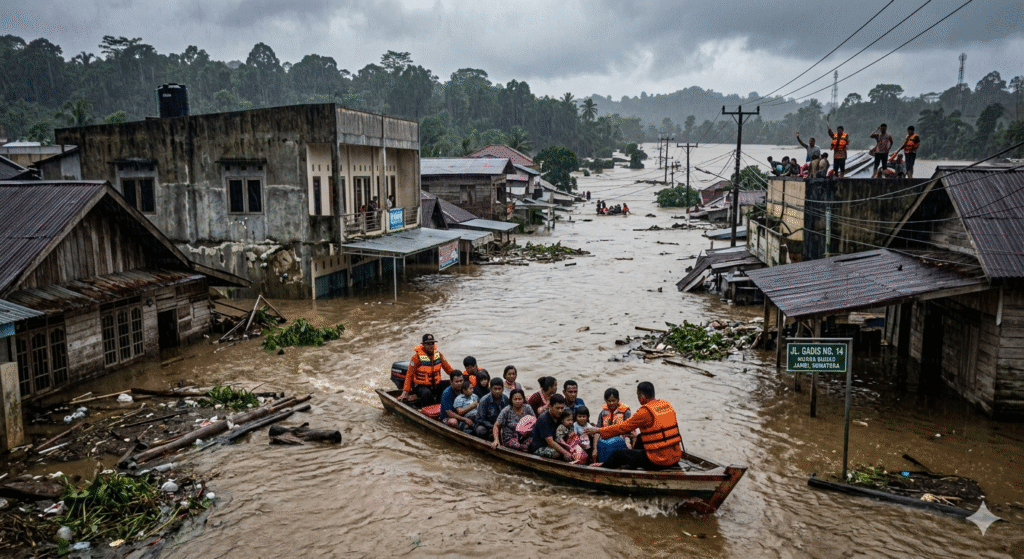
“This year, we do not even know how to make a living anymore. All our land is gone. The orange orchards, everything has been wiped out,” said Mulyawati in a trembling voice, as reported by BBC Indonesia. Toward the end of 2025, Indonesia, an archipelago nation sitting on the Pacific Ring of Fire, was struck by one of the worst tragedies in its history. Thousands of people lost their lives, hundreds more were left without homes, and communities were suddenly thrown into a new chapter filled with nothing but uncertainty. The start of 2026 came heavy with grief, especially for the people of Sumatra living in the provinces of Aceh, North Sumatra, and West Sumatra, whose homes had been battered by floods and landslides in November 2025. This disaster felt like it tore open old wounds for the people of Sumatra, particularly in Aceh, a community that historically had never fully recovered from the trauma of the 2004 tsunami, one of the largest tsunamis ever recorded in human history.
The disaster continued to have a massive impact well into early 2026, driven by a domino effect of damaged public facilities, disrupted community services, and lost livelihoods as residents’ farmland was destroyed. The total losses were recorded at around 68.67 trillion rupiah, an enormous figure for the Indonesian economy. But what was far more heartbreaking than the financial damage was the sheer number of lives that could not be saved. By December 31, 2025, the death toll had reached 1,154 people, with around 7,000 others injured. These are numbers too large to be understood simply as the result of a natural event. The scale of casualties also raised serious questions in the minds of ordinary people about the effectiveness of the Early Warning System, or EWS. If the system was actually in place, why did so many people die? It felt as though there had been no chain of preventive effort at all.
Right after the floods hit, Indonesian social media filled up with thousands of messages of grief from people across all walks of life. Some called for prayers, while many others began linking the tragedy to the ecological destruction that has been spreading across Sumatra in recent years. A lot of people online condemned Indonesian government policies, seeing them as negligent in protecting the diversity of communities’ living spaces and essentially allowing ordinary people to become victims of environmental degradation in the name of economic interest. This public debate seemed to split opinion on the Sumatra floods into two camps. One camp believed this was purely a natural tragedy that had to be accepted. The other believed it was the consequence of ecological sins that humans had been committing for years.
One side of the Sumatra flood tragedy stems from the island’s own geomorphological structure, which makes the region naturally vulnerable to major flooding when rain falls. From Aceh all the way down to Lampung, the terrain is mountainous with extremely steep and sharp slopes. But beneath those steep slopes, in the volcanic fan areas, the soil is fertile and has long attracted dense human settlement. When rainfall intensity rises sharply upstream, the volume of water rushing downstream becomes enormous and floods residential areas. That surge in rainfall intensity is also tied to climate change, which has been triggering Tropical Cyclone Senyar in the equatorial region. On top of that, according to a forestry expert from Gadjah Mada University, the flash floods in Sumatra that carried logs and sediment were also inseparable from a worsening ecological condition on the ground. Large-scale land clearing in upstream areas combined with widespread forest conversion has greatly increased surface runoff. When forests disappear, the soil’s ability to hold water disappears with them, and the volume of water at the highest points upstream can no longer be controlled.
As reported by BBC Indonesia, one survivor described the flash flood in Aceh Tamiang as “a tsunami from the hills,” a phrase that captures just how suddenly the water arrived and destroyed homes within minutes, leaving residents with no time to evacuate effectively or save themselves or their belongings. What made things even more heartbreaking was that help did not come immediately after the disaster leveled Aceh Tamiang. Several Indonesian news outlets, through the accounts of journalists on the ground, described conditions in the aftermath as nearly unbearable to endure. Aid was slow to arrive, children and adults began going hungry, many showed signs of illness, and the smell of bodies that had not yet been evacuated made the situation even worse. One volunteer recounted that in the first 72 hours after the disaster, help had still not come. People were beginning to starve, struggling to find and help the family members they still had left, with no electricity and no decent shelter even just to recover in. It was a truly devastating picture of suffering, so it is no surprise that it stirred deep anger among the wider public, especially among environmental activists.
Furthermore, what made this even more shocking and deeply regrettable was the fact that experts, including those from BRIN (the National Research and Innovation Agency) and BMKG, (the Meteorology, Climatology, and Geophysics Agency) had already issued early warnings long before the disaster struck, backed by data they had gathered. Unfortunately, those warnings were not taken seriously, partly due to weak institutional coordination and a policy tendency that focuses more on emergency response after the fact than on long-term prevention. This makes a lot of sense when you consider the death toll. Without adequate coordinated prevention efforts, when a disaster strikes, communities are immediately swept under all at once because there is no safety preparation or readiness to fall back on. To make things worse, many residents living in those areas did not fully understand the steps to take when a sudden disaster hits. So when the floodwaters came, they were like a colony of ants instantly swept away by the rushing water.
Before the flash floods hit, BMKG had also released information about the potential for extreme weather, including a report on Tropical Cyclone Senyar affecting parts of Sumatra just days before the floods occurred. But that report had not been fully optimized and was not seriously grounded in an impact-based approach. This happened because of several obstacles, including limited equipment and sensors, the absence of a clear standard operating procedure with evacuation command instructions before disasters occur, and limited maintenance budgets at the regional level. Because of these gaps in facilities and technology integration at the local level, BMKG struggled to translate warning signs into specific alerts that could be directly understood by people at the grassroots level. As a result, the information never moved beyond documents and failed to be translated into actual early evacuation action. On top of that, the central government’s decision not to declare a national disaster status had a crucial effect on regional governments. When national disaster status is not declared, the primary legal responsibility for handling the disaster stays on the shoulders of local governments, and the problem is that local governments have very limited fiscal capacity. Without a national disaster declaration, regional governments have a much harder time accessing large-scale financial support from the central government. This in turn slowed the entire response, and even after three weeks had passed, not all victims had received assistance. If local governments were already running out of capacity just handling emergency response and saving lives because they had no funds, the situation in the long-term mitigation phase would be even worse. Technology-heavy early warning systems that require large maintenance budgets will almost always end up being pushed aside when regional budget priorities are set.
The fact that experts had already spoken up but were not heard, combined with the minimal support from the central government for regions in crisis, makes one thing very clear. The biggest problem with the Sumatra floods was not the absence of science or disaster prevention technology. The problem was broken coordination across levels of government, which meant political decisions made on paper had absolutely no connection to the real emergency happening on the ground. One researcher working in disaster mitigation in Indonesia explained that Indonesia’s policy decision-making governance has still not fully learned from past events, even though large-scale floods have happened many times before in Indonesia, and mitigation policy efforts remain very weak. That BRIN researcher explained that while the Sumatra floods were indeed part of the natural biological consequences of the environment, it cannot be denied that the environmental degradation that continues to take place today also made the disaster significantly worse. A damaged ecosystem can no longer function as a line of defense when a natural disaster strikes. When both of these things come together at the same moment, communities are truly left to face the catastrophe alone, because the ecosystem they live in can no longer serve as a buffer against flooding. The result is an enormous number of casualties, and that number becomes very hard to control because of political and administrative burdens that do not work in favor of ordinary people.
Indonesia’s disaster emergency response does not meet the standard it should, compared to the emergency response systems of countries like Japan and the United States. This comes down to challenges in policy decision-making, bureaucracy, and administrative limitations in the form of inadequate disaster management budgets, all of which prevent the actors involved in disaster response from giving their best effort. On top of that, implementing an Early Warning System also requires a large budget and strong political backing, both of which are still very difficult to secure within Indonesia’s bureaucracy. Indonesia’s policy system is also still very much oriented toward economic gains and pays too little attention to ecological safety, meaning policies to protect ecosystems as a protective shield for communities when floods hit remain a major challenge. It does feel unbalanced when we compare Indonesia’s disaster management governance to that of more developed countries. But as the largest archipelago nation sitting in a disaster-prone area, having disaster-responsive governance should rightfully be a development priority that must be continuously pursued. Because without intervention in this area, the losses will multiply: economic losses from facilities destroyed by natural disasters, financing losses as the state must spend its budget on recovering the social order of communities, and most seriously of all, the loss of thousands of human lives.
It may feel difficult for a still-developing country like Indonesia to immediately adopt a reliable disaster response system like those of developed nations. But this is precisely the point that must be noted. At the very least, if the country is not yet able to build a reliable ecosystem of disaster response equipment, the government should be able to minimize the impact through a multi-level governance system, or MLG. Good governance within MLG will be highly determinative of how many victims can be saved and how much damage can be prevented. MLG does not only involve the government as the sole stakeholder. It involves a wide range of actors who work together in the disaster prevention process. Efforts to prevent natural disasters through good MLG governance can be initiated from the ground-level government, or bottom-up. For example, ground-level governments need to be more aware of the warning signs that scientists have already flagged. From there, ground-level governments can open up consolidation to advocate for disaster threats to higher levels of government. But it must be noted that if the central government remains indifferent to disasters occurring across sub-regions, whether small or large, ground-level advocacy efforts will not produce maximum results either. Because in a country system like Indonesia, the central government still holds the primary position in determining the direction of policy support. In short, optimizing MLG is a goal that the Indonesian government must keep fighting for in the context of disaster management. Because optimizing MLG is the main capital for minimizing impact when the government is not yet fully capable of adopting the systems and technology that more developed countries already have.
Keywords: Sumatra Flood, Climate Crisis, Mitigation Failure






 Reston Dennis Juah
 Noor Ul Ain

 Hassan Barrie
 Hoby Nasandratra Andriamiandrisoa
+ There are no comments
Add yours