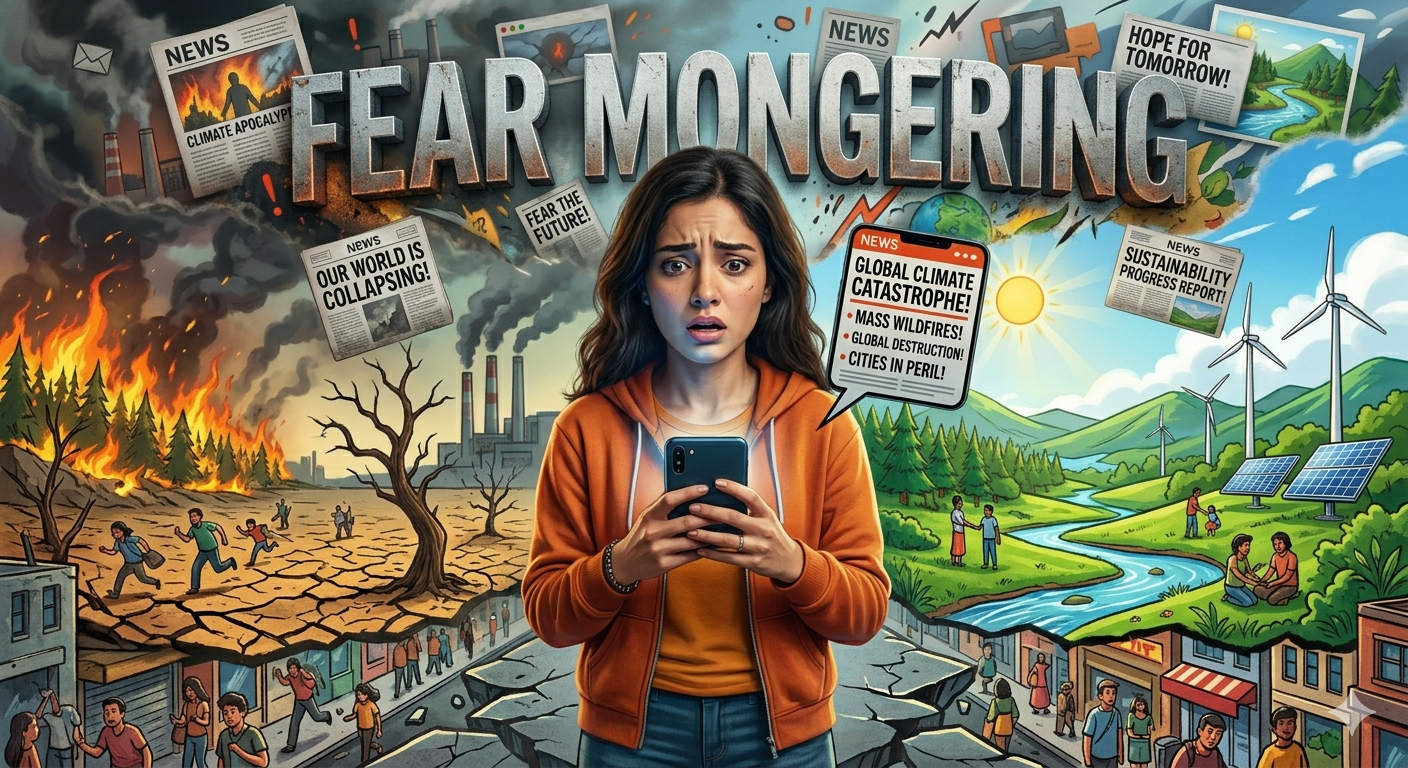

Most people in Indonesia have probably heard phrases like “Jakarta will sink by 2050,” or “Demak is at risk of disappearing from the map,” or the even more commonly heard phrase “the end of the world is near.” If you look more closely at these phrases, they are not just expressions pulled from mythology or religious eschatology floating around in everyday conversation. Behind each of them, there is a layer of scientific reasoning that can actually be explained. All three point toward the possibility of major disasters happening in the future, and all three share something in common: they are backed by legitimate data and scientific evidence about environmental damage, climate change, and global warming, all of which are projected to have a significant impact on the future of human survival.
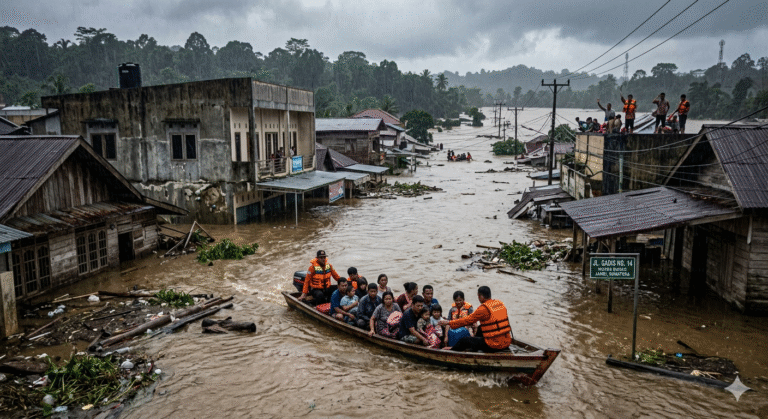
Take the claim that Jakarta will sink by 2050. It did not come out of nowhere. It grew from a body of scientific studies showing that the land in Jakarta has been experiencing subsidence, sinking at an average rate of around 3.9 centimeters to more than ten centimeters per year. This is caused by excessive groundwater extraction in the Jakarta area, combined with the weight of infrastructure that has exceeded what the soil can actually handle. The geographic condition of Jakarta itself, which sits largely on swampy land with peat soil texture, also speeds up the rate of land sinking. All of these factors are made worse by global warming, which causes coastal areas like Jakarta to become even more vulnerable to submersion as sea levels continue to rise. The claim that Demak is at risk of disappearing from the map also has a scientific foundation behind it. This comes from several reports stating that much of the northern coastal area of Java could be underwater by 2030 due to the impacts of climate change. Data from Climate Central maps show several areas along the Java coast that are under threat of sinking, and Demak is one of them.
The threat facing Demak shares the same scientific basis as Jakarta, namely land subsidence and rising sea levels. Based on available data, the rate of land sinking in the Demak coastal area averages around 17.60 centimeters per year. When these two conditions come together at the same time, the result is a rapidly expanding tidal flood in the Demak region. The flooding has already submerged at least three hamlets in Sayung district and has begun reaching the Pantura highway. All road access to those areas is now underwater, as tidal floods have been hitting the region regularly since 2016. Experts estimate that Demak will officially disappear from the map as a land area by 2030. Looking at conditions today, that prediction seems entirely plausible. Many residents in Demak who lost their homes to tidal flooding have long since relocated to other areas. The places they left behind have now turned into open water, the result of a devastating combination of coastal erosion, rising sea levels, and land subsidence. Those areas have officially ceased to exist as dry land. So the claim that Demak will vanish from the map by 2030 is one with a high degree of scientific accuracy, given the evidence already visible on the ground today.
Something similar can be said about the phrase “the end of the world is near.” On one level, it comes from the eschatological teachings of religions like Islam and is commonly used by people when they see situations that feel too chaotic or too large to fix. But on another level, this phrase also has a scientific foundation when examined more carefully. The climate crisis has long been identified as a factor with crucial implications for the survival of living things on earth. Experts and the Director-General of the World Health Organization have repeatedly emphasized that the climate crisis has the potential to become the pandemic of the future. Scientific studies project that climate change carries the risk of reducing the global population by as much as 50 percent. This kind of scientific forecast provides a real basis for imagining the possibility of human extinction down the road. The fear of that kind of collapse is part of what leads people to feel that the end of the world may not be far off, and that it could come through the climate crisis itself.
At first glance, all three of these phrases look like frightening narratives that can immediately make readers feel uneasy. For people who tend not to engage with information in depth, these kinds of statements can trigger excessive anxiety after reading them, creating a kind of paralysis where fear of making the wrong move keeps people from acting at all. But taking into account the scientific data that supports claims like Jakarta sinking, Demak disappearing from the map, or the end of the world being near, we can conclude that these phrases were born as a form of environmental alarmism. Various articles on social media deliberately use these kinds of phrases to describe an increasingly urgent situation on earth that needs ecological help as soon as possible. This is a fairly normal part of how environmental discourse develops, as people who care deeply about ecological issues tend to produce critical narratives aimed at generating greater public engagement. Many activists and journalists in Indonesia frame future scenarios in alarming terms because environmental degradation is genuinely continuing. Environmental groups like Greenpeace, for example, have never stopped voicing narratives about Indonesia’s ecological urgency and the worsening effects of climate change on the planet. The hope behind spreading these narratives is that the public will wake up to the dangers of climate change and that the government will move quickly to take firm action.
But spreading narratives about ecological urgency does not always receive balanced assessments across different audiences. The narratives put out by Greenpeace, for instance, have at times been met with critical responses labeling them as fear-mongering. This label first gained traction during a debate aired on Kompas TV between Iqbal Damanik, speaking as a representative of environmental activists, and Ulil Abshar Abdalla, who took a position supportive of mining. Ulil Abshar Abdalla argued that the narrative brought by Iqbal Damanik, about how the current generation can no longer enjoy nature the way previous generations did because of the destruction of the natural environment, was essentially a scare tactic. His reasoning was that Iqbal’s claims did not take into account the needs of the present generation, who still very much depend on natural resources to support their economic lives. For Ulil Abshar Abdalla, the desire to fight for future generations so they can enjoy nature should not be allowed to block the development rights of the people living today, rights that must also be taken seriously. Iqbal pushed back against the fear-mongering label by arguing that narratives about the environmental crisis are not meant to frighten people. They are information about potential future dangers that the public needs to be aware of so they can take action before it is too late.
The fear-mongering premise stirred up conversation on Indonesian social media and found a new wave of attention when floods hit Sumatra at the end of 2025. The public began asking again whether the environmental narratives long voiced by activists were just there to scare people, or whether they were actually something that needed to be said, especially given how much evidence of natural disaster had piled up, including the Sumatra floods that visibly claimed thousands of lives. This piece tries to bridge the gap between those two questions through the lens of Mathias Thaler’s concepts of Eco-Miserabilism and Radical Hope. But before going deeper, it helps to first understand what fear-mongering actually means. According to Barry Glassner in his book The Culture of Fear: Why Americans Are Afraid of the Wrong Things (1999), fear-mongering is a communication tactic or strategy deliberately used to create excessive fear or anxiety among the public about a particular issue or event. It is carried out with the goal of influencing people to take a desired action related to that issue. Fear-mongering can spread through mass media, social media, or print media like newspapers, magazines, or posters. It works in various ways, but generally operates through the spread of narratives that have been shaped by certain interests, whether political, economic, or otherwise, depending on what the person producing the narrative wants to achieve. Glassner further explains that people use fear-mongering as a storytelling technique to control how others reason, and sometimes that reasoning is distorted, for example by taking a partial or isolated event and framing it as if it represents a universal trend in order to generate public fear. That fear is then used for various purposes, including shifting attention away from one issue toward another that is more desirable to whoever is pushing the narrative.
So does spreading alarming environmental narratives count as fear-mongering? Referring to Barry Glassner’s definition, deliberately making the public panic and afraid through environmental narratives could technically be categorized as fear-mongering. The language Greenpeace uses in its environmental campaigns does follow a direct and sharp communication style, one that targets emotional tipping points and uses what could be called shock advertising. A good example is a 2017 Greenpeace report about air pollution in Jakarta titled Silent Killing in Jakarta. Giving a report that title naturally makes readers feel unsettled, as if death were quietly stalking them through the air every single day. Reading that title, people are almost made to feel that their lives could end at any moment simply by staying in Jakarta and breathing its air. If we look at fear-mongering only through the narrow lens of whether something spreads fear, then some of the narratives produced by Greenpeace could indeed fall into that category. But the fear-mongering label is not entirely accurate either, because as Glassner explains, a key marker of fear-mongering is the presentation of partial information as if it were a universal fact, done deliberately to manipulate public opinion. That description does not quite fit the accusations made by Ulil Abshar Abdalla against Greenpeace’s narratives. The climate crisis is not a partial or isolated phenomenon. It is a scientific reality agreed upon by a large number of scientists around the world. The climate crisis is multifactorial, meaning each region experiences its own symptoms and impacts at different levels of intensity. What the crisis looks like in one area may not look exactly the same in another due to differences in natural characteristics. For this reason, labeling the narratives put out by Greenpeace as fear-mongering misses the mark, because what Greenpeace communicates is a universal fact that can be verified through scientific reports.
But beyond the question of whether Greenpeace’s narratives qualify as fear-mongering or not, those narratives still need to exist, and a certain degree of fear-driven communication is actually necessary. Let us look more closely through the lens of Mathias Thaler in his article Eco-Miserabilism and Radical Hope: On the Utopian Vision of Post-Apocalyptic Environmentalism. Thaler explains that narratives about the future of the world have long been split into two camps. The first is a group that believes humans have already run out of time to save the earth and human civilization, that our planet has already undergone drastic and irreversible change due to the climate crisis. This group is referred to as Eco-Miserabilists. They reject the blind optimism pushed by various observers who believe the earth can still be saved through different kinds of intervention, such as transitioning to renewable technology, green development projects, and the like. For the Eco-Miserabilist camp, grand fantasies about science and technology riding in to save the planet are nothing more than false hope, the kind of hope that has long propped up an unjust and unsustainable status quo on an earth that is slowly dying from climate change. The other camp consists of those who criticize Eco-Miserabilism. They reject the Eco-Miserabilist worldview as overly pessimistic, arguing that it tends to generate fear among the public and ends up causing people to lose the motivation to take action on climate change because everything feels hopeless and beyond repair. This group worries that if Eco-Miserabilism spreads too widely, society could become completely paralyzed and unable to act.
From this explanation, we can draw a parallel with the fear-mongering claim made by Ulil Abshar Abdalla. Even though the contexts are not identical, both share a common concern about paralysis of action. If those who oppose Eco-Miserabilism worry that the idea that the earth can no longer be saved will drain people of the motivation to do anything, then Ulil Abshar Abdalla’s fear-mongering claim carries the same worry, that the environmental narratives spread by Greenpeace might end up blocking the development rights of the current generation, causing a paralysis of progress at a time when Indonesia still very much needs natural resources to improve the quality of national development. But does that mean fear-inducing narratives are something we simply should not have? Mathias Thaler in his article actually offers a scientific defense of Eco-Miserabilism. For Thaler, this perspective is not a purely pessimistic one with no upside. He argues that Eco-Miserabilism carries an important lesson for thinking through the complexity of a world that has already changed because of the climate crisis. The sense of disappointment and despair long expressed by Eco-Miserabilists is actually a project supported by an investment in what Thaler calls radical hope.
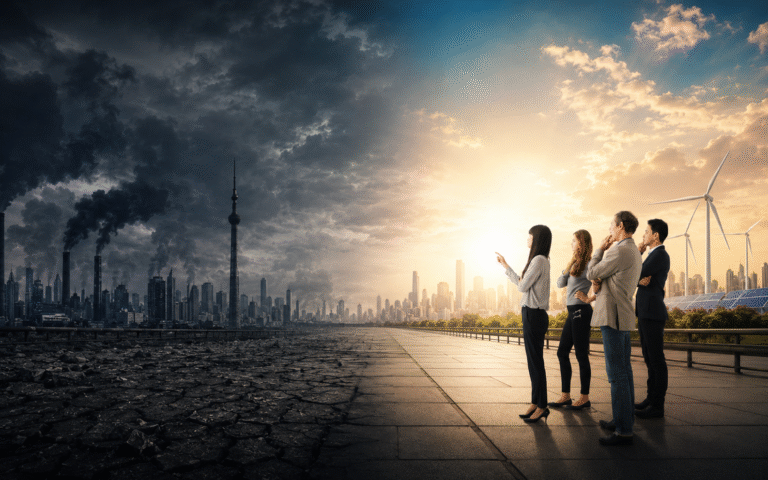
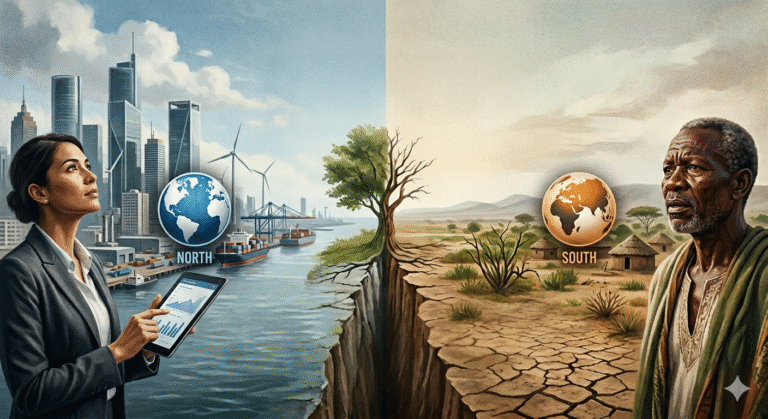
The radical hope Thaler refers to is a kind of hope that arises after humans have acknowledged that the state of the earth is already deeply troubled and very difficult to save. It is a hope that holds onto the belief that something good can still happen in the future. Even though it sounds contradictory, radical hope has a logical foundation. Thaler argues that even though Eco-Miserabilism is built around despair, it functions almost like a political strategy for building greater resilience in society. The analogy works like this: if people feel genuine fear and hopelessness about the future of a planet that may be beyond saving, that despair, in Thaler’s view, never really stands alone. The pessimism comes paired with a drive to act better. People begin looking for ways to help each other survive. They start letting go of ego, including the ego of individual nations when it comes to reducing emissions, because there is no other option left for fixing the shared home they all live in. They become willing to reach out and hold hands with one another in the hope that the earth’s condition will improve. The language of “me” and “you” fades away, replaced by “us,” as fellow human beings sharing one planet. These are the kinds of hopes that Thaler calls Radical Hope, and they tend to produce deeper and more meaningful action toward real change, even if that action has to begin with first accepting bad news, specifically the news of the earth’s destruction. Thaler sees Eco-Miserabilism not as a view that leads to social paralysis, but as one that is actually more effective than the current approach, which is too passive in pursuing mitigation because it is still seduced by scientific fantasies that the earth is safe and can be rescued through science alone.
It is this belief in Radical Hope within Eco-Miserabilism that connects back to the fear-mongering claim. Even though the environmental narratives put out by Greenpeace use language that can sound frightening and might cause some degree of public panic, those narratives also carry the value of Radical Hope, which is important for raising public awareness. What Greenpeace communicates about the environmental crisis is not baseless scary content. It is grounded in scientific facts that can be verified and defended. The panic and fear that ordinary people feel when confronted with the reality of the earth’s destruction is a completely natural response, and it is actually a kind of narrative that needs to keep existing, because it creates a deeper sense of responsibility toward the earth as the only home humanity has in the universe. The analogy is simple: humans only truly act when they feel threatened. The same goes for the climate crisis. People may not take genuine action without feeling that threat, yet the earth is already in desperate need of help. This is why clear, direct communication that hits emotional tipping points matters when presenting scientific facts about our planet. That said, the spread of these narratives must always be grounded in real science. Spreading information that has no scientific basis and only creates false fear is irresponsible behavior. In the end, this piece concludes that the environmental narratives shaping the climate debate in Indonesia cannot be fully labeled as fear-mongering, and regardless of that label, they still need to exist in order to keep the element of Radical Hope alive, because that hope is what drives meaningful action toward mitigation.
Keyword: Fear-mongering, Eco-Miserabilism, Radical Hope




 Reston Dennis Juah
 Noor Ul Ain
 Hassan Barrie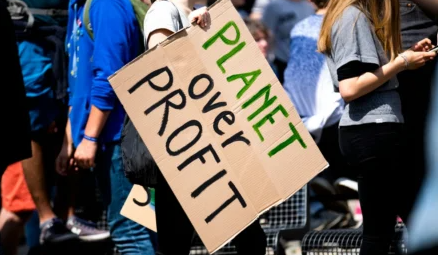
 Hoby Nasandratra Andriamiandrisoa
Bạn có thể thoải mái lựa chọn vật phẩm và vũ khí đa dạng để tiêu diệt con mồi hiện ra trên màn hình. 66B Chưa dừng lại ở đó, với hơn 50+ boss khủng sẽ giúp ngư thủ mang về phần thưởng cực lớn với giá trị Jackpot hàng tỷ đồng. TONY07-03
Finally found a platform that doesn’t lag during peak hours. The registration process was a breeze. Great job guys at phjljl1.
Really loving the game variety here. I had a great run last night and the bonuses are actually worth it. Check out pk888gj if you want a fun experience.